
I kept waiting for the unity argument to survive contact with a spreadsheet. It never did. Every defence of keeping Sindh whole is dressed in heritage: the river, the language, the ancestors. Almost none of it is dressed in arithmetic, because the arithmetic doesn’t cooperate.
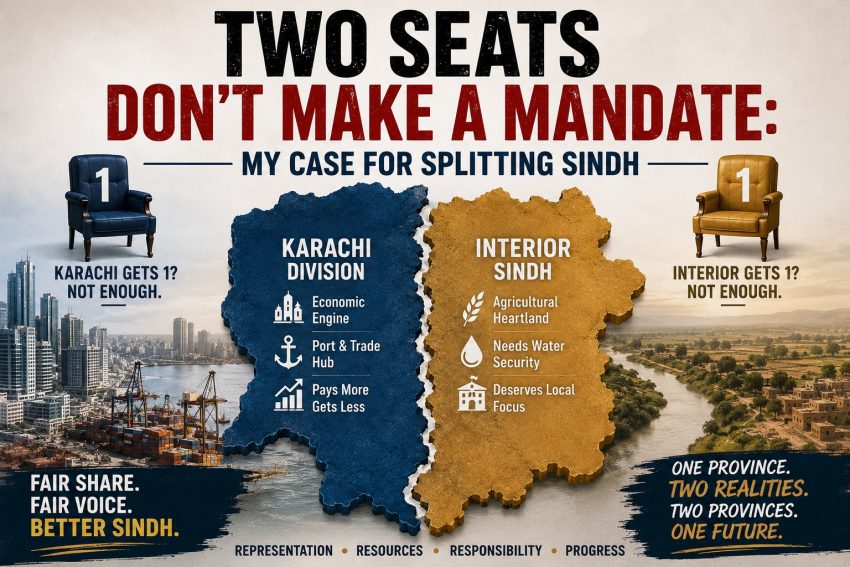
Karachi’s Inland Revenue offices brought in 45 per cent of Pakistan’s total direct tax collection in FY2024/25, Rs 2.54 trillion of a national Rs 5.71 trillion. The city likely produces a fifth to a quarter of GDP. In return, it holds 47 of the Sindh Assembly’s 130 general seats, just 36 per cent, and only reached that after 2023’s delimitation. In the province’s 2023/24 development budget, the city footing roughly half the bill got 9 per cent of the spending, rising to a budgeted 20 per cent the next year. The World Bank flagged a $10 billion hole in Karachi’s infrastructure in 2017, and nothing suggests it has closed. That isn’t a scheduling problem. It’s a structure that cannot correct itself, because the people voting on the budget aren’t the people living with the shortfall.
Who’s blocking a fix? Not who you’d expect. The Grand Democratic Alliance, Sindh’s dedicated nationalist coalition, took two of 130 seats in February 2024, a rounding error dressed as a movement, mostly borrowed from an ally outside the nationalist core. Qaumi Awami Tehreek’s Ayaz Latif Palijo, probably nationalism’s most familiar face, lost his own seat in Hyderabad by more than five to one. The hardline separatist parties, Jeay Sindh Qaumi Mahaz and Jeay Sindh Muttahida Mahaz, boycott elections outright, opting out of the only mechanism that could confer a mandate. Their combined footprint in a 168-seat legislature rounds to nothing, yet the objection is treated as if it speaks for the province.
The real veto belongs to the PPP, which would have to approve any split and has no reason to. It took 84 of Sindh’s general seats in 2024, but only 10 from Karachi; the other 74 came from interior constituencies that generate a fraction of the city’s revenue. With reserved seats, its assembly strength sits around 116 to 117, past the 112 needed to clear the two-thirds bar for creating a new province, though nowhere near two-thirds nationally, so nothing moves soon regardless. Karachi’s tax base funds the transfers and hiring quotas the interior depends on, and nobody holding that lever has a reason to pull it. Even the civil service quota, fixed at 40 per cent urban and 60 per cent rural in the early 1970s when urban Sindh held about 30 per cent, hasn’t moved since, though the 2023 census puts urban Sindh at 53 per cent now.
The counter case is real. Sindhi speakers are close to 60 per cent of the province. The Indus system runs through Sindh as one connected network, so a split reopens water-sharing questions nobody has answered. National representation wouldn’t grow, just split into two smaller voices. Roughly 82 per cent of rural Sindhi women have no formal schooling, and Thatta’s maternal mortality rate runs four times the global target; Karachi’s money is doing something about that.
None of it removes the need; it just raises the price of meeting it. Water sharing has to be negotiated eventually regardless. A transfer negotiated openly between two provinces beats a formula buried in one province’s budget, where the paying side has no vote on what it owes. Karachi isn’t asking for flags or ministries. It needs a structure that puts its own money back into its own water and transit, on a timeline that matters, while the only people who could grant that have every reason not to.