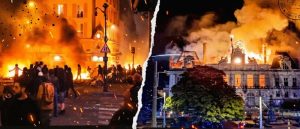

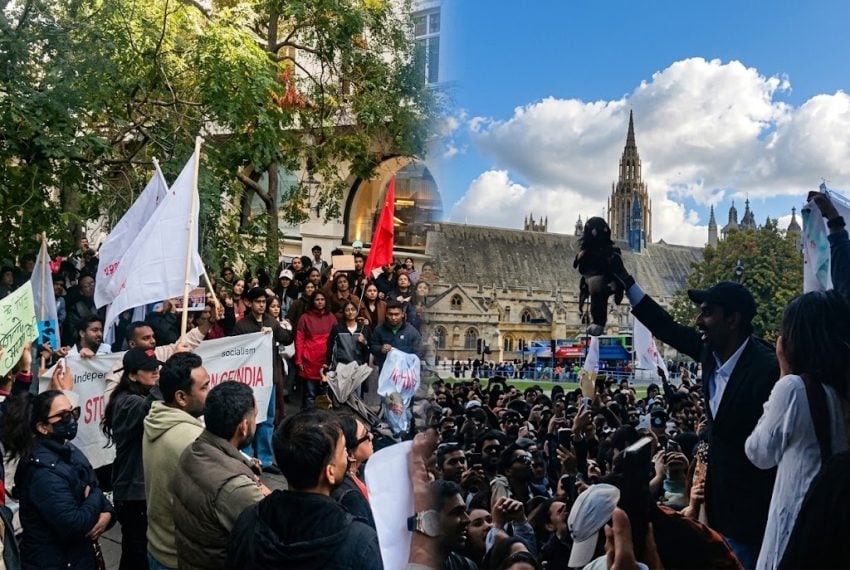
LONDON — Tensions over India’s controversial voter-list revision spilled onto streets of London, where anti-government demonstrators and supporters of Prime Minister Narendra Modi faced off outside the Indian High Commission in a series of politically charged rallies that drew widespread attention on social media.
The protests centred on Election Commission of India’s Special Intensive Revision (SIR) of electoral rolls. Demonstrators opposing exercise accused the authorities of risking exclusion of legitimate voters, while pro-Modi groups staged counter-protests in defence of the government.
“Chhappan inch ka chhota bandar”, loosely translated as “the little 56-inch monkey”, that helped propel footage of the London demonstrations across social media.
🇬🇧🇮🇳 There’s a BIG PROTEST in London by the Indian diaspora against Modi
They’re outside the Indian High Commission chanting “chhappan inch ka chhota bandar,” which means “the little 56-inch monkey.” It’s a jab at Modi, who used to talk about having a 56-inch chest.
One person even brought a small monkey with him.
The protest is over the Election Commission’s voter list revision in India.
A smaller group of Modi supporters stood on the other side of the police line.
Writer: Lucas
https://t.co/0r4mv6MeV0— Mario Nawfal (@MarioNawfal) October 17, 2026
Clips circulating on X showed protesters chanting the slogan, a satirical jab at Modi’s long-associated “56-inch chest” political image, often linked to perceptions of strength and masculinity.
The clip was shared through social media accounts including by commentator Mario Nawfal. While the slogan attracted attention, mainstream coverage of the rallies focused primarily on electoral integrity, opposition demands and the confrontation between rival diaspora groups.
The demonstrations unfolded over several days, bringing together student organisations, opposition-linked groups, activists and supporters of the Indian government.
The gathering expressed solidarity with anti-SIR protests in India, including the movement known as “Jantar Mantar 2.0”. Participants demanded the removal of Chief Election Commissioner Gyanesh Kumar and called for the revision exercise to be scrapped.
On 16 October, another demonstration organised by the Students’ Federation of India’s UK chapter drew participants associated with the National Students’ Union of India and other groups. A smaller contingent of Modi supporters mounted a counter-protest.
The rival groups displayed Indian flags but delivered sharply contrasting messages. Anti-SIR demonstrators chanted “Azadi” and “Saare Jahaan Se Achcha”, while the counter-protesters responded with “Bharat Mata Ki Jai” and “Modi, Modi”. A large cut-out of the prime minister was also displayed by his supporters.
The confrontation continued on 17 October at Parliament Square, where hundreds reportedly gathered near Mahatma Gandhi’s statue for a demonstration titled “Stop Vote Chori”. Organised by the youth wing of the Indian Overseas Congress, the event received support from SFI UK, Save Democracy, the South Asia Solidarity Group and other organisations. YouTuber and activist Dhruv Rathee was among the announced keynote speakers.
A smaller counter-gathering associated with India Diaspora UK and Team Bharat assembled nearby, with participants again chanting “Modi, Modi”. Police maintained separation between the two sides.
Beneath the slogans and viral footage lies a contentious dispute over how India maintains its electoral registers. Indian Election Commission says the Special Intensive Revision is intended to improve voter-list accuracy by identifying duplicate registrations, deceased voters, people who have moved and individuals who are otherwise ineligible. Eligible citizens can use established procedures to seek inclusion or challenge omissions.
Supporters of Modi defended the government’s democratic mandate and rejected the criticism levelled at the prime minister and his administration. Some argued that anti-government demonstrations on foreign soil risk damaging India’s international reputation and investor confidence.
The opposing camps therefore presented sharply different accounts of the same political dispute: one portraying the revision as a threat to electoral participation, the other defending the government and the legitimacy of its policies.
Although the scenes generated heated political exchanges, available media coverage did not report major violence at the gatherings. Police efforts centred on preventing direct confrontations between the groups.
Indian Youth alleges Rs40,000 offer to defend Modi amid CJP Jantar Mantar Protest