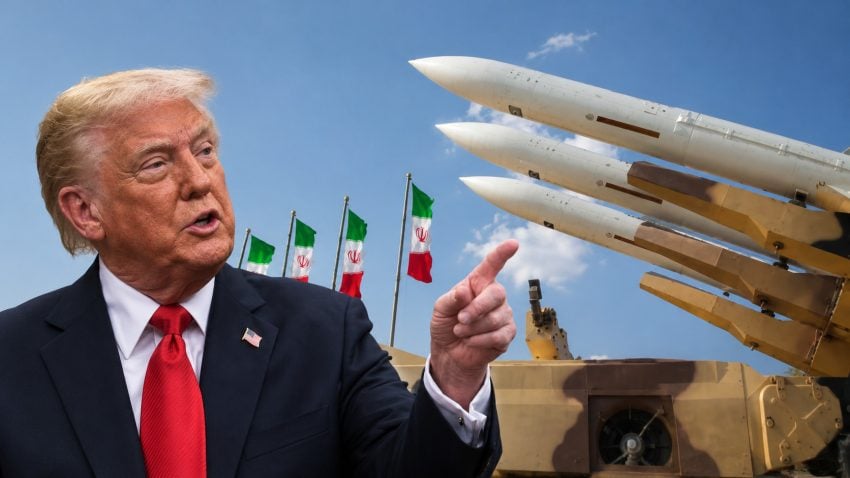
MISSISSIPPI – US President Donald Trump made big claims about Iran’s expanding missile capabilities, arguing at a recent election rally in Mississippi that Tehran poses a growing threat to Europe and potentially American cities, including Los Angeles and San Diego.
Experts’ assessments of Iran’s missile arsenal do not support claim that the country currently possesses an operational missile capable of reaching US. At recent events, Trump linked Iran’s missile development and nuclear ambitions to the justification for US military action, presenting campaign as necessary to prevent a more dangerous future threat.
The statements reignited questions about the distinction between Iran’s established military capabilities and the potential dangers posed by its future weapons development.
Trump claimed that Iran developed missile capable of reaching Europe, questioning how Tehran had acquired such a capability. He then warned that Iranian weapons could threaten American cities, specifically naming San Diego and Los Angeles, and argued that US had to act before the danger escalated.
The president framed military campaign as response to Iran’s growing missile capabilities and its nuclear ambitions. His argument rests on the possibility that allowing Tehran to advance its weapons programmes could eventually expose the United States and its allies to more serious threats.
White House allies have defended this rhetoric as an attempt to highlight risks of Tehran acquiring more advanced delivery systems alongside nuclear weapons. Critics, including officials in California, have questioned the language, arguing that it risks exaggerating Iran’s current capabilities and creating unnecessary alarm.
What Iran’s missile arsenal can actually reach
Iran maintains one of the Middle East’s largest ballistic missile arsenals, with systems capable of attacking Israel, regional US military installations and other targets across the Gulf and eastern Mediterranean.
Iranian ballistic missiles estimated ranges of approximately 1,400 to 2,000 kilometres. Some variants, particularly those designed to carry lighter payloads, have been assessed as potentially capable of travelling farther.
Estimates for certain Khorramshahr variants have extended to roughly 2,500–3,000 kilometres or beyond under some configurations, although such figures are not equivalent to proof of a routinely deployable missile with that range and payload.
A missile with a range near 2,000 kilometres could threaten targets across much of the region. Longer-range configurations might reach parts of southeastern or eastern Europe, depending on their actual performance and trajectory. However, the claim that Iran can reach Europe should not be interpreted as evidence that every European country falls within the range of its operational missile force.
Trump goes off script with ‘One Hell of Beautiful Ass’ Comment about Nicki Minaj
The geographical gap between Iran’s established missile capabilities and the ability to strike US West Coast needs to be discussed. Los Angeles and San Diego are 12,000 kilometres or more from Iran. No publicly confirmed Iranian operational ballistic missile is known to possess the range required to cover that distance.
A 2025 assessment by the U.S. Defense Intelligence Agency reportedly suggested that Iran could potentially develop a militarily viable intercontinental ballistic missile by around 2035 if it prioritised the effort and leveraged relevant space-launch technology.
Open-source assessments identify several Iranian missile families with reported ranges around or below 2,000 kilometres, although performance estimates vary by model, payload and configuration. The solid-fuel Sejjil and Sejjil-2 are generally assessed to have ranges of around 2,000 kilometres, with some claims extending to approximately 2,500 kilometres.
The Khorramshahr family, including variants referred to as Kheibar or Khorramshahr-4, is associated with heavy payloads and reported ranges around 2,000 kilometres. Some assessments suggest that lighter-payload configurations could travel farther.
Ghadr and Emad missiles, derived from the Shahab-3 family, are generally assigned ranges of approximately 1,600–2,000 kilometres. Shahab-3 estimates vary by version, with reported ranges extending from roughly 1,300 kilometres to around 2,000 kilometres. Other systems, including the Kheibar Shekan and Haj Qassem, are generally assessed to operate in the 1,400–1,500-kilometre range. Iran also fields cruise missiles such as the Soumar, Hoveyzeh and Paveh, for which reported ranges vary considerably.