ISLAMABAD – As tens of millions in Pakistan are living below poverty line, a monthly income of Rs121,000 is enough to place individual among Pakistan’s top 10% income earners, according to income inequality estimates that expose widening financial divide in South Asian nation.
The figures from World Inequality Database reveal a grim economic reality, as an income that may barely cover the expenses of a middle-class family is sufficient to rank among the country’s highest earners. An adult earning Rs121,443 per month falls within Pakistan’s top 10% income bracket, while those earning around Rs188,511 monthly qualify for the top 5%.
The income thresholds, based on 2024 estimates expressed at 2025 rates, show a sharp contrast between Pakistan’s higher-income groups and the millions of citizens struggling to meet their daily needs.
How Much Do Pakistan’s Richest People Earn?
| Income category | Estimated monthly income |
|---|---|
| Top 10% earners | Rs121,443 |
| Top 5% earners | Rs188,511 |
| Top 1% earners | Rs439,852 |
| Top 0.1% earners | Rs1.93 million |
These figures refer to estimated individual income rather than household salaries alone.
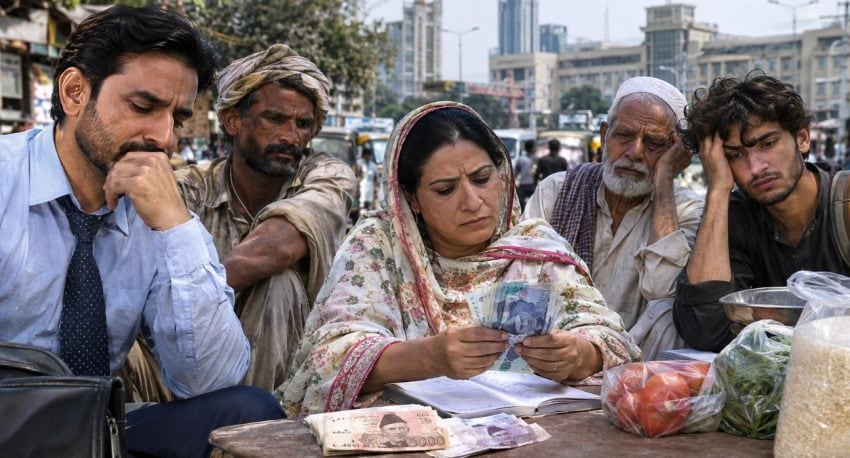
While earning one lac 20 thousand may appear substantial compared with the national income distribution, families facing high electricity bills, school fees, rents and other essential expenses may still find it difficult to maintain a comfortable standard of living.
57 Million Pakistanis Living in Extreme Poverty
The severity of Pakistan’s economic challenges becomes clearer when examining the country’s poverty estimates.
Nearly Half of Region’s Poorest People are in Pakistan, and the Number is Rising
World Bank data suggests that approximately 5.76 crore people, or 23% of Pakistan’s population, were living below the international $3-a-day poverty line in 2024, based on purchasing power parity. The figures cited in the circulated report further suggest that nearly 47.9% of the population falls below the $4.20-a-day benchmark, equivalent to more than 12 crore people.
Meanwhile, approximately 21.88 crore Pakistanis were estimated to be living below the $8.30-a-day international poverty threshold, illustrating how a substantial majority of the population faces economic vulnerability.
These dollar-based poverty benchmarks reflect differences in purchasing power between countries and should not be interpreted through ordinary exchange-rate conversions. World Bank’s separate 2024 estimate places approximately 87.1% of Pakistan’s population below the $8.30-a-day poverty threshold.
The poverty crisis is severe in rural areas, where limited employment opportunities, low agricultural incomes and inadequate access to basic facilities continue to affect millions of households. According to the Pakistan Economic Survey 2025–26, the country’s official poverty rate reached 28.9% in 2024–25, compared with 21.9% in 2018–19. The report places rural poverty at 36.2%, significantly higher than the 17.4% recorded in urban areas.
Rising living expenses have added another layer of hardship for Pakistani households, particularly those earning low and moderate incomes. Higher food prices, electricity tariffs, gas bills and transport costs have forced many families to devote a larger portion of their earnings to basic necessities. For households already living close to the poverty line, even a modest increase in essential expenses can create serious financial difficulties.