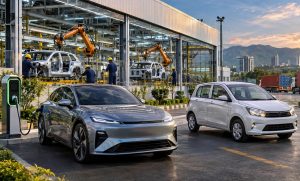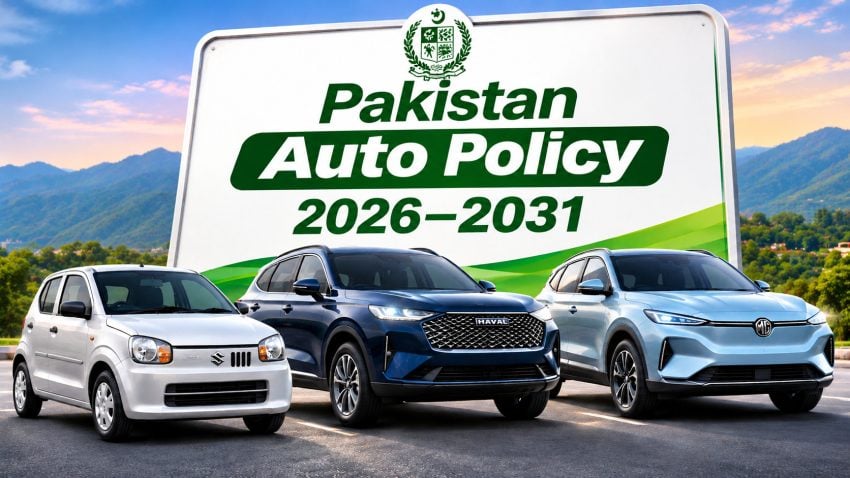
KARACHI (Daily Pakistan) – Car prices in Pakistan could witness big cut with federal government’s approval of Auto Policy 2026–2031, and preliminary estimates suggesting savings upto Rs2Million on several popular petrol, hybrid and electric vehicles.
The newly announced automotive policy raised hopes of cheaper vehicles across Pakistan, particularly for buyers considering Suzuki Alto, Cultus, Kia Sorento, Haval H6 and imported electric cars. The government’s revised tax framework is expected to play a major role in reducing automobile costs, although manufacturers have yet to announce revised prices.
Kia Sorento, Haval H6 and Hybrid SUVs Expected to Get Cheaper
Plug-in hybrid vehicles could emerge as some of the biggest beneficiaries of the new policy, particularly following the announcement of a proposed 9% General Sales Tax (GST) rate for this category.
According to market estimates, Kia Sorento PHEV could see a reduction of Rs12.6 lakh to Rs21.1 lac, making it one of the vehicles with the highest projected savings. Haval H6 PHEV could become cheaper by Rs9.8 lakh to Rs16.5 lac, while the Jetour T2 i-DM may witness a reduction of Rs9.8 lac to Rs16.4 lac. Other hybrid SUVs, including the JAECOO J7, Chery Tiggo 7 and MG HS, could also benefit from the revised tax structure.
| Vehicle Model | Expected Price Reduction |
|---|---|
| Kia Sorento PHEV | Rs12.6–21.1 Lac |
| Haval H6 PHEV | Rs9.8–16.5 Lac |
| Jetour T2 i-DM | Rs9.8–16.4 Lac |
| JAECOO J7 PHEV | Rs8.0–13.4 Lac |
| Chery Tiggo 7 PHEV | Rs7.6–12.8 Lac |
| MG HS PHEV | Rs7.5–12.0 Lac |
Suzuki Alto, Cultus and Every Expected Price
The new automotive framework could also provide relief to consumers looking for affordable locally assembled petrol vehicles. Suzuki models, including Alto, Cultus and Every, are among the vehicles expected to benefit if reductions in Federal Excise Duty (FED) and customs duties on imported assembly components are implemented.
Suzuki Alto could become cheaper by Rs50,000 to Rs75,000, while the Cultus may see a price reduction of Rs85,000 to Rs1.1 lakh. Similarly, the Suzuki Every could experience a reduction of Rs60,000 to Rs70,000, whereas certain Kia Stonic variants may become cheaper by Rs1.1 lakh to Rs1.5 lac.
| Vehicle Model | Expected Price Reduction |
|---|---|
| Suzuki Alto VX/VXR/VXL | Rs50,000–75,000 |
| Suzuki Cultus VXR/VXL/AGS | Rs85,000–1.1 Lac |
| Suzuki Every | Rs60,000–70,000 |
| Kia Stonic Turbo X/S | Rs1.1–1.5 Lac |
Imported Cars to Become Cheaper
Japanese imported vehicles are another category that could benefit from changes in customs duties. Preliminary calculations suggest that the Toyota Raize and Daihatsu Rocky could experience landed-cost reductions of Rs1.5 to Rs2.5 Lac. Similarly, Japanese hatchbacks such as the Toyota Vitz, Passo, Roomy and Thor may become cheaper by Rs1.5-2Lac.
For 660cc Japanese vehicles, including the Suzuki Alto JDM, Daihatsu Mira, Honda N-Box, Suzuki Hustler and Nissan Dayz, estimated savings range between Rs1 and Rs1.5 lac.
Electric Car Prices
Pakistan’s emerging electric vehicle market could also witness substantial changes under the new policy. The government has outlined a preferential taxation framework for electric mobility, including 1% GST on Battery Electric Vehicles (BEVs), 6% on Range-Extended Electric Vehicles (REEVs) and 9% on Plug-in Hybrid Electric Vehicles (PHEVs).
| EVs | Expected Price Cut |
|---|---|
| GAC Aion UT | Rs12–14 Lac |
| BYD Seagull / Changan Lumin | Rs10–13 Lac |
| Wuling Air / Honri Ve / Rinco | Rs10–12 Lac |
| BYD Seal / GAC Aion V / Audi e-tron | Rs4–10 Lac |
| Deepal L07 / S07 Pure / Hyundai Ioniq 5 | Rs4–10 Lac |
Beyond potential price reductions, the Auto Policy 2026–2031 aims to reshape Pakistan’s automobile industry through six major priorities: affordability, exports, localization, vehicle safety, electric mobility and transparency.
The government plans to encourage domestic vehicle manufacturing, reduce dependence on imported components and attract international investment in modern automobile technologies. The new framework is also expected to support Pakistan’s existing target of electric vehicles accounting for 30% of new vehicle sales by 2030.
Although the policy’s approval has generated considerable excitement among car buyers, no official model-wise price reductions have been confirmed by automobile manufacturers.
The government’s detailed tax notifications, tariff schedules and implementation procedures will determine which vehicles qualify for concessions and when any savings take effect. Manufacturers will also need to assess production costs, existing inventories and applicable taxes before announcing revised showroom prices.
Pakistan’s Auto Policy 2026–31 approved with Big Tax Relief, Push for Cheaper Cars