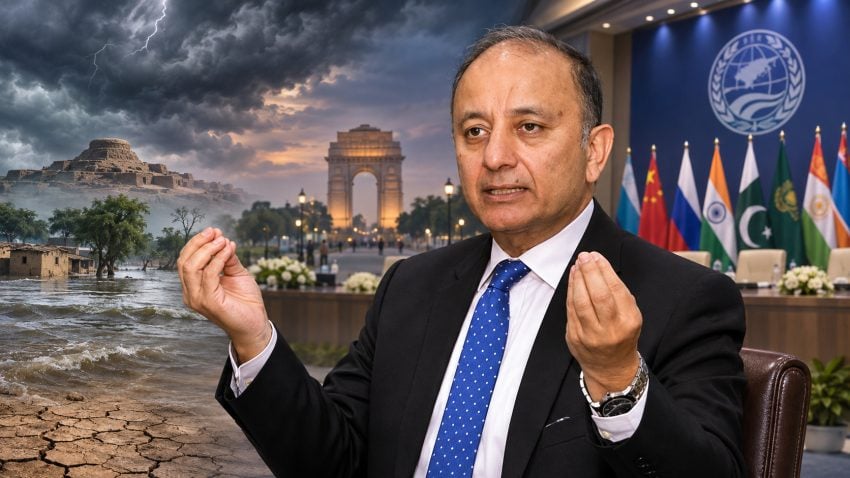
NEW DELHI – Pakistan’s Climate Change Minister Musadik Malik delivered strong message from New Delhi, warning that climate change poses far greater threat to civilisations than disputes between nations.
Addressing SCO forum, Malik urged regional countries to look beyond their differences and unite against a crisis that threatens lives, ancient heritage and future generations. He highlighted devastating impact of natural disasters across South Asia, particularly the catastrophic floods that struck Pakistan in 2022.
His remarks came during rare three-day visit to India, making him first Pakistani minister to travel to the neighbouring country since former foreign minister Bilawal Bhutto-Zardari attended an SCO meeting in May 2023. Malik said civilisations should no longer view one another as enemies when they face a far greater common danger in the form of climate change.
He referred to the devastating floods in Nepal on August 26, which reportedly claimed more than 1,400 lives and left thousands missing, before recalling the destruction caused by Pakistan’s historic floods in 2022. The disaster killed around 1,700 people and submerged nearly one-third of Pakistan, with Sindh among the worst-affected provinces.
Malik drew particular attention to Mohenjo-Daro, the ancient Indus Valley civilisation site, where unusually heavy rainfall damaged structures that had survived for thousands of years. He said walls that had stood for approximately 4,500 years were brought down by just four days of rain, illustrating how climate change could destroy historical treasures that had withstood centuries of natural and human challenges.
The minister acknowledged humanity’s role in accelerating environmental destruction, warning that human activities were contributing to the very crisis threatening civilisation. Recalling humanitarian consequences of 2022 floods, Malik said Mohenjo-Daro, commonly known as the “Mound of the Dead”, had symbolically become a refuge for the living as displaced families struggled to find shelter.
He described how flood victims sought protection in parking areas, shopping centres and other public spaces, while mosques, temples, shrines and schools in Balochistan opened their doors to affected communities. For Malik, these acts of compassion demonstrated the real strength of civilisation, which he said lay in humanity’s ability to unite during difficult times.
Moving beyond the warnings, the minister presented three proposals aimed at strengthening cooperation among SCO member states. He suggested establishing a network of cultural institutions to promote exchanges between countries, creating a digital repository to preserve and showcase the region’s historical and natural heritage, and developing a climate-resilient framework to protect ancient monuments and cultural landmarks from environmental damage.
The proposals, he said, could help SCO countries safeguard their shared heritage while preparing for increasingly severe climate-related disasters. Malik chose to deliver his speech in Urdu rather than English, explaining that the historical and cultural surroundings of New Delhi had influenced his decision. Referring to the nearby resting places of renowned Urdu poet Mirza Ghalib and Sufi saint Hazrat Nizamuddin Auliya, he said speaking in English felt somewhat unusual in a city so closely associated with the region’s shared literary and spiritual traditions.
The minister also used the occasion to underline the importance of cultural diversity, arguing that meaningful dialogue could only exist when people and nations possessed different identities and perspectives. He compared civilisation to a vase filled with flowers of different colours and fragrances, explaining that its beauty came from diversity rather than uniformity.
He pointed to Pakistan’s historical connections with Bukhara and Samarkand, while noting that its poetry, religious traditions and intellectual heritage reflected strong influences from Persia and the wider Middle East. Malik said the exchange of ideas, traditions and identities across borders had enriched societies throughout history, making cultural cooperation essential for mutual understanding.
Pakistani minister also held separate meetings with senior representatives of Tajikistan and Iran on the sidelines of the forum. During his meeting with Tajikistan’s Minister of Culture Sattoriyon Amonzoda, Malik discussed the longstanding historical and cultural relations between the two countries and reaffirmed Pakistan’s commitment to expanding people-to-people exchanges.
He also met Mohammad Mahdi Imanipour, president of Iran’s Islamic Culture and Relations Organisation, and emphasised the importance of further strengthening the deep-rooted cultural and historical ties between Islamabad and Tehran. According to the Pakistan High Commission in India, both meetings focused on expanding bilateral cooperation and promoting closer cultural engagement.