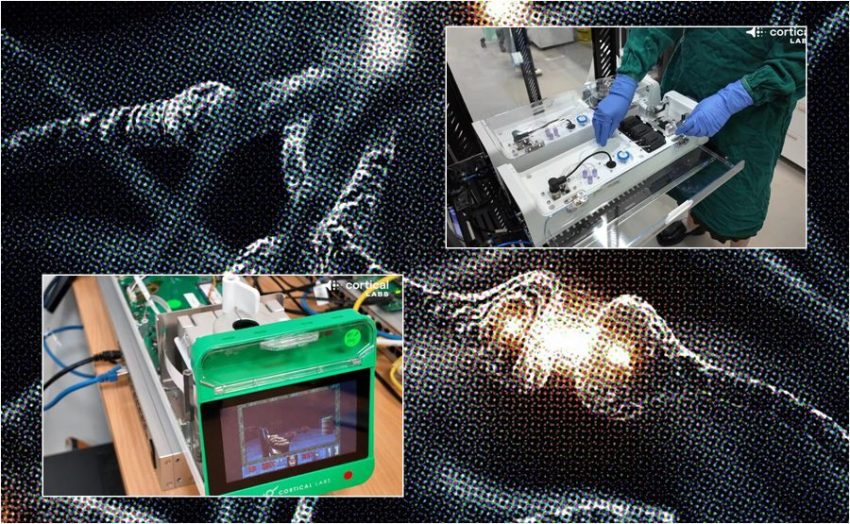
MELBOURNE – Scientists at Cortical Labs decided to blur line between biology and modern technology, growing living neurons on a silicon platform and inviting them to interact with a digital world.
With software crafted by independent developer Sean Cole, the tiny cluster of cells received translated signals from the game and responded in ways that researchers say resemble learning. It is a modern parable of curiosity, human ingenuity reaching into the realm of living computation, asking whether neurons and silicon might one day think together.
View this post on Instagram
Australian biotechnology giant Cortical Labs claims it has fused living human neurons with silicon hardware and trained them to interact with digital version of the legendary shooter Doom. The experiment reportedly used around 200,000 brain cells grown on a microelectrode array, effectively creating a hybrid biological-computational system.
The setup converts game data into electrical signals that neurons can respond to, allowing the cells to “learn” and adapt within a virtual environment. While the tiny biological players are nowhere near competing with human gamers, the mere fact that living neural tissue can engage with a three-dimensional game world has stunned scientists and technologists alike.
This is not the company’s first foray into wetware computing. Years earlier, it famously connected lab-grown neurons to Pong, demonstrating that biological networks could receive feedback and control in-game actions. That milestone hinted at a future where living cells might complement traditional silicon processors.
The latest leap to Doom posed an even greater challenge, neurons have no eyes, so developers had to translate visual information into signals the cells could interpret. Independent programmer Sean Cole reportedly solved this in just a week by building a Python-based interface that mapped game environments to electrical patterns.
Reserachers still do not understand, or want to share, how neurons “perceive” or interpret the game data. Yet proponents argue that such experiments could unlock revolutionary applications, from adaptive biological processors to robotic systems controlled by living neural tissue.
Understanding Epilepsy: A Call for Awareness, Compassion, and Accessible Care