
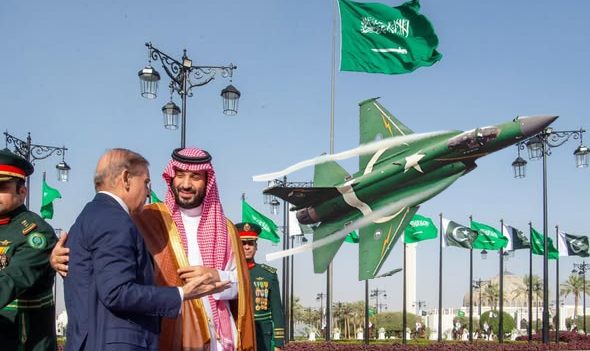
ISLAMABAD – Pakistan and Saudi Arabia are reportedly in talks to transform roughly US$2 billion in existing Saudi financial support into structured defence procurement programme centred on JF-17 Thunder fighter aircraft.
The initiative shows recalibration of bilateral ties, merging Islamabad’s urgent fiscal stabilisation needs with Saudi Arabia’s effort to strengthen airpower capabilities amid growing uncertainty over traditional security guarantees in the Middle East.
Pakistani defence officials termed proposal as debt-to-capability mechanism that would ease pressure on country’s foreign-exchange reserves while converting Saudi Arabia’s long-standing financial assistance into tangible military assets. The negotiations are framed as a practical implementation of the bilateral defence cooperation agreement signed in September 2025, unfolding against a backdrop of economic strain in Pakistan and heightened geopolitical fragmentation across both South Asia and the Gulf.
At heart of talks is JF-17 Block III, the most advanced variant of Pakistan’s indigenous multirole fighter. Equipped with an AESA radar, upgraded electronic warfare systems, modern data links, and beyond-visual-range combat capability, the platform is increasingly marketed as a cost-effective yet credible solution for air forces seeking operational relevance without the financial and political burdens associated with Western combat aircraft.
For debt-ridden Pakistan, the proposal aligns with its broader economic predicament after repeated balance-of-payments crises and reliance on IMF programmes, including its latest US$7 billion arrangement. For KSA, the deal shows deliberate move to diversify defence suppliers as concerns grow over sanctions exposure, export-control restrictions, and the unpredictability of foreign policy decisions by traditional partners.
The structure under discussion would offset Saudi loans against aircraft deliveries, with total value potentially reaching US$4 billion once weapons, training, simulators, spares, and long-term support are included. This approach allows both sides to avoid immediate cash outlays while converting financial exposure into deployable military capability. The JF-17’s estimated unit cost, far below that of most Western fourth-generation fighters, strengthens its appeal as Gulf states reassess force affordability amid fluctuating energy revenues.
Pakistani officials argue that Block III’s sensor fusion, open-architecture avionics, and compatibility with a wide range of precision-guided munitions narrow perceived capability gaps with Western platforms. The aircraft is positioned as a flexible multirole asset rather than a limited air-defence solution, capable of air-to-air, strike, and maritime missions.
Operational references, including Pakistan’s aerial engagements with India in May 2025, are cited domestically as validation of the JF-17’s combat credibility in contested electromagnetic environments. From an export standpoint, such experience enhances the platform’s appeal among air forces prioritising demonstrated performance over theoretical specifications.
Pakistan views deal as a means to reduce near-term debt-servicing pressure while sustaining production at the Pakistan Aeronautical Complex, a central pillar of its defence-export strategy. Senior officials have increasingly portrayed arms exports as a pathway to economic sovereignty, pointing to recent multi-billion-dollar defence packages and ongoing discussions with other prospective buyers as evidence of industrial scalability.
For Saudi Arabia, converting financial assistance into airpower represents a shift from passive balance-sheet leverage to active force generation. Defence planners reportedly see the JF-17 as a politically resilient supplement to existing Western fleets—one that expands sortie capacity and operational redundancy without undermining high-end deterrent platforms. Supplier diversification itself is viewed as a strategic hedge, reducing vulnerability to external political pressure and supply-chain disruption.
If successfully implemented, the deal would mark an important milestone for Pakistan’s defence-industrial ambitions, demonstrating its ability not only to export aircraft but to support them within complex, mixed-origin air-force environments.
For KSA, operating a more diverse fighter fleet would enhance resilience, complicate adversary planning, and reduce dependence on any single supplier during crises.
Bangladesh Air Chief lands in Pakistan with JF-17 Fighter Jet talks on Agenda