ISLAMABAD – Pakistan and Bahrain called for safe and uninterrupted maritime navigation through the Strait of Hormuz and Bab el-Mandeb as regional tensions continue to threaten vital global trade and energy routes.
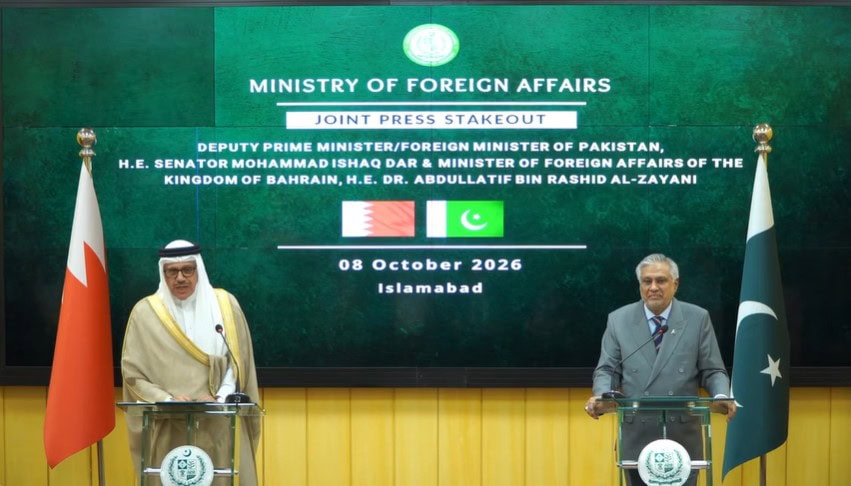
The third Pakistan-Bahrain Joint Ministerial Commission meeting held in Islamabad on Thursday, jointly chaired by Pakistan’s Deputy Prime Minister and Foreign Minister Ishaq Dar and Bahrain’s Foreign Minister Dr. Abdullatif bin Rashid Al Zayani. The two sides signed the protocol of the commission’s third meeting and agreed to strengthen their institutional framework by activating multiple joint working groups, a move Islamabad said would improve regular coordination and ensure effective implementation of decisions.
But the maritime security issue emerged as one of the most strategically significant points of discussion.
Addressing a joint presser, Deputy premier Dar said Pakistan and Bahrain had discussed the imperative of maintaining safe and free maritime traffic through the Strait of Hormuz and Bab el-Mandeb, describing both waterways as critical to regional and global food and energy security.
With global energy and supply chains heavily dependent on these routes, any disruption could have consequences far beyond the Middle East, potentially affecting energy supplies, trade flows and food security worldwide.
The talks also focused heavily on the rapidly changing situation in the Middle East. Dar said both countries emphasized restraint, de-escalation, dialogue and diplomacy, with Pakistan reaffirming its commitment to playing a constructive role in diplomatic efforts aimed at promoting regional peace and stability.
The discussions, however, extended well beyond the Gulf crisis. Pakistan and Bahrain also reviewed developments in South Asia, including the situation in Afghanistan and the Indus Waters Treaty. Dar stressed the need to ensure that no foreign territory is used against Pakistan, underscoring Islamabad’s continuing security concerns in the region.
On the Indus Waters Treaty, Dar delivered a particularly strong message, declaring India’s unilateral decision to suspend the agreement a serious violation of international law. He accused India of attempting to turn shared water resources into a political weapon, calling the move a dangerous development with potentially far-reaching consequences.
While regional security dominated the strategic agenda, the meeting also produced a major push for deeper economic cooperation. The two countries agreed to expand collaboration in trade and investment, industry, agriculture and food security, skills development, higher education, information technology, logistics and maritime affairs.
Bahrain’s Foreign Minister announced that Islamabad and Manama had agreed to establish a joint working group on trade and investment. An additional joint working group on energy, covering oil, gas and minerals, is also expected to meet next month.
Bahrain also reaffirmed the two countries’ commitment to bringing a Gulf Cooperation Council (GCC)-Pakistan free trade agreement to completion. The economic ambitions were underscored by an even more ambitious target.
Responding to a question, Bahrain’s Foreign Minister said Pakistan and Bahrain should seek to double bilateral trade within the next three years, signaling a push to transform strong political ties into substantially greater economic engagement.
Flights from Pakistan to Saudi Arabia, Bahrain and UAE delayed, cancelled amid fresh tensions