
Most of us learned it as children — that you do not throw stones when your own house is made of glass. It is not wisdom that requires a university education. A grandmother can teach it. A neighbour can demonstrate it simply by living next door with some dignity. It is one of those truths so obvious that only the truly reckless choose to ignore it.
India, it seems, has made ignoring it a national sport.
Tune into Indian television on any random evening — truly, pick any night — and the ritual plays out with the reliability of a broken clock that somehow still knows when it is time to perform. The set changes. The anchor’s tie changes. The manufactured fury rises and falls depending on how desperate the producers are feeling. But the story? The story never changes. It is always Pakistan. It is always Azad Jammu & Kashmir. Somewhere in an editorial meeting that nobody will ever publicly admit to attending, a decision has been made: the day does not count unless something has been said against Pakistan. The propaganda quota must be filled.
This would be easier to stomach if these were the same voices that spoke up when their own country bled.
They are not.
Ask them about Manipur. Since May 2023, more than 220 people have died in ethnic violence there — not in some distant conflict zone, but inside India’s own borders. Women were filmed, on camera, being paraded naked through the streets. That footage did not vanish. It circulated for months. It took India’s own Supreme Court stepping in — publicly, uncomfortably — to force the government to even acknowledge what was happening. The godi channels covered it, yes. Briefly. Uncomfortably. Then they moved on, back to safer ground, back to Pakistan.
Ask them about Chhattisgarh, where Adivasi families have spent generations trapped between Maoist militants and state security forces, their villages caught in a war that nobody in Delhi seems in any hurry to end. Ask them about Indian Illegally Occupied Jammu & Kashmir, where the UN flagged serious human rights violations, where Amnesty International called the overnight stripping of Article 370 a form of collective punishment, where the Armed Forces Special Powers Act means a soldier can kill and face no court, and where hundreds of ordinary people — most of them young — have been blinded by pellet guns fired by security forces into crowds.
None of that gets the prime-time graphics. None of that gets the panel of twelve people screaming at each other for forty-five minutes.
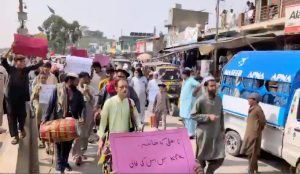
So when trouble broke out in Rawalakot, the machine across the border did not pause to ask questions. Questions slow things down. Within hours, the numbers were already being published with the confidence of eyewitnesses: 200 killed by Pakistan Army firing, said one account. 300, corrected another, apparently feeling the first figure lacked ambition. Coordinated social media accounts — many of them traceable to Indian networks — began pushing clips. Some were staged. Some were pulled from entirely unrelated incidents and relabelled. All of them were moving in the same direction, telling the same story: Pakistan is burning its own people.
Here is what actually happened.
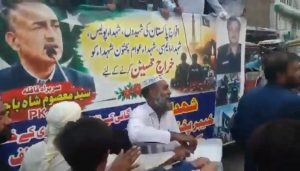
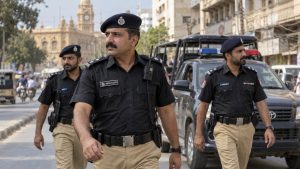
The banned Joint Awami Action Committee, known as JAAC, organised a direct armed assault on the Combined Military Hospital in Rawalakot. They did it under the cover of a funeral — the procession for a young man named Shahzaib. The people who carried out this attack did not look like grieving mourners. They were armed, coordinated, and they came ready to fire. They opened up on law enforcement officers without hesitation. When the smoke cleared, four officers had been martyred — three from the AJK Police, one from the Federal Constabulary. More than twenty others were left with gunshot wounds. Every injury from a bullet. Not a baton, not a rubber round. A bullet.
Now go through every video from that day. All of them. There is not a single verified clip showing Pakistan Army soldiers firing on civilians. Not one. What exists — and what the international press is now starting to highlight — are videos showing armed men inside the JAAC crowd, weapons visible, firing. Journalists outside India are already asking the question that Indian anchors will never let near a microphone: where is the evidence that security forces fired first?
The quiet that greets that question says more than any answer would.
The people of AJK are not naive. They have watched JAAC’s leaders disappear — truly vanish — the moment the situation turned serious, leaving behind the young men they had wound up and pointed at the hospital gates. These same people know that 90 per cent of JAAC’s demands had already been agreed to before any of this happened. They are starting to ask who, exactly, this organisation was fighting for. The answer they are arriving at is not a comfortable one for JAAC.
Pakistan has said what it will do. Those who planned this, who funded the weapons, who made the calls — they will be found. The law does not forget. And no armed faction, whatever agenda it serves, will be handed control over AJK’s peace.
As for India, the glasshouse still stands. The stones are still flying. But the cracks are spreading, and the rest of the world has started to notice where they came from.