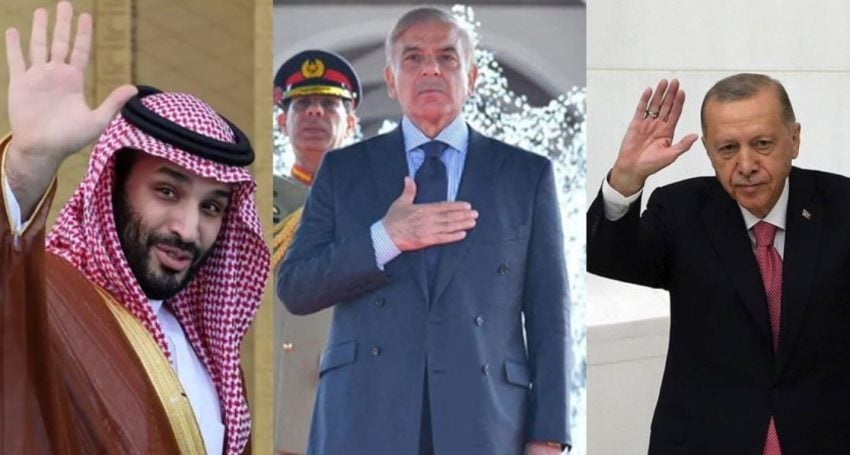
ANKARA – Turkey is on the verge of joining strategic defence pact with nuclear-armed Pakistan and financially powerful Saudi Arabia. The trilateral partnership could mark dawn of a new era in international defence strategy, potentially rewriting the rules of engagement in South Asia, the Middle East, and beyond.
A report shared by Bloomberg said Pakistan–Saudi Arabia Strategic Mutual Defence Agreement (SMDA), signed in September 2025, states that an attack on one member will be considered an attack on all—mirroring NATO’s famous Article 5.
People familiar with the talks say Ankara’s negotiations are moving rapidly, with a formal deal expected soon. Analysts warn that Turkey’s entry could create a new military bloc, altering the balance of power in the Middle East, South Asia, and Africa.
SMDA unites Pakistan’s nuclear arsenal and missile capability with Saudi Arabia’s financial muscle and manpower, while Turkey brings battlefield experience and an advanced defence industry, according to Nihat Ali Özcan, strategist at the Ankara-based think tank TEPAV. He noted that shifting regional dynamics are driving countries to explore new security arrangements outside traditional alliances.
Sources suggest Turkey is pursuing this pact amid growing uncertainty over US commitments to NATO and questions about former President Donald Trump’s stance on the alliance. Ankara sees the SMDA as a key deterrent and security booster, complementing its long-standing military cooperation with Pakistan and increasingly closer ties with Saudi Arabia.
If finalized, Turkey’s inclusion would mark a dramatic thaw in relations with Saudi Arabia, which have been strained for years. The two nations recently held their first-ever naval meeting in Ankara, signaling a deepening partnership. Both countries also share concerns over Iran, favor a stable Sunni-led state in Syria, and support Palestinian statehood.
Islamabad and Ankara already maintain close defence collaboration. Ankara is building corvette warships for the Pakistan Navy, has modernized dozens of F-16 fighter jets, and shares drone technology with both Pakistan and Saudi Arabia. Reports suggest Turkey is also inviting its new partners to participate in its KAAN fifth-generation fighter jet program, a potential symbol of the emerging trilateral alliance.
The SMDA talks come on the heels of a recent ceasefire between Pakistan and India after a four-day military clash in May 2025, which saw Pakistan shoot down multiple Indian fighter jets, including Rafales, and intercept numerous drones following Indian missile strikes. Tensions remain high with Afghanistan, where Pakistani forces conducted targeted operations in Kandahar and Kabul after Taliban-linked militants attacked Pakistani territory, killing 23 soldiers and resulting in over 200 militant casualties.
The landmark SMDA was signed in Riyadh on September 17, 2025, during Prime Minister Shehbaz Sharif’s visit. Crown Prince Mohammed bin Salman reaffirmed Saudi Arabia’s commitment to deepening regional security ties, while Pakistan signaled that more countries were exploring similar defence arrangements—hinting at the potential birth of a Middle Eastern or South Asian “NATO-style” alliance.
Analysts warn that Turkey joining this alliance could dramatically shift regional and global power dynamics, especially amid ongoing US-NATO uncertainty. With Pakistan’s nuclear capability, Saudi financial strength, and Turkey’s military expertise, the new bloc could emerge as a counterweight to both regional rivals and traditional Western security guarantees.
Is Pakistan offering JF-17 Jets to Saudi Arabia as Repayment for US$2Bn Loans?