

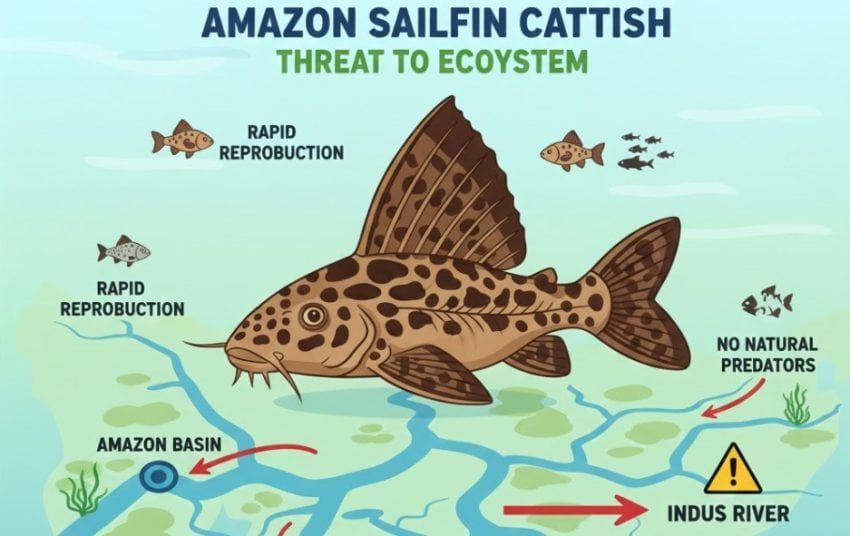
SUKKUR – A wave of alarm is sweeping through Pakistan’s fishing communities and environmental circles after sailfin catfish, a striking and colorful species native to South America’s Amazon River, was reportedly spotted in Indus River near Sukkur.
Known for its vibrant fins and shimmering scales, this aquarium favorite has long been admired by hobbyists, but now same beauty is raising fears about its potential to disrupt Pakistan’s delicate aquatic ecosystem.
Environmental experts warn that if sailfin catfish begin breeding in natural water bodies, the consequences could be severe. “These fish compete aggressively with native species for food, space, and reproduction,” said one expert. “Valuable local fish could gradually disappear, creating long-term ecological problems.”
But the story is far from black-and-white. Mohammad Moazam Khan, aquatic wildlife specialist at the World Wildlife Fund (WWF), urges caution before sounding the alarm.
“Finding one or two fish does not mean an ecological disaster,” Khan said. “Not all exotic fish are invasive, and not every report is scientifically accurate.” He added that sailfin catfish are mainly kept for aquarium decoration, not for cleaning tanks as some believe. The real danger only arises when people irresponsibly release them into rivers or streams.
Khan said the crucial difference between sighting fish and evidence of breeding in the wild. “Pakistan does have examples of truly invasive species, like red-bellied tilapia and pacu fish, whose aggressive reproduction has been scientifically documented,” he noted.
World Wildlife Fund also stressed role of research and evidence over fear. “We must act if there is clear proof of population growth and negative impacts on native species, but jumping to conclusions from a single incident only spreads unnecessary panic.”
Pakistan’s aquarium trade operates with almost no oversight. Lack of laws and quarantine systems for importing exotic fish could turn a minor problem into a serious ecological threat. He concluded with stark warning, “Pakistan must avoid two extremes, irresponsible behavior on one hand, and unscientific fear on the other. The solution lies in research, monitoring, public awareness, and balanced policy to protect our rivers without turning every sighting into a doomsday scenario.”