
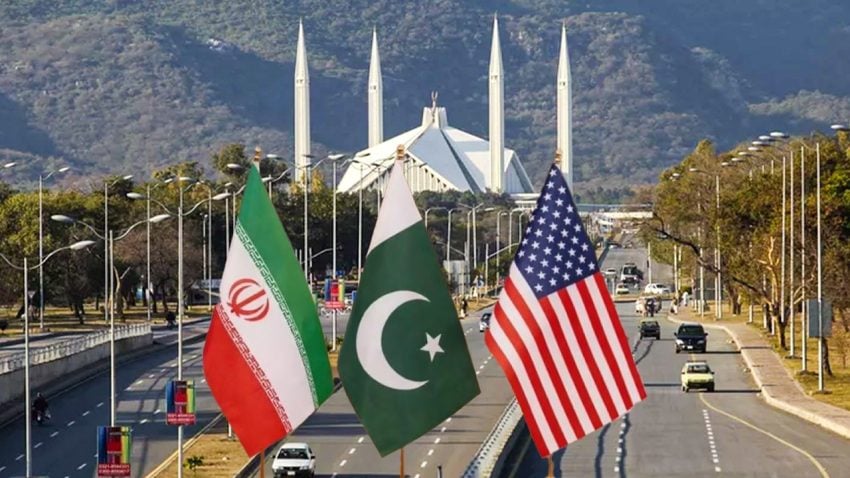
There was a moment on Tuesday night that the world will not fully appreciate for some time. Ninety minutes remained before Donald Trump’s self-imposed deadline — his promise, made in the unsparing language of Truth Social, to reduce Iranian civilisation to rubble. The Strait of Hormuz was closed. Oil markets were in freefall. In Islamabad, Pakistan’s mediators were still working.
Then, Prime Minister Shehbaz Sharif’s statement was issued. American stock markets reversed their decline. Trump posted. A ceasefire was announced.
The headlines that followed called it a last-minute reprieve, a diplomatic miracle, a fortunate accident of timing. What the headlines did not adequately convey was that the outcome was neither miraculous nor accidental. It was the product of weeks of backchannel effort that unfolded largely outside the glare of the international press — and almost entirely outside Pakistan’s own domestic news cycle, which had other preoccupations. Pakistan, in its characteristic fashion, had been quietly doing serious work.
That work deserves to be named.
Over the course of roughly twenty-one hours of continuous diplomacy — spanning multiple sessions, shuttle negotiations, and at least one wholesale revision of Iran’s counter-proposal into language both delegations could approach without publicly surrendering ground — Pakistan’s team held together a process that had every reason to collapse. The final stretch of the Islamabad talks lasted twenty-one unbroken hours, making them among the most sustained direct engagements between Washington and Tehran since the Islamic Revolution of 1979.
At the centre of the effort was Deputy Prime Minister and Foreign Minister Ishaq Dar, whose mediatory role was explicitly acknowledged by both the American and Iranian delegations — an acknowledgment that, in diplomatic convention, carries far more weight than any formal statement of appreciation. Dar moved between the two sides when they would not move toward each other. He carried proposals. He absorbed frustration. He revised frameworks past midnight and past dawn. The discipline with which he and his team maintained confidentiality about the substantive contents of the negotiations — declining, even under pressure, to discuss what was said in the room — was itself a mark of professional seriousness that both sides noticed and respected.
Pakistan’s army chief, Field Marshal Asim Munir, brought a different but equally vital ingredient: personal trust with the Trump administration, built painstakingly over the preceding year through a series of exchanges that included Pakistan’s cooperation on the Abbey Gate bombing case and the quiet role Islamabad played during the India-Pakistan crisis last May. That trust gave Pakistan direct access to the Oval Office at moments when the ceasefire was most at risk. Prime Minister Sharif’s public statement at the critical hour — timed with evident precision — provided the political architecture that made Trump’s announcement possible without any party losing face.
The scale of international confidence in Pakistan’s mediation was visible in a detail that passed largely unremarked: Chinese, Egyptian, Saudi, and Qatari officials quietly gathered in Islamabad not as competing mediators but as supporting ones. When the world’s major powers travel to a country’s capital and accept a secondary role, that country has earned something that cannot be manufactured.
The question being asked in some quarters is a pointed one: since no final agreement was reached, what exactly did Pakistan accomplish?
It is, in a meaningful sense, the wrong question — though it deserves a serious answer.
A mediator’s function is not to manufacture agreement between parties who remain fundamentally divided. A mediator’s function is to create and hold the conditions under which agreement becomes possible — to bring adversaries into the same room, sustain them through the inevitable moments of rupture, and ensure that when they leave, they carry with them a precise understanding of where the other side actually stands. By every one of those measures, Pakistan’s mediation in Islamabad succeeded.
The United States and Iran — two countries with no direct diplomatic relations, who have not engaged at this level since the revolution forty-seven years ago — sat across from each other. They exchanged substantive proposals. They revised and counter-revised. They argued through the night about nuclear programmes, the Strait of Hormuz, war reparations, and the shape of a potential peace. When Vice President Vance departed, he carried with him what he described as America’s “final and best offer” — a concrete, textured proposal that exists only because Pakistan constructed the environment in which it could be made and delivered.
What Islamabad could not do — and was never asked to do — was resolve the deep structural divergences that separate Washington and Tehran. Iran’s domestic politics cannot absorb unconditional nuclear surrender. America’s domestic politics cannot absorb Iranian enrichment. Those are not Pakistani problems. They are the weight of history and sovereignty that two great adversaries must carry for themselves. Pakistan held the room. What happened inside it was the parties’ own responsibility.
Vice President Vance, to his credit, made this distinction explicitly. Standing before cameras in Islamabad before boarding Air Force Two — visibly exhausted, departing a summit that had produced no breakthrough — he chose his words carefully. Whatever shortcomings existed in the negotiations, he said, they were not because of the Pakistanis, who had done “an amazing job” and genuinely tried to help both sides bridge the gap and reach a deal.
These are not words of diplomatic courtesy. A man leaving a failed summit has no incentive to offer generous assessments of his hosts unless they are warranted. Vance said what he said because Pakistan’s effort, observed at close quarters over twenty-one hours, earned it.
There remains, in the rubble of an inconclusive summit, a fragile but real glimmer of hope. The ceasefire holds as of this writing. The offer made in Islamabad has not been withdrawn — it sits on the table, waiting. Both sides have now looked directly at each other, across a room in Pakistan’s capital, and know with specificity what the other requires. That knowledge — unsentimental, unvarnished — is the raw material from which lasting agreements are eventually constructed.
Pakistan’s future role in this process will depend on whether Washington and Tehran believe Islamabad kept faith with them. The evidence, on both sides, suggests they do.
In a world that is dangerously short of credible, trusted, disinterested mediators, Pakistan this week demonstrated that it can be one. That is not a minor footnote to a failed summit. In the long ledger of this conflict, it may prove to be among the most consequential entries of all.