
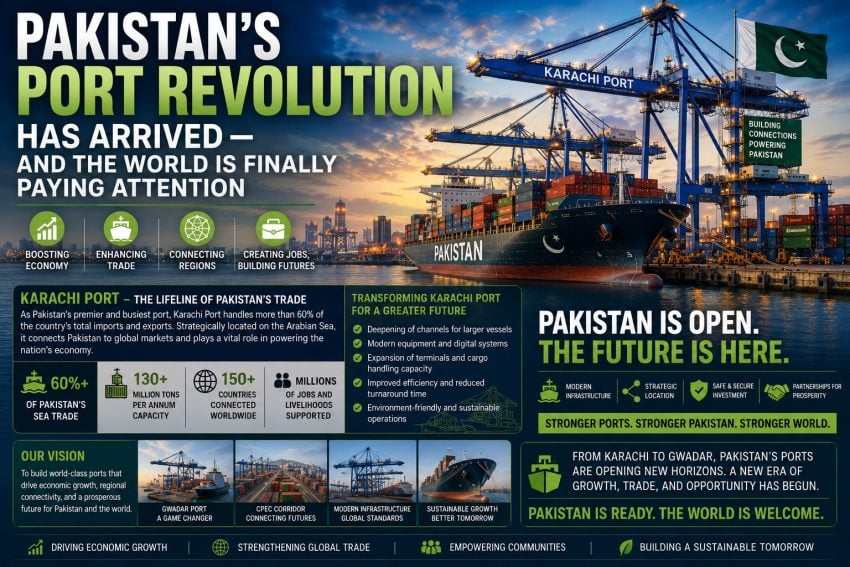
For years, Pakistan’s maritime potential was discussed in the future tense — a country perpetually on the verge of becoming a regional shipping power, always one reform away, always one investment short. In fiscal year 2025-26, that future tense finally became the present. The Karachi Port recorded 2,003 ship arrivals — its highest traffic in eight years — with total tonnage exceeding 84.4 million tons and ship arrivals rising by 7.5 percent. Pakistan did not just participate in global maritime trade this year. It stepped forward and claimed a place at the table.
This is not a story about luck. It is a story about a country that was ready when the moment came.
When the World Needed an Alternative, Pakistan Delivered
When the Strait of Hormuz — through which roughly 20 percent of the world’s oil and natural gas flows — was effectively closed to commercial traffic from March 2026, global shipping faced one of its most severe disruptions in modern history. Every major container line suspended transits. The world’s most familiar transhipment gateways — the UAE’s Port of Jebel Ali, Oman’s Port of Salalah — became inaccessible. Carriers faced reroutes around the Cape of Good Hope, adding up to 4,000 nautical miles and two weeks of transit time to Asia-Europe voyages.
The world needed an alternative. Pakistan answered.
Karachi Port emerged as a pivotal transhipment hub, absorbing approximately 75 per cent of all cargo redirected to Pakistan, with Port Muhammad Bin Qasim handling the remaining 25 per cent. Daily cargo handling at Karachi Port reached 168,850 tons on March 31 — nearly tripling the 57,198 tons recorded on the same day the prior year. In the first 24 days of March alone, the port processed 8,313 containers designated for transhipment, surpassing the total volume handled in all of 2025. Annualised, that pace represents approximately 126,000 TEUs in transhipment — compared with 8,300 in all of the prior year. The increase was not marginal. It was transformational.
Pakistan proved, under pressure and at scale, that its ports could perform.
A Government That Rose to the Occasion
What made Pakistan’s response remarkable was not just the volume of cargo it absorbed, but the speed and decisiveness with which its government moved to make it happen.
Within weeks of the regional disruption, Maritime Affairs Minister Junaid Anwar Chaudhry announced a sweeping package of port incentives effective March 18, 2026. Vessels carrying dry bulk export cargo received a 60 percent concession on port dues, wharfage, and storage charges under the revised Karachi Port Trust tariff. Large container ships carrying at least 25 per cent transhipment cargo became eligible for up to a 50 per cent discount on applicable wet charges. Ships using environmentally friendly fuels received an additional 5 percent reduction in berthing charges — a signal that Pakistan was not just chasing volume, but positioning itself as a forward-looking, sustainable maritime hub.
The government simultaneously overhauled its international transhipment regulations to allow cargo handling at both seaports and airports — dismantling a bureaucratic barrier that had historically limited Pakistan’s competitiveness. A dedicated feeder service was launched on March 11, connecting Karachi to the UAE ports of Fujairah and Khor Fakkan, creating a new regional corridor. Orient Overseas Container Line unveiled a Southeast Asia-to-Indian-subcontinent service that incorporated Karachi into a loop through Singapore and Malaysia’s Port Klang — a direct acknowledgement from one of the world’s major carriers that Pakistan had earned a permanent place in regional shipping architecture.
The minister described the growth in maritime trade as a “positive indicator” for the national economy. That may be an understatement.
The Infrastructure Was Already There
Pakistan’s ability to absorb this surge was not coincidental. It reflected years of infrastructure investment — most significantly through the China-Pakistan Economic Corridor — that quietly built capacity long before the world’s attention turned to Karachi.
Karachi Port operates 30 berths. Port Qasim offers deep-water facilities with 17 operational berths. Gwadar, developed with $1.6 billion in CPEC investment on the Arabian Sea coast, is expanding with nine new multipurpose berths currently under construction — timed precisely to meet the moment Pakistan finds itself in. The $62 billion CPEC framework, which includes the Karachi-Lahore motorway and Karakoram Highway, provides the inland connectivity that transforms a port from a destination into a corridor. Pakistan was not scrambling to build infrastructure in a crisis. The infrastructure was already there.
Gross Registered Tonnage at Karachi Port grew by 3 percent during the fiscal year — a technical measure that reflects not just more ships, but larger and more capable ships choosing Karachi as their port of call. The world’s carriers did not simply divert to Pakistan as a last resort. They arrived, found a functioning port, and stayed.
“Pakistan was always geographically positioned to compete. Now, the world knows it.”
Perhaps no voice captured the significance of Pakistan’s moment more clearly than Syed Tahir Hussain, Secretary-General of the Pakistan Ship’s Agents Association. “Previously, we were not even in the race,” Hussain said in March. “Now, due to the Middle East disruption, Pakistan has a unique opportunity as ships are looking for nearby alternatives, and Pakistan is the closest. They can unload here and move later when conditions improve.”
That statement deserves to be read carefully. Pakistan is not simply the closest alternative — it is a genuinely competitive alternative. The 60 per cent tariff concessions on dry bulk cargo and 50 per cent discounts for transhipment vessels make Karachi price-competitive with established hubs such as Dubai, Salalah, and Colombo. Combined with Pakistan’s geographic position at the mouth of the Arabian Sea — equidistant between the Gulf and South and Southeast Asian markets — the country now offers a value proposition that exists entirely on its own merits.
The disruption did not create Pakistan’s maritime potential. It revealed it.
A Permanent Shift in Global Shipping Geography
The significance of what Pakistan achieved in 2025-26 extends beyond a single fiscal year’s statistics. It marks the moment global carriers — Maersk, CMA CGM, MSC, Hapag-Lloyd and others — built operational familiarity with Pakistani ports, established feeder routes, trained local agents, and embedded Karachi into their logistics networks. That institutional knowledge does not disappear when disruptions subside. Routes that are launched tend to persist. Relationships built in a crisis become the foundation of ordinary commerce.
The US-Iran peace deal announced on June 14, with its framework for reopening the Strait of Hormuz, represents a stabilisation of the broader region — and Pakistan stands to benefit from that stability too. A more secure Gulf means that the feeder routes connecting Karachi to Fujairah and Khor Fakkan become commercially viable long-term links rather than crisis workarounds. It means that the carriers who came to Karachi can now plan for Karachi — building it into their permanent rotation with confidence that the regional environment is stable enough to justify the commitment.
Pakistan’s maritime ambitions are no longer hypothetical. They are operational.
What Comes Next?
The eight-year high in ship arrivals is a beginning, not a ceiling. Pakistan has demonstrated capacity, responsiveness, and competitive pricing. It has established new international shipping routes, reformed its transhipment regulations, and attracted global carriers who previously had no operational presence in the country. The Karachi Port Trust has delivered on performance. The government has delivered on policy. And the country’s geography — long underutilised — is finally being recognised as the strategic asset it has always been.
The next chapter will be written by sustained investment: the completion of Gwadar’s nine new berths, the deepening of digitalisation at Pakistani ports, the full realisation of CPEC’s logistics and connectivity potential, and the continued competitive tariff positioning that makes Karachi not just the nearest option but the preferred one.
Pakistan did not just record its best ship traffic in eight years. It announced, to anyone in global shipping paying attention, that it is open for business — permanently, competitively, and on its own terms.
The world came to Karachi when it had no choice. It will come back because it wants to.