
LAHORE – Lahore University of Management Sciences (LUMS) has brought the lost treasures of Maharaja Ranjit Singh’s legendary toshakhāna (royal treasury) back into public view with a landmark exhibition titled “Maharaja Ranjit Singh’s Toshakhāna: The Material Splendour of 19th Century Punjab.” Running at the Mushtaq Ahmad Gurmani School of Humanities and Social Sciences (MGSHSS) until December 19, the exhibition offers visitors an unprecedented glimpse into the opulence and cultural life of the Lahore Darbār.
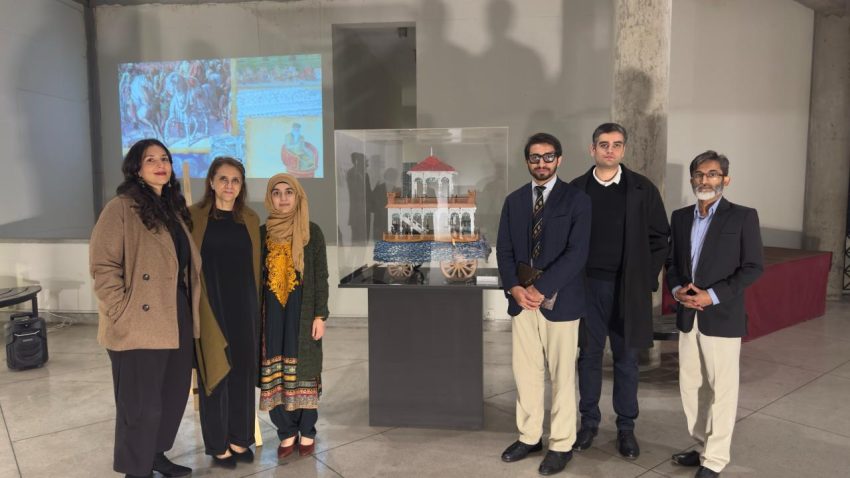
The exhibition traces the history and dispersal of the Maharaja’s toshakhāna, famed for its exquisite gold, silver, and gem-encrusted objects. Following the annexation of Punjab in 1849, many of these treasures were dismantled, auctioned, or lost. Through extensive research and digital reconstruction, the exhibition recreates these lost artifacts, allowing audiences to engage with Punjab’s royal material culture in new and immersive ways.
Curated by Dr. Nadhra Shahbaz Khan, Associate Professor of Art and Architectural History, and Dr. Murtaza Taj, Associate Professor of Computer Science, the exhibition reflects an interdisciplinary approach combining historical scholarship with cutting-edge digital technologies. Visitors experience video narratives, infographics, immersive installations, and reimagined models of vanished objects, including the famed Koh-i-Noor diamond and the silver bangla, a double-storied mobile throne dismantled after annexation.
Speaking at the opening, Vice Chancellor Dr. Ali Cheema emphasized the exhibition’s role in connecting heritage to contemporary identity. “Heritage at LUMS aims to centre heritage as a way for us to discover who we are as a people, and to reflect on what inclusive futures could look like,” he said.
The event also featured remarks from LUMS’ Founding Pro Chancellor Syed Babar Ali, who highlighted the global dispersal of Punjab’s heritage, and scholar Fakir Syed Aijazuddin, who stressed the importance of historical memory in shaping society.
The exhibition is part of the broader Heritage at LUMS initiative, which includes projects like the LUMS Digital Archive and the Lutfullah Khan Archive, preserving thousands of hours of recordings for future generations.
Dr. Khan underscored the curatorial vision: “The intention is not to mourn what has been lost, but to recall or reimagine, and then read these objects as living portraits of their age; of the hands that shaped them, the eyes that admired them, and the refined aesthetics of a society that brought them into being.”