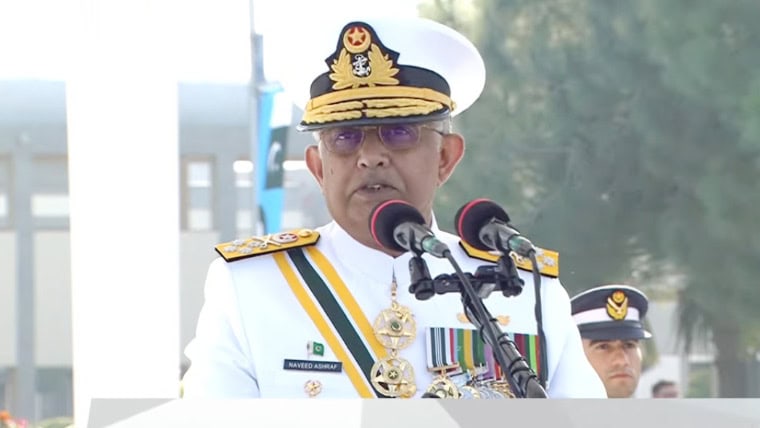
ISLAMABAD – Chief of the Naval Staff (CNS) Admiral Naveed Ashraf said on Thursday that the Pakistan Navy has substantially strengthened its combat capabilities across all operational domains.
Speaking at the graduation parade of the Pakistan Air Force Academy Asghar Khan in Risalpur, Nowshera district, Khyber Pakhtunkhwa, he said the navy is making steady progress in modernising its fleet. He listed the induction of state-of-the-art warships, Hangor-class submarines, indigenously developed long-range weapons and unmanned systems, along with the establishment of the Pakistan Maritime Science & Technology Park, as key developments. According to him, the navy’s capabilities have recently been transformed to meet the demands of present and future warfare.
The navy will induct eight Hangor-class submarines in total. The first arrived at Karachi Port in June and carried out its first live weapon firing in the Arabian Sea in September. In mid-April, the navy fired a locally developed anti-ship ballistic missile at an extended range, and days later successfully tested Taimoor, an indigenous anti-ship weapon system. In November last year, it tested a ship-launched anti-ship ballistic missile developed at home.
Changing nature of warfare
Admiral Ashraf said modern warfare is changing at an unprecedented pace, driven largely by new technologies that are reshaping concepts, doctrines and organisational structures. Conflicts, he noted, are no longer confined to traditional battlefields and now extend into electronic warfare, cyber, space and cognitive domains. Autonomous systems, artificial intelligence and information warfare have also changed how battles are fought and won, he added.
Security challenges
The naval chief said the global and regional strategic environment has grown more complex, especially amid heightened tensions in the Middle East. Rapidly shifting geopolitical dynamics, he said, demand constant vigilance, strategic foresight and a high level of operational readiness to deter conventional, hybrid and asymmetric threats. He added that the armed forces are fully aware of these developments and have prepared accordingly.
He said Operation Muhafizul Bahr, launched in March this year when the Middle East conflict erupted, is still continuing successfully.
Reference to the May 2025 conflict
Calling the armed forces invincible and capable of deterring any aggression, Admiral Ashraf recalled the Pakistan-India conflict of May 2025, which the Pakistan Army named Marka-i-Haq, covering the period from the April 22 Pahalgam attack to the May 10 conclusion of Operation Bunyanum Marsoos. “I am sure our adversary has learned the lesson, and it would be unwise to need a second,” he said.
Praising the air force’s extraordinary performance, he said that for the first time in the history of warfare, the PAF conducted multi-domain operations built chiefly on indigenous capabilities, particularly a homegrown kill chain, the result of an aggressive and innovative modernisation and indigenisation strategy. He said the Pakistan Navy successfully deterred the Indian Navy from any hostilities at sea, keeping it at bay throughout the conflict.
Describing the air force and navy as “brothers in arms” who share the maritime domain as an operational space, he said they exercise together and will fight side by side to defend the motherland.
Admiral Ashraf said Pakistan is a peace-loving nation that prioritises restraint, dialogue, diplomacy, regional stability and world peace, but “knows how to defend its motherland”. He said the country and its armed forces have made matchless sacrifices for peace and remain determined to keep working until peace and stability are established in the region.
He also welcomed the presence of Türkiye’s air force chief, General Rafet Dalkiran, at the parade, saying Pakistan is proud of its time-tested friendship with Türkiye, with the two nations standing shoulder to shoulder through thick and thin. He concluded by congratulating the graduating cadets.