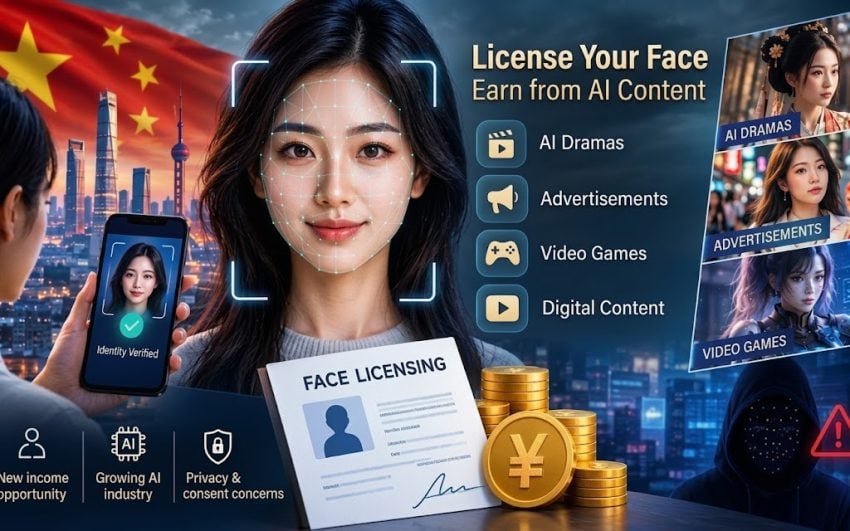
Imagine offering your face to earn money without you stepping in front of a camera. In China, AI is turning that once-unusual idea into reality, with people licensing their digital likenesses for dramas, advertisements, and video games.
People can now allow their appearance to be digitally reproduced for short dramas, advertisements and video games, turning something as personal as a face into a potential source of income.
The emerging trend is transforming the way digital content is produced while raising major questions about how much a face is worth, who controls a digital likeness and how consent works when AI can reproduce a person almost perfectly.
Imagine earning money without appearing on a film set, recording an advertisement or even acting in front of a camera. That idea is becoming a reality in China, where platforms are connecting ordinary people with producers seeking faces for AI-generated characters.
Under these arrangements, producers can obtain permission to use a person’s appearance and digitally incorporate it into entertainment and commercial projects. The person essentially licenses their likeness, allowing their digital appearance to be used while receiving payment in return.
The development is creating a new market around something that has traditionally been considered part of a person’s private identity. Instead of relying exclusively on professional actors or models, AI producers can source faces from the general public and use them as the visual foundation for digital characters.
This means people who have never worked in entertainment could potentially see their appearance used in dramas, advertisements or games. The process also changes the meaning of a “digital identity”, as a person’s face can now be copied, modified and incorporated into entirely new virtual characters.
The practice was initially associated with relatively small circles within China’s film and television industry, as well as private online chat groups. However, the face-licensing business began appearing more prominently on public platforms after April, bringing the concept to a much wider audience.
Various platforms are now helping connect people willing to license their appearance with producers looking for suitable digital faces.
While the emerging market offers a potential source of income, it also raises complicated questions about personal identity. Once someone’s appearance is licensed for AI use, questions arise over where the face can be used, how long permission remains valid and how much control the individual retains over their digital likeness.
There are also concerns about whether a face could eventually be reproduced or reused beyond the original agreement.
As AI-generated entertainment expands, these questions are becoming increasingly important because a digital copy of someone’s appearance can potentially travel far beyond the original project.