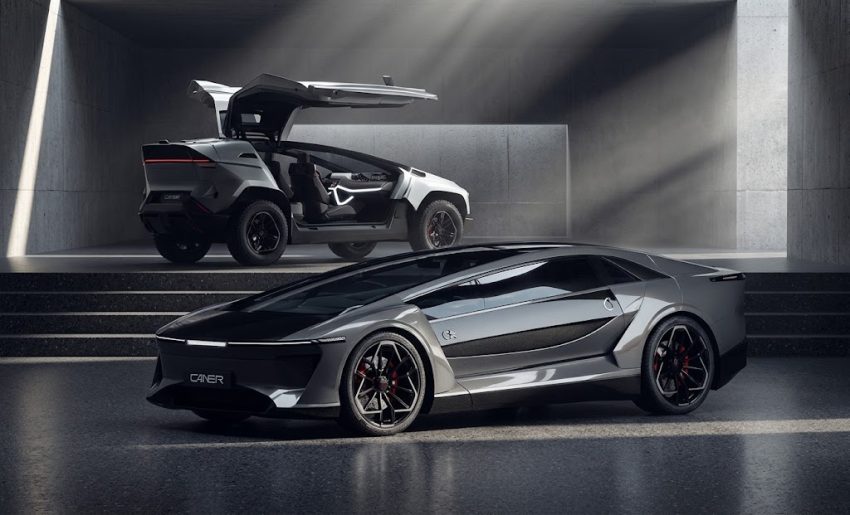
Oil-rich Saudi Arabia entered the high-performance electric vehicle race with two futuristic models from its first national automotive brand, Ceer.
Ceer unveiled Exobot electric sedan and SUV, showcasing vehicles that combine extreme performance, advanced technology and a distinctly Saudi-inspired design. The new EVs are expected to go on sale in Saudi Arabia and selected Gulf markets in early 2027. Production is scheduled to begin around January 2027 at the Ceer Manufacturing Complex in King Abdullah Economic City, with first deliveries targeted for March 2027.
Saudi Arabia UNVEILS EXOBOT models, two EVs from homegrown CEER
Fast charging sedan and SUV sport up to 1,111 HORSEPOWER and 1,500 Nm of torque pic.twitter.com/2OkJlOncFA
— RTVisual (@RT_Visual_on_X) September 21, 2026
Exobot delivers up to 1,111 horsepower
Both Exobot models use a tri-motor all-wheel-drive system, a 112 kWh NCM battery and an 800V electrical architecture. The launch versions produce up to 850 horsepower and 1,000 Nm of torque. A higher-performance configuration takes output to an impressive 1,111 hp and 1,500 Nm.
The sedan can accelerate from 0 to 100 km/h in 2.6 seconds, while the top configuration can reportedly complete the sprint in just 2.1 seconds. SUV records a 0–100 km/h time of 2.9 seconds in its launch specification and as little as 2.4 seconds in the higher-output version.
Exobot Specs
The electric sedan measures approximately 5,260 mm long, 2,102 mm wide and 1,428 mm high, with a 3,200-mm wheelbase. Ground clearance is around 155 mm and can increase to approximately 165 mm when the air suspension is raised.
| Feature | Exobot Sedan |
|---|---|
| Launch power | Up to 850 hp |
| Maximum power | 1,111 hp |
| Launch torque | 1,000 Nm |
| Maximum torque | 1,500 Nm |
| Battery | 112 kWh NCM |
| Drive | Tri-motor AWD |
| 0–100 km/h | 2.6 seconds |
| Top configuration | 2.1 seconds |
| Claimed range | Up to 670 km NEDC |
| Top speed | Up to 250 km/h |
| Wheelbase | 3,200 mm |
| Length | ~5,260 mm |
| Width | ~2,102 mm |
| Height | ~1,428 mm |
Exobot SUV
Exobot SUV measures around 5,016 mm in length, 2,101 mm in width and 1,693 mm in height. It shares the sedan’s 3,200-mm wheelbase but offers significantly more ground clearance, starting at around 280 mm and rising to approximately 300 mm with the air suspension.
The SUV also provides about 402 litres of boot space.
| Feature | Exobot SUV |
|---|---|
| Launch power | Up to 850 hp |
| Maximum power | 1,111 hp |
| Launch torque | 1,000 Nm |
| Maximum torque | 1,500 Nm |
| Battery | 112 kWh NCM |
| Drive | Tri-motor AWD |
| 0–100 km/h | 2.9 seconds |
| Top configuration | 2.4 seconds |
| Claimed range | Up to 560 km NEDC |
| Top speed | Up to 210 km/h |
| Ground clearance | Up to 300 mm |
| Wheelbase | 3,200 mm |
| Boot space | ~402 litres |
Exobot models feature a dramatic wedge-shaped profile, large glass surfaces and styling influenced by science-fiction concepts. One of the most noticeable elements is the large glass roof, which Ceer describes as among the largest fitted to a current production car.
The vehicles also feature 32-element matrix LED lighting. The number 32 references 1932, associated with the unification of modern Saudi Arabia. Another unusual feature is the upward-opening “Shahin Wing” doors.
Instead of conventional B-pillars, Ceer has used high-strength structural materials to maintain rigidity and safety.
Exobot features a large curved Digital Horizon screen stretching across the dashboard, accompanied by additional displays. Despite the digital-focused cabin, Ceer has retained physical controls for important functions such as climate settings and volume.
The vehicles use an aluminium space-frame body and a cell-to-pack battery structure.
Fast charging in under 30 minutes
Exobot’s 800V architecture allows DC fast charging at up to approximately 250 kW. Ceer says the battery can charge from 10% to 80% in less than 30 minutes under suitable conditions.
The range figures, however, are based on the NEDC testing cycle, which is generally more optimistic than newer testing standards and real-world driving. Actual range will vary depending on factors such as temperature, road conditions, speed and air-conditioning use.
Ceer will initially offer the Exobot in a limited First Edition specification. The launch models will be available with exclusive colours including Harrat Grey and White Musk, along with black exterior trim, dark badges, black wheels and red brake calipers.
The cabin features red-and-black Nappa leather, debossed headrests, bespoke floor mats and a numbered VIN plaque. The SUV is also expected to offer 22-inch and 24-inch performance wheels.
Companion Package
First Edition buyers will receive a six-year ownership package covering several major vehicle services.
| Benefit | Coverage |
|---|---|
| Vehicle warranty | 6 years / 200,000 km |
| Scheduled service | 6 years |
| Roadside assistance | 6 years |
| Battery warranty | 8 years / 200,000 km |
| Home charger | Up to SAR 2,000 |
Ceer was established in 2022 as a joint venture between Saudi Arabia’s Public Investment Fund (PIF) and Taiwan’s Foxconn. The Exobot programme combines Saudi investment and design input with technology from a network of international suppliers.
Foxconn provides the electrical architecture and vehicle platform, while BMW contributes component technology and engineering expertise through a licensing arrangement. The front motors are supplied by Hyundai Transys, while Rimac Technology provides the rear motor.
Other suppliers, including Lear, Shin Young, Benteler and Fangxin, are also involved, alongside Saudi companies supporting the local manufacturing chain.
Saudi Vision 2030
The launch is closely connected to Saudi Arabia’s Vision 2030 programme, which seeks to reduce the Kingdom’s dependence on oil and develop new industrial sectors. Ceer aims to build a domestic automotive supply chain, attract international investment and create skilled employment.
The project is expected to generate around 30,000 to 35,000 direct and indirect jobs by 2034. The company is also targeting approximately 45% local content by 2034.
The wider programme is projected to contribute more than SAR 30 billion, or about $8 billion, to the Saudi economy by 2034.
Exobot sedan and SUV are only the beginning of Ceer’s product strategy. The company plans to introduce five additional models by 2030, including compact and midsize vehicles. Future models are expected to include not only pure EVs but also plug-in hybrid and internal-combustion vehicles, allowing Ceer to address different markets and consumer requirements.
The company plans to expand into additional nearby markets from 2028, followed by a broader push across the Middle East and North Africa.
Tesla, Lucid and other top EVs looking at CEER
Exobot enters a rapidly expanding premium electric vehicle market. Its performance places it in the same broad segment as the Tesla Model S Plaid and Model X, while Saudi-backed Lucid is another significant player with a manufacturing presence in the Kingdom.
Other established premium EVs include the Porsche Taycan, BMW i7, BMW iX, Mercedes-Benz EQS, Mercedes-Benz EQE and Audi e-tron GT.
Chinese manufacturers are also increasing competition, with brands such as NIO, XPeng, BYD and Zeekr expanding their premium electric lineups.
Ceer is seeking to differentiate the Exobot through its Saudi identity, futuristic design, high-output powertrain and international technology partnerships.
Exobot price remains undisclosed
Ceer has yet to announce the official price of either Exobot model. The vehicles are positioned as premium offerings, with their high-performance powertrains, advanced technology, luxury interiors and limited First Edition specifications placing them in the upper end of the EV market.
The final price, independent range testing and production scale will become clearer as the vehicles move closer to their 2027 launch.