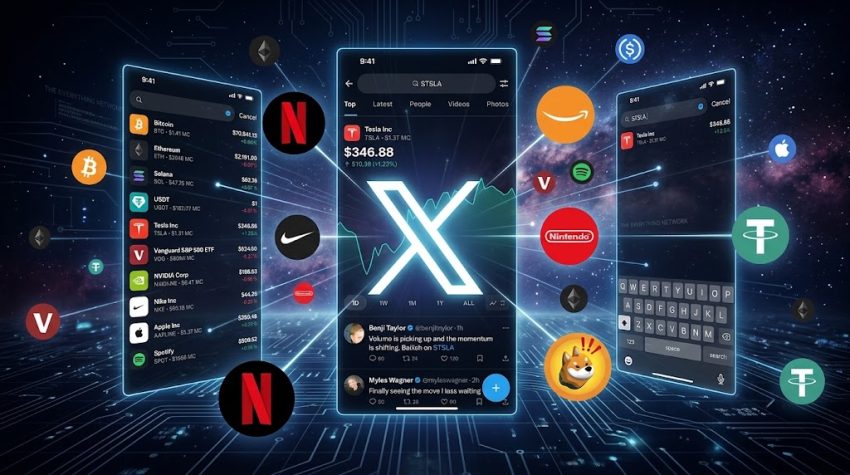
Millions of people X to discover stories, companies, cryptocurrencies, market narratives and breaking developments. Now X is putting a financial doorway next to that attention.
Imagine scrolling through Twitter when a ticker like BitCoin catches your eye. You check the chart, go through the conversation, and even Trade. Elon Musk’s social portal officially switched on new Cashtag Partner Program, adding something that could fundamentally change how users interact with financial content.
Until now, X’s smart Cashtags were primarily a discovery tool. Tap something like $BTC, $ETH, $AAPL or $TSLA, and X could take you to a dedicated asset page featuring price information, charts and related posts. This mean users could see what was happening around an asset without leaving the platform.
But if they actually wanted to buy or sell it, there was still another step, usually opening a brokerage or exchange, searching for the asset again, logging in and starting the trade.
The new program removes much of that friction. Cashtag page now adds a Trade option that can connect users with participating financial platforms. In other words, X is attempting to close the gap between: “Everyone is talking about this” and “I want to look at the market.” That is a much more powerful position for a social platform to occupy.
There is an important catch, and it is also one of the most important details of the entire launch. X does not execute the trade. It doesn’t take custody of your stocks or cryptocurrency, and the order is not completed inside X.
The brokerage or exchange remains responsible for the actual transaction, account requirements, eligibility and supported assets. So this isn’t X becoming Coinbase or Interactive Brokers overnight. It is X putting itself much closer to the moment when a user decides to trade.
Five financial giants are already at the door
X launched the program with five partners:
Crypto
- Coinbase
- Kraken
- Gemini
Stocks, ETFs and broader markets
- Interactive Brokers
- Moomoo
That combination is significant because it gives the Cashtag system a route into both the cryptocurrency and traditional-investment worlds. The experience can vary depending on the asset, brokerage and user.
For X, this is about convenience. For brokers, it could be about distribution. Think about the difference between someone seeing a random advertisement for a brokerage and someone who is already staring at a chart for $BTC or $AAPL and actively reading hundreds of posts about it.
The second person has already demonstrated interest. X can potentially put a brokerage directly in front of that user at precisely that moment. That makes the platform more than a place where financial conversations happen. It becomes a potential customer-acquisition pipeline for trading platforms. And that is arguably where the business significance of the feature begins.
X’s earlier pilot reportedly generated around $1 billion in global trading volume in its first three days. That figure has been cited as evidence that there is significant demand for connecting financial discovery with trading access. It does not mean the new US program will automatically generate the same level of activity.
Cashtag move also makes sense when viewed as part of X’s wider attempt to expand beyond social media. The company has been building financial functionality around the platform, including X Money, while simultaneously trying to make X a place where users can discover information and take action without constantly jumping between different apps.
X is not creating social-driven trading. Financial discussions on social platforms have existed for years. But putting a trading pathway directly beside those conversations changes the experience. Viral posts, bots, coordinated activity, speculative enthusiasm and rapidly changing narratives can all affect what users pay attention to.
A shorter path to a brokerage doesn’t determine what users will trade, but it can make acting on a moment of interest much easier. That makes the design of the experience, and the information users see before they trade, increasingly important.
Apple TV Price in Pakistan: How much does it cost with iCloud+?