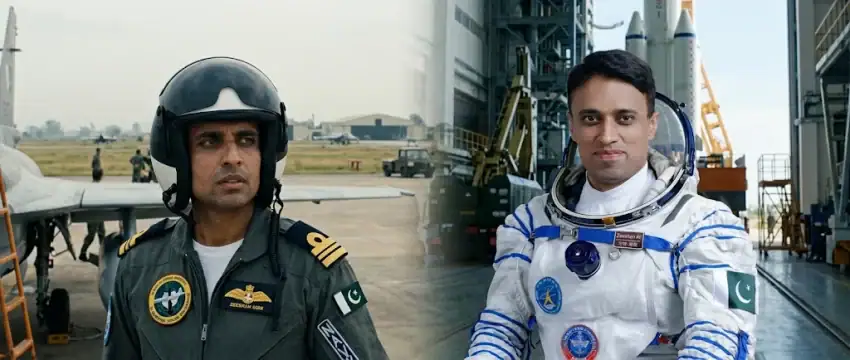
ISLAMABAD/BEIJING – From serving as Pakistan Air Force fighter jet pilot to preparing for historic journey into space, Muhammad Zeeshan Ali has come a long way. At 40, he becomes first Pakistani astronaut on an orbital space mission, earning a place aboard China’s Tiangong Space Station.
China picked Zeeshan for its Shenzhou-24 mission, making him the first international astronaut to join a Chinese crew travelling to the Tiangong Space Station. But who exactly is Muhammad Zeeshan Ali, how did he qualify for this extraordinary assignment, and what will he do during his time in space?
Pakistani Astronaut Zeeshan Ali
Zeeshan Ali previously served as a pilot in Pakistan’s armed forces before entering the country’s astronaut selection programme. His aviation background provided an important foundation for the demanding requirements of human spaceflight, where technical knowledge, physical endurance and the ability to respond to emergencies are essential.
His journey towards space began under a cooperation agreement signed between Pakistan and China in February 2025. The arrangement established a framework for selecting and training Pakistani candidates for China’s human spaceflight programme.
After a rigorous selection process, two Pakistanis, Muhammad Zeeshan Ali and Khurram Dawood, were shortlisted in April 2026. Both candidates subsequently travelled to China and underwent specialised training at the country’s Astronaut Centre. Their preparation involved spacecraft operations, scientific research, physical conditioning and emergency response procedures.
Zeeshan Ali secured the opportunity to represent Pakistan in the historic mission, while Khurram Dawood also earned recognition for reaching the final stage of the selection process.
Although Zeeshan Ali had previous experience as a fighter pilot, adapting to China’s space programme presented an entirely different set of challenges. His training included centrifuge exercises, rescue and survival drills, emergency procedures and simulations designed to prepare astronauts for the physical demands of space travel.
However, learning Chinese proved to be one of the most difficult parts of his preparation. In an interview shared by China’s space programme through its social media channels, Zeeshan explained that almost everything inside the spacecraft operates in Chinese. From switches and software systems to onboard programmes and voice announcements, astronauts must understand technical instructions accurately to perform their duties.
He therefore had to learn both everyday Chinese and specialised terminology used in spacecraft operations. Despite these challenges, he praised his Chinese crewmates for their cooperation and professional attitude, saying they respected his opinions and worked together to find solutions whenever difficulties arose. He also termed friendship among the crew as per all weather friendship Sino-Pak ties.e Into Space’
For Zeeshan Ali, the upcoming mission is about more than an individual achievement. He believes he is carrying the hopes and expectations of millions of Pakistanis as he prepares to leave Earth. In a statement shared by Shanghai Daily on social media, the Pakistani astronaut said: “As a Pakistani, I am taking the dreams of the Pakistani people with me into space.”
He added that people in both Pakistan and China had placed their expectations in the mission and that their joint efforts in space would contribute to the future of humanity. His statement added national dimension to an achievement that could open new opportunities for Pakistani scientists and researchers.
Zeeshan Ali will not simply be travelling to space as an observer. He has been trained for role of payload specialist, meaning his primary responsibility will involve conducting scientific experiments aboard the Tiangong Space Station. Pakistan’s space agency, the Space and Upper Atmosphere Research Commission (SUPARCO), received more than 300 research proposals from universities and scientific institutions across the country.
After an evaluation process, four Pakistani scientific experiments were selected for the mission with the involvement of Chinese experts. The research will primarily focus on biotechnology and biological sciences, with potential applications in food security, climate change research and future space exploration.
The mission will involve four scientific projects related to biotechnology and materials science, including research into photosynthetic microorganisms. These experiments are expected to provide researchers with opportunities to examine scientific processes under the unique conditions of space. Zeeshan will spend around one week aboard the Chinese space station, considerably less than the six-month missions commonly undertaken by Chinese astronauts.
China’s Manned Space Agency officially confirmed Zeeshan Ali’s participation on November 24, announcing the three-member crew for the Shenzhou-24 mission.
The crew consists of Tang Hongbo: Mission commander, Wu Yi: Flight engineer, and Muhammad Zeeshan Ali, the Payload specialist and Pakistan’s representative. The spacecraft is scheduled to launch on November 25 from the Jiuquan Satellite Launch Centre in northwestern China.
China has also made specific arrangements to accommodate the Pakistani astronaut during his stay aboard the space station. Operational instructions have been prepared in both Chinese and English to ensure effective communication and coordination between crew members. Another notable arrangement involves food. Chinese authorities have organised halal space meals in consideration of Zeeshan’s dietary requirements.
Launch centre officials have also introduced special monitoring measures to maintain suitable environmental conditions during the final stages of mission preparation. Temperature and humidity levels are being monitored through an intelligent system to ensure that the launch facility meets the required operational standards.
Pakistan does not currently have its own human-rated spacecraft or launch vehicle capable of independently sending astronauts into orbit. This means the country is relying on China’s spacecraft, launch infrastructure, training facilities and technical expertise for the mission. However, the opportunity represents much more than a symbolic space journey.
It provides Pakistani scientists with access to international research facilities and offers the country’s emerging space programme valuable experience in human spaceflight operations. Citizens from around 50 countries have travelled into space. However, only the US, Russia and China possess independent capabilities to send humans into orbit using their own spacecraft.
China completed construction of its Tiangong Space Station in 2022 and is increasingly opening its space programme to international cooperation. The partnership with Pakistan is also expanding beyond astronaut training.
China previously helped launch Pakistani satellites, while another ambitious project involves sending a Pakistan-developed rover to the Moon through China’s Chang’e-8 lunar mission, currently planned for around 2028.