
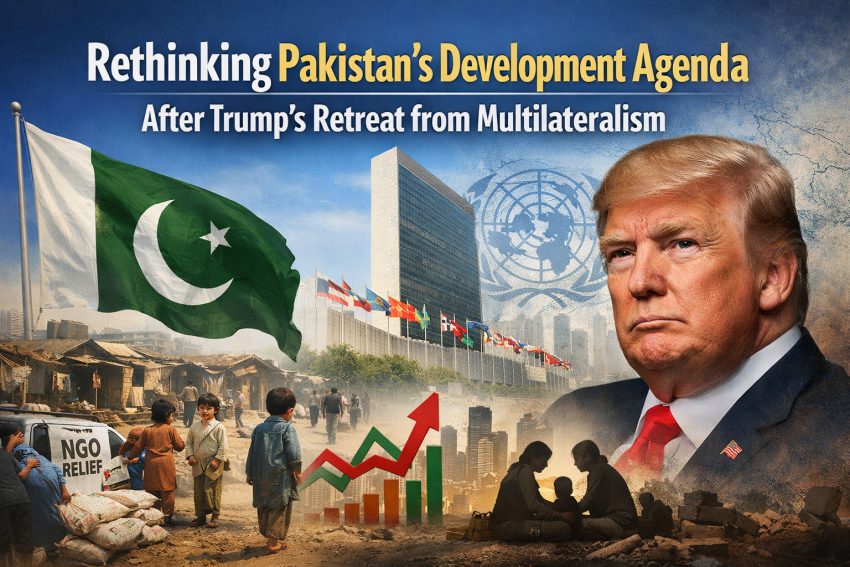
For over four decades, Pakistan’s development and poverty-reduction landscape has been shaped by financial and technical assistance from the UN agencies, the United States and Western countries. Non-profit organisations (NPOs) have served as the backbone of this engagement, translating donor priorities into interventions in climate change, poverty reduction, livelihoods, education, health, human rights, governance, gender, disaster response, Physical Infrastructure, interfaith harmony, youth engagement and social protection. Today, however, this relationship is undergoing a fundamental shift, one that is redefining not only funding volumes but also the very fundamentals of development cooperation.
The direction of US and Western countries’ funding for Pakistan is no longer expanding or even stable. It is contracting, becoming increasingly selective, and far more transactional. This transformation carries serious consequences not only for NPOs working in these thematic areas but also for millions of people living in poverty, whose well-being depends on sustained development interventions.
Donor Fatigue in a Fragmented World
One of the most obvious drivers of this change is donor fatigue. There is a growing Public aversion to funding for overseas aid, particularly long-term development assistance to poor countries. Western governments are facing increasing domestic pressures due to internal economic slowdowns, political divergence, uncontrolled inflation, insufficient funding for health care, ageing populations, and local welfare.
In recent times, global crises have multiplied, especially the Ukraine war has affected many Western economies, and there are conflicts, large-scale displacement, and accelerating climate disasters that have redirected Western attention and resources toward regions considered more important to their strategic priorities. Pakistan, once central to Western geopolitical calculations, now occupies a peripheral position in donor priorities.
This scenario has led to a steady reduction in large, multi-year development programmes historically supported by donor agencies such as USAID, FCDO, GIZ, and the European Union (EU). Development assistance is now increasingly framed not as a long-term partnership for structural poverty reduction, but as a short-term tool for managing migration, peace and exerting political pressure on the recipient country.
The Trump Legacy and the Retreat from Multilateralism
Under President Trump’s restructuring plans, the United States withdrew from 66 global agreements, protocols, UN Conventions, UN agencies, and effective programmes in climate change, global health, disaster migration, human rights, and development cooperation.
The United States’ sudden withdrawal from the international multilateral framework and the prioritisation of national sovereignty have weakened the multilateral financing architecture for global development, which has been pivotal to global efforts in poverty reduction and the well-being of the poor. Consequently, it reduces US participation in global affairs and systemically damages the pooled global funding mechanisms. These were a few of the key channels through which countries like Pakistan accessed international development assistance for institutional reforms, poverty alleviation, infrastructure projects, etc.
For countries such as Pakistan, this sudden withdrawal by the USA resulted in less predictable and more fragmented funding flows. European donors, already stretched by crises closer to home, responded by narrowing member countries’ portfolios, tightening eligibility criteria, and thereby concentrating funds in fewer thematic areas and shrinking fund size, focusing more on strategically motivated projects. The cumulative effect has been a sharper decline in available funding for long-term poverty reduction programmes in developing countries.
Shifting Donor Priorities and Narrowing Focus
Another defining feature of the current funding landscape is the shift in thematic priorities. Traditional development sectors, namely rural livelihoods, basic education, agricultural development, and community-based poverty alleviation, are steadily losing ground.
Donor agencies have replaced them with climate change, counter-extremism, peace building, anti-migration, gender-based violence, rights-based advocacy, and digital governance, to name a few. While these areas are important, the imbalance for Pakistan is concerning. Poverty remains deeply entrenched in inequality, disparity and limited economic opportunities. Fueled by the government’s inability to adequately collect taxes, document the informal economy, and implement corrective measures to address symptomatic economic issues without addressing the underlying foundations, risks shallow outcomes.
European development cooperation, largely channelled through the European Union (EU) funding mechanism, has also become increasingly aligned with political interests, regulatory compliance, and migration management. EU Funding now favours short-term pilots, policy, experimentation, and reporting-heavy interventions over scale, continuity, and real indigenous grassroots impact.
A Shrinking Space for Local NPOs
Perhaps the most damaging consequence of these shifts in funding mechanisms is the shrinking operational space for Pakistani NPOs, compounded by strict government regulatory compliance. While the funding size and duration of projects have shrunk, making it more cumbersome due to an extensive compliance mechanism. Smaller and mid-sized organisations, especially those rooted in rural and marginalised regions, are being edged out by large international NGOs and consultancy-style actors that are better equipped to navigate complex donor requirements and articulate superior proposals.
Consequently, the trust between donors and local civil society has eroded. A more client and contractor relationship has evolved, overtaking partnership relations. While accountability is essential, excessive proceduralism kills innovation, and local ownership in response to community needs is no longer a priority.
It’s a stark paradox at a time when poverty, inequality, discrimination and climate vulnerability is growing, the institutions most capable of addressing these issues are struggling to sustain themselves.
The Way Forward
Western development assistance to Pakistan is largely a nostalgic relic, unlikely to return to earlier levels, and expecting a restoration of past funding patterns would be strategically naïve. Yet within this difficult and disastrous moment for organisations lies an opportunity. What is required now is strategic realism, a clear-eyed reassessment of how development work is financed, governed, and owned.
First, Pakistani NPOs must move beyond dependence on foreign donors and toward diversified funding models, stronger domestic resource mobilisation, and partnerships rooted in local priorities, to ensure that support for poor communities remains central. Diversification toward domestic philanthropy, social enterprise, provincial partnerships, and South-South cooperation is no longer optional; it is essential.
Second, it is now clearly established that community- and village-level projects undertaken by NPOs cost substantially less than those implemented by government contractors. Therefore, it is important that governments rebuild trust with local NPOs. More funding should flow to NPOs through simplified procedures and genuine investment in institutional capacity, rather than relying solely on short-term outputs.
Third, the state plays a critical role. A coherent national framework that is supportive and facilitative of civil society engagement and public-interest partnerships with NPOs can restore confidence, strengthen local ownership, and reprioritise the national interest in development strategies.
A Closing Reflections
The changing direction of US and European funding should not be viewed merely as a loss. Though it is a setback, it is also an opportunity. If Pakistan’s development sector continues to operate on outdated assumptions of donor generosity, it risks irrelevance. However, if it uses this moment to rethink priorities, partnerships, and power dynamics, a more resilient and locally grounded development model can emerge.
The question is no longer whether Western aid will decline; it already has. The real question is whether the Pakistani NPO sector is prepared to lead its own indigenous development agenda in the changing world order?
The writer is the CEO of the IRM and has over 30 years of experience in institutional strengthening, capacity development, and policy implementation. He has advised the United Nations, World Bank, and development agencies, and now chairs networks on human development, climate action, and philanthropy. He holds a PhD in Anthropology, a master’s from New Jersey Institute of Technology, and executive education from Harvard Business School.