If you tune into any global news network right now, it feels like the Middle East is just one errant spark away from a total explosion. With the ongoing, fierce standoff between Iran and the US-Israel alliance eating up headlines, global energy markets are sweating. But for Pakistan, let’s be frank—this is not just an evening TV drama. It is a very real threat to the national economy. When nearly 90 per cent of your country’s trade and the vast majority of its oil come floating across these exact volatile waters, a very serious question demands to be asked: how exactly does a developing nation secure its bread and butter without driving blindly into a foreign warzone?
The state recently offered its answer. And from an editorial perspective, it shows exactly the kind of level-headed, street-smart statecraft the public desperately wants to see.
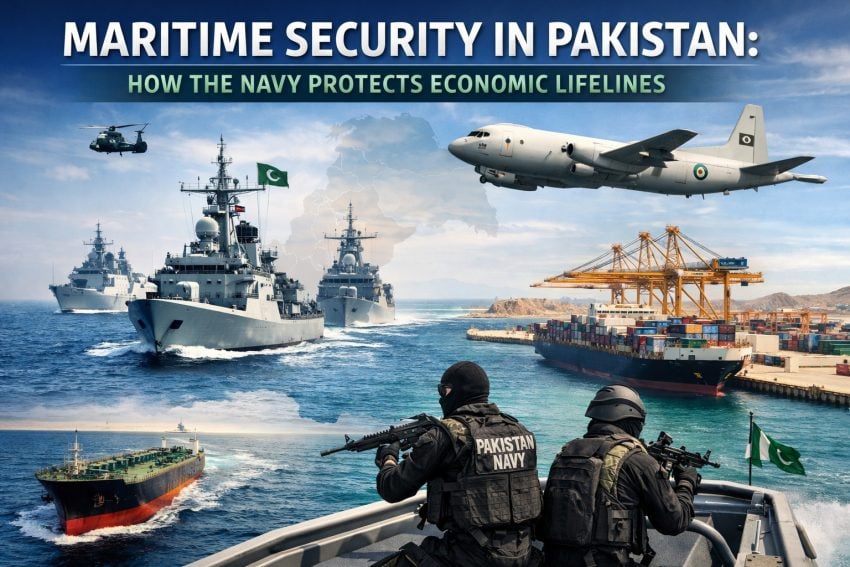
To safeguard commercial lifelines, the Pakistan Navy launched Operation Muhafiz-ul-Bahr. Working hand in glove with the state-owned PNSC, the Navy has deployed vessels to escort our merchant ships plying the crucial Karachi-Gulf and Karachi-Red Sea routes. For the common man stressing over inflation or next month’s petrol prices, this provides immense relief; the supply chains are being protected. But when analysing the shifting pieces on the regional chessboard, the sheer brilliance of this military deployment lies entirely in what the Navy is refusing to do.
Earlier this week, well-placed security officials made a critical point to the press, setting a hard boundary. They categorically stated that Pakistan Navy escorts will not enter or pass through the heavily contested Strait of Hormuz.
One really has to pause and ask: Why is drawing that specific geographic line such a big deal?
If you look at the map, the Strait of Hormuz is the ultimate global chokepoint. It handles a fifth of the world’s oil, and right now, it is the exact arena where Iranian warnings and American-Israeli gunboats are locked in a high-stakes staring contest. Why in the world should Islamabad drive its sovereign frigates straight into that chaos? What sense does it make to risk a stray missile, a catastrophic miscalculation, or severe diplomatic blowback over a conflict that simply is not ours?
It is profoundly reassuring to witness the country’s leadership asking itself these exact questions and coming back with the right answers. We all know the history of this region. Emerging nations are constantly pressured, coaxed, or bullied into serving as proxies for the proxy wars of bigger powers. But not this time. By explicitly saying “we stop here” with Operation Muhafiz-ul-Bahr, Pakistan chose defensive pragmatism over toxic military adventurism.
Just look at the sheer panic rattling the global maritime industry right now. Freight companies are terrified, furiously rerouting ships away from the Gulf, while marine insurance premiums are rocketing through the roof. If left completely unchecked, that global market panic would smash into Pakistan’s domestic economy, leading to delayed cargo, crippled supply chains, and brutal fuel hikes. By putting grey hulls in the water to patrol our own sea lanes—and carving out a safe, secure corridor away from the actual war zone—the state is sending a powerful message to the global market: Pakistani ports are safe, and the routes to them are protected.
Isn’t this the ultimate definition of true national sovereignty?
You don’t project strength by jumping into a burning building you have no business being in; you project it by making sure the fire doesn’t reach your own backyard. Islamabad is walking a brilliant diplomatic tightrope right now—staying relatively quiet regarding the Middle Eastern hostilities while fiercely locking down what actually matters: our trade, our oil imports, and the economic sanity of our citizens.
No government on earth can control the geopolitical storms brewing in its neighbourhood. The only thing a nation can control is how it steers its own ships when the water gets rough. With this specific, boundary-conscious operation, the Pakistan Navy is doing just that. They are guarding our goods, ignoring the surrounding bait, and staying entirely focused on home. For any observer watching how state institutions handle crises, this cool, calculated maturity is exactly the kind of leadership that deserves a nod of respect.