
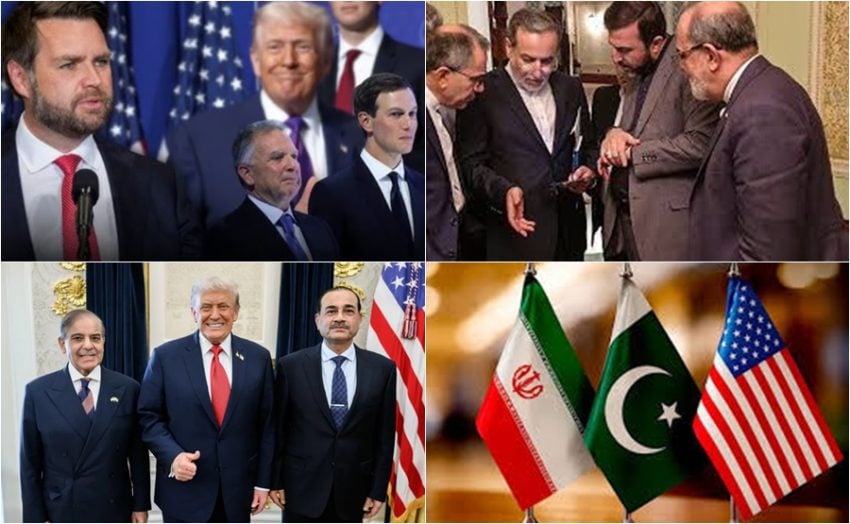
I want to be honest with you about something the morning headlines will probably bury under the weight of the word “failure.” The talks in Islamabad ended without a deal. Vice President JD Vance boarded Air Force Two just after 7 a.m. local time, exhausted and empty-handed, after more than twenty-one hours of combined diplomacy spanning backchannels, shuttle sessions, and what became a gruelling twenty-one-hour final negotiating marathon between two countries that have not sat across a table from each other at this level since the Iranian Revolution of 1979. Iran would not yield on its nuclear program. The United States would not blink on its red lines. The gap, in the end, proved too wide.
But here is what I cannot let pass without remark: Pakistan — a country that the Western foreign policy establishment has spent the better part of two decades treating as a problem to be managed rather than a partner to be cultivated — pulled off something that no one else could. It got Washington and Tehran into the same room.
Let that land for a moment.
Analysts have spent years cataloguing Pakistan’s complications: its fraught relationship with the IMF, its domestic political turbulence, its complicated geography between nuclear rivals. Nobody was writing think pieces about Islamabad as the indispensable broker in the most consequential diplomatic standoff of this decade. And yet, when the United States was bombing Iran and the Strait of Hormuz was closed and global energy markets were teetering, it was Pakistan’s Foreign Minister Ishaq Dar shuttling between delegations, Pakistan’s army chief General Asim Munir leveraging his personal relationship with the Trump administration, and Pakistan’s Prime Minister Shehbaz Sharif making the public appeal that — quite literally — reversed a stock market freefall and bought the world ninety minutes of breathing room before Trump’s deadline expired.
That is not a minor diplomatic footnote. That is statecraft.
Third-party observers noted that this was the first time in recorded modern diplomatic history that Pakistan had simultaneously mediated an active military conflict between two adversaries with no direct contact between them amid ongoing military escalation. Iran’s ambassador to Pakistan described the process as “positive and productive.” Chinese, Egyptian, Saudi, and Qatari officials quietly made their way to Islamabad not to compete but to assist — a tacit acknowledgement that Pakistan had the trust no one else possessed.
I sat with the arc of this effort over the last several days and kept returning to a single question: what made Pakistan the one country both sides would accept? Part of it is structural. Pakistan has no diplomatic relationship with Israel, which freed it from the perception of bias that dogged American allies. Part of it is personal. The relationship between General Munir and the Trump inner circle — cemented during Pakistan’s cooperation on the Abbey Gate bombing suspect and validated during the India-Pakistan crisis last May — gave Islamabad a direct line to the Oval Office. Part of it is simply geography: a Muslim-majority nuclear state with relationships across the Gulf and with Iran, capable of credibly conveying that it had skin in this game.
But credit also belongs to the unglamorous grind of the work itself. Twenty-one hours of continuous diplomacy, I am told by sources familiar with the process, involving multiple sessions, revised frameworks, and at least one wholesale redrafting of Iran’s ten-point counter-proposal into language both sides could approach without publicly losing face. Pakistan’s mediators worked through nights and past sunrises. They absorbed the frustration of both delegations. They held confidences that they have declined — with admirable discipline — to break.
Vance acknowledged it plainly in his remarks at his departure. Whatever shortcomings existed in the negotiations, he said, they were not because of the Pakistanis, who “did an amazing job and really tried to help us and the Iranians bridge the gap, and get to a deal.” From an American Vice President departing a failed summit, those are not words spoken lightly.
Does it count as success if no deal was signed? Diplomatically, the honest answer is: it depends on what comes next. The ceasefire, fragile as it is, still holds as of this writing. Both sides know, with precision, where the other stands — not through intermediaries and speculation, but from direct engagement. The parameters of a potential agreement are, for the first time, not hypothetical. Vance left Iran with what he called a “final and best offer.” That offer exists because Pakistan created the conditions for it.
Mediation is not a referee calling fouls. It is the harder art of making conversation possible between people who have every incentive not to talk. By that measure, Pakistan did not fail in Islamabad. Pakistan delivered. The parties themselves, burdened by their domestic audiences, their historical grievances, and the maximalist positions those pressures demand, could not close the distance. That is their responsibility, not Islamabad’s.
Whether this week becomes our new standard or just a high-water mark, it feels like the beginning of a much-needed story—one where Pakistan is defined by its potential rather than its past. I am so proud to say that when the world needed a steady hand, Pakistan showed up. We outdid ourselves, proving that we have the poise and the sincerity to lead. We walked away with credibility, the kind that can’t be bought or forced, only earned. Being an ‘honest broker’ in such a complicated world is a massive win, and it’s a role Pakistan was born to play.