
ISLAMABAD – Pakistan conducted series of nuclear tests in 90s in Chaghai region of Balochistan, adding another chapter in the country’s strategic and scientific history.
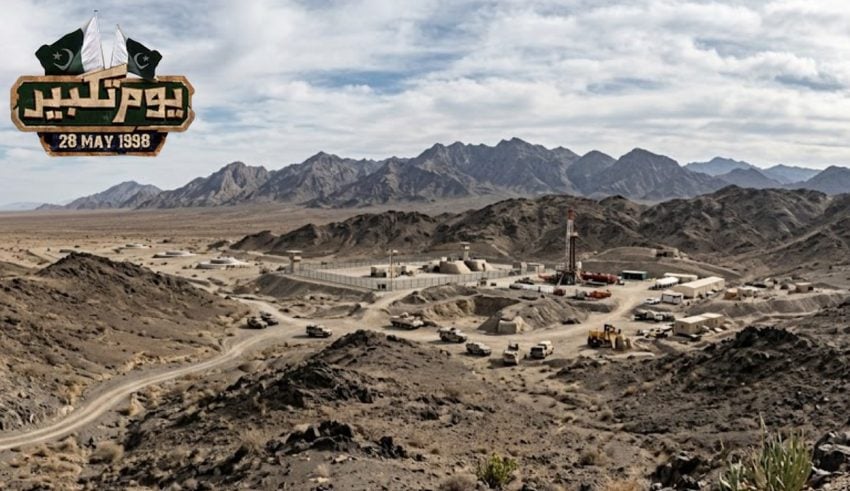
The site of testing, Chagai region, lies in northwestern Balochistan, where the landscape dissolves into rock, sand and silence. The district is Pakistan’s largest region by area and bordering Afghanistan and Iran, and is sparsely isolated. It was precisely this isolation, along with its rugged geology, that led to its selection for Pakistan’s nuclear tests.
The region lies at Ras Koh mountain range, stretching roughly 200 kilometres along the district’s southern edge. Beneath its barren rock, in an area near the village of Chattar and the locality of Dostan Wadh, preparations were carried out in deep secrecy for what would become a defining moment in the country’s strategic history.
According to accounts cited in technical and historical works, the site was chosen for its remoteness, sparse population, and solid rock structure — conditions considered suitable for containing underground nuclear detonations and limiting the spread of radioactive material. Nearby settlements, home to only a few hundred residents, were quietly evacuated in advance.
Engineers constructed a long underground tunnel, described in accounts as a fishhook-shaped shaft stretching approximately 3,000 feet, where multiple nuclear devices were assembled. Diagnostic systems were installed to monitor the impending detonations. By 26 May, the tunnel was sealed with thousands of sandbags and cement sacks, and engineers later confirmed the structure was stable enough to contain the blast.
The operation remained tightly controlled, with around 200 local residents relocated from surrounding areas before final preparations were completed.
At around 3:16 PM on 28 May 1998, five underground nuclear devices were detonated simultaneously beneath the Ras Koh hills. There were temors as dust rose into the sky and the rocky terrain was transformed in seconds. The black granite of the mountains was reportedly covered in pale dust as shockwaves rippled through the region.
Two days later, on 30 May, a sixth nuclear test was conducted in the Chaghai desert region, reportedly under a separate scientific leadership structure.
In the hours following the tests, senior officials and scientists gathered at the site. Despite known institutional rivalries between leading nuclear institutions, accounts from observers describe a moment of collective relief and unity among those present.
It was remarkable example of teamwork as technical challenges had been resolved collectively under intense pressure during the approximately 10-day field operation. That evening, Prime Minister Nawaz Sharif addressed the nation, announcing the success of five nuclear tests and declaring that Pakistan had secured its strategic deterrence.
Today, Chaghai remains as remote and sparsely populated as ever, but its place in Pakistan’s national narrative is permanently altered. What unfolded in the silent mountains of Ras Koh in May 1998 was not only a scientific achievement, but also a moment shaped by geopolitical pressure, institutional competition, and high-stakes decision-making.
Pakistan Civil, Military Leadership reaffirms nuclear deterrence posture on Youm-e-Takbeer