
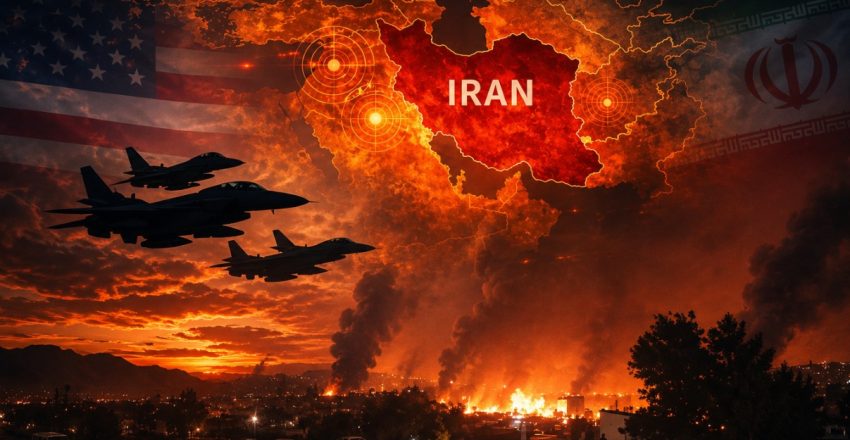
TEHRAN – United States launched its 7th consecutive night of military strikes on Iran, intensifying the rapidly escalating conflict that is spreading across Middle East. US Central Command (CENTCOM) said the operation aimed at further denting Iran’s military capabilities.
Blasts rocked Iran overnight, with at least five explosions reported in the central city of Yazd, and several southern provinces, showing the expanding scope of US offensive campaign.
Iranian media said the latest US strikes targeted key infrastructure, including bridges, a maritime control tower, electricity facilities, and desalination pumps in the southern city of Jask, Hormozgan province. The attacks are expected to disrupt essential services in the region.
At least three Iranians were killed in the latest wave of US strikes as military operations expanded beyond southern Iran into central parts of the country. Satellite imagery revealed fresh damage inside Iran’s Bushehr nuclear power plant complex, adding to growing international concern over the safety of critical nuclear infrastructure.
Iran Strikes Back
The conflict between Iran and US took another turn as Tehran launched ballistic missile at a US military base in Saudi Arabia, marking its first direct strike on the Gulf kingdom in nearly four months.
A report shared by Axios said the attack was confirmed by a US official. While officials did not disclose which US installation was targeted, the reported strike signals a significant expansion of the ongoing regional confrontation. Authorities have yet to release details on casualties, damage or the missile’s impact, leaving questions over the scale of the attack unanswered.
🔴IRAN 🇮🇷-SAUDI ARABIA 🇸🇦|#Iran fired ballistic missiles at #SaudiArabia overnight on Friday, July 17 : US bases in the Kingdom were hit, and massive fires are currently burning. These are the first direct strikes of Iran on the Saudi Kingdom territory in four months. pic.twitter.com/ULuMzYLJBo
— Nanana365 (@nanana365media) July 18, 2026
The reported strike is the first direct Iranian attack involving Saudi Arabia since early April, when Tehran targeted the Jubail petrochemical complex during an earlier wave of regional hostilities.
As US attacks intensified, Tehran announced a fresh round of retaliatory operations targeting American military assets across the Gulf. Drone strikes were launched against several US military installations in Kuwait and Jordan. Iranian media identified reported targets as Camp Udairi’s ammunition depot, headquarters buildings and ammunition storage at Ali Al Salem Air Base in Kuwait, and military fuel tanks at Muwaffaq Salti Air Base in Jordan.
Iran also claimed its missile strikes hit US fighter aircraft stationed in Jordan, although no independent confirmation has been provided. Kuwaiti authorities said several military personnel were injured during the attacks, while Jordan confirmed it had responded to aerial threats. Air raid sirens also sounded three times in Bahrain, underscoring fears that the conflict is drawing more Gulf states into the confrontation.
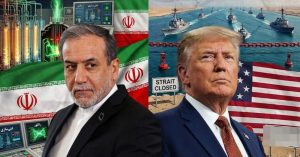
Tensions also escalated in one of the world’s most strategically important waterways. Iranian media reported that two oil tankers exploded and caught fire after passing through alleged minefields in Hormuz. US military rejected claims by Iran’s Islamic Revolutionary Guard Corps (IRGC) that the vessels struck naval mines, calling the allegation false.
IRGC said it targeted a Thai-flagged commercial vessel after accusing it of attempting to transit the Strait of Hormuz without authorization and ignoring repeated warnings. Any prolonged disruption in the waterway could have significant implications for global energy markets.
Senior Iranian officials signaled that the conflict could enter an even more dangerous phase. Iran’s Supreme Leader’s aide warned that Tehran could abandon its defensive posture if US military operations continue. He said any attempt by Washington to seize Iranian territory would trigger offensive military action, adding that several more days of US strikes could push Iran into what he described as a “full-scale offensive.”
Pakistan rules out reports of Withdrawing From US-Iran Peace Efforts