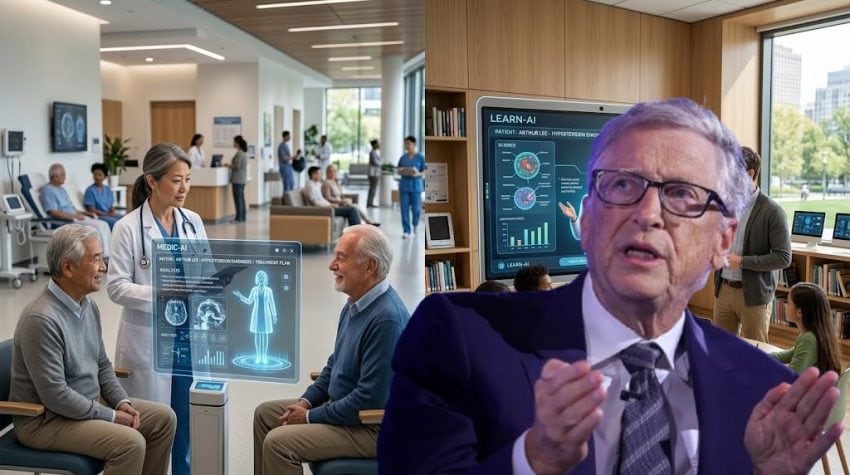
WASHINGTON – Microsoft co-founder Bill Gates issued stark warning about rapidly advancing artificial intelligence (AI), predicting that the technology could eventually replace doctors, teachers, and workers across several major professions.
Gates, who has repeatedly spoken about the transformative potential of AI, said the pace of technological development is now so rapid that governments and societies may not be adequately prepared for the disruption ahead.
In a recent article published on his blog, Gates argued that some professions should effectively be “reserved” for humans even as AI and robotics become increasingly capable. He particularly highlighted medicine, warning that while AI could dramatically improve healthcare, there should still be situations where human expertise remains indispensable.
Gates asked readers to imagine a future in which a robot delivers devastating medical news to a patient, arguing that certain deeply human responsibilities should not simply be handed over to machines.
He previously made an even more striking prediction about the future of healthcare and education. Speaking in March 2025, he said that within the next decade, AI could become capable enough to perform many tasks currently carried out by humans, including those of doctors and teachers.
According to Gates, human specialists remain essential in fields such as medicine and education today, but that could change dramatically as AI systems become more sophisticated.
His prediction suggests that future AI systems could potentially diagnose illnesses, provide medical guidance and perform other tasks traditionally associated with healthcare professionals. In education, AI could similarly take on increasingly sophisticated teaching responsibilities, potentially providing personalized instruction and assistance to students on a scale that would be difficult for human teachers to match.
Gates already warned in February 2025 that AI and virtual assistants could transform almost every aspect of life, including significantly improving disease diagnosis.
Gates has described the speed of AI development as both exciting and unsettling. “This is happening very quickly,” he said, warning that the pace of progress can be frightening.
In September 2024, he described AI as the first technology he had seen that was advancing even faster than experts had anticipated. He also argued that AI could ultimately have a greater impact than computers, smartphones and the internet, calling it the biggest technological advancement of his lifetime.
In his latest article, Gates compared the idea of protecting certain professions for humans to preserving natural areas from human activity. He said governments should establish frameworks determining where AI should be used and where human involvement must remain essential.
His warning goes far beyond employment. Gates said AI could reshape jobs, education, healthcare, energy, elections, public health, financial systems, law enforcement, transportation, air and water resources, and national security. He stressed that governments worldwide are not yet prepared for the scale of these changes.
Gates called for international as well as national AI frameworks and said cooperation between the United States and China would be necessary to manage the technology’s global impact.
Gates also predicted that AI could fundamentally change the traditional working week. As machines become capable of handling more tasks, he believes the need for conventional full-time employment could decline and working hours could eventually become shorter.