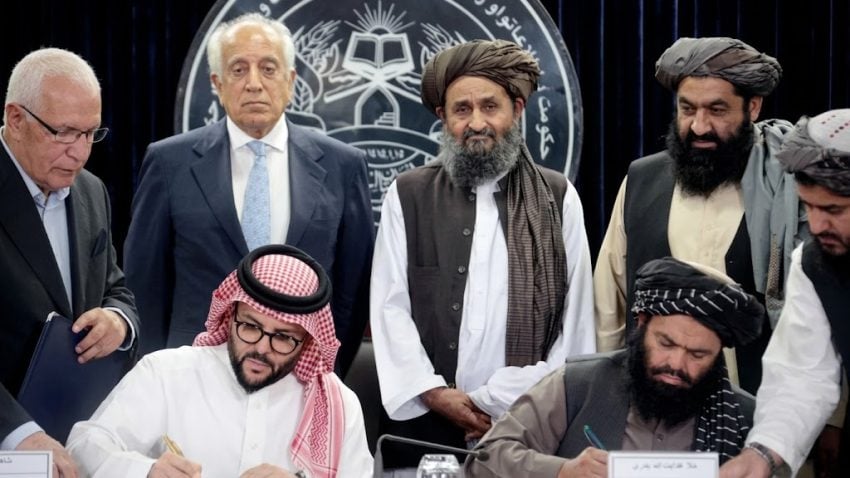
KABUL — Afghanistan’s Taliban led regime signed oil and gas exploration and extraction agreement with Saudi company Delta International, putting the country’s untapped energy reserves of war torn nation and growing regional economic ties back in the spotlight.
The agreement was signed in Kabul by Taliban Minister of Mines and Petroleum Hedayatullah Badri and Delta International CEO Shaher Al-Taqi, with Taliban Deputy Prime Minister Mullah Abdul Ghani Baradar and former US Special Representative for Afghanistan Zalmay Khalilzad among those attending the ceremony.
Under the deal, Delta International will explore for and extract oil and gas in the Kushk-Tirpul area, a vast region spanning around 22,000 square kilometers across Herat and Badghis provinces.
Saudi oil giant is expected to initially invest $200 million in the exploration and extraction of gas from seven blocks, with the exploration phase set to continue for eight years. The overall agreement will run for 25 years, potentially giving the Saudi investor a long-term foothold in Afghanistan’s energy sector.
Afghanistan’s Ministry of Mines and Petroleum says much of the area’s reserves consist of natural gas, raising hopes that successful production could help the cash-strapped country reduce its dependence on imported petroleum products.
Zalmay Khalilzad’s Rare Presence gets unwanted attention
The deal attracted attention for another reason as Zalmay Khalilzad’s spotted at the signing ceremony. Afghan-born former US diplomat, who previously served as US Special Representative for Afghanistan Reconciliation, attended the ceremony alongside senior Taliban officials and the Saudi company’s leadership.
Khalilzad described the agreement as evidence that Kabul is ready to attract major investment into its natural resources. He said Afghanistan managed to secure major investment aimed at developing its resources, particularly natural gas, while also creating opportunities for transportation and exports beyond the country.
However, neither the Taliban government nor the Saudi company has officially explained Khalilzad’s role in the negotiations, leaving his presence open to speculation.
Khalilzad previously appeared alongside Delta International officials during discussions with Taliban authorities. In November last year, Delta International CEO Shaher Al-Taqi met Mullah Abdul Ghani Baradar in Kabul alongside Khalilzad. Discussions reportedly focused on oil and gas exploration, extraction and transportation pipelines.
Khalilzad also traveled to Afghanistan with a US delegation in March last year following the Taliban’s release of an American citizen who had reportedly been held hostage for two years.
The agreement triggered intense debate over whether Saudi Arabia is beginning to expand its economic engagement with Taliban-ruled Afghanistan, which continues to allow TTP and other splinter groups who are attacking Pakistan using Afghan soil.
Despite Pakistan’s rift with Taliban led regime, Riyadh is deepening strategic and military relationship with Pakistan and the investment is apparently part of a broader regional shift.
The development could become particularly sensitive amid continuing tensions between Islamabad and Kabul, and increased Saudi economic and political engagement with Kabul may not be viewed positively in Islamabad.
Saudi Arabia playing backdoor role in Pakistan–Afghanistan’s crisis