
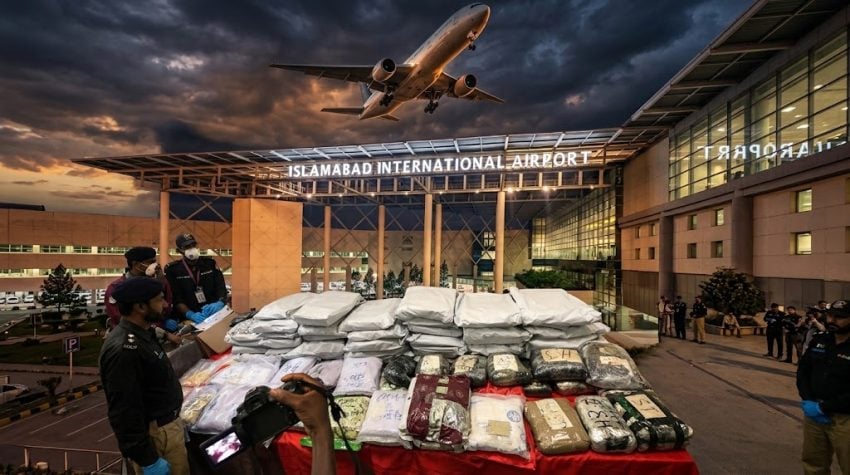
ISLAMABAD — A string of major narcotics seizures around Islamabad puts the capital’s airport and surrounding transport routes under the spotlight, with Customs authorities reporting drug consignments collectively worth billions of rupees.
The most dramatic operation came in early hours of October 2, when Customs officials intercepted a vehicle near M-2 Motorway carrying approximately 1,200 kgs of cannabis (charas), along with around 100 kgs of poppy seeds.
The seized drugs had an estimated international market value of around Rs5.40 billion. Once the seized vehicle and other items were included, the total value was put at approximately Rs5.41 billion. The operation was carried out by the Anti-Smuggling Squad of the Collectorate of Customs (Enforcement), Islamabad, following what authorities described as credible intelligence about the movement of a large narcotics consignment.
But the suspects were gone before the net could close. According to Customs, the accused abandoned 2005-model Toyota Prado and fled into the darkness as the enforcement team moved in. A firearm was also recovered, while the vehicle was taken into Customs custody for being non-customs-paid.
A case has been registered against unidentified suspects under the Control of Narcotic Substances Act, 1997, and the Customs Act, 1969. Investigators are now attempting to identify the people behind the consignment and determine the wider network responsible for transporting it.
The motorway raid came amid series of seizures at Islamabad International Airport. On September 26, Pakistan Customs announced the interception of approximately 35 kilograms of suspected hashish/charas from the luggage of a passenger arriving on Thai Airways flight TG-349. Customs estimated the value of the seized material at more than Rs660 million and registered an FIR against the passenger.
Authorities said the operation was intelligence-led and that investigators were examining both the source of the narcotics and their intended destination. The airport action was followed by further seizures reported in early October.
Authorities recovered 47 kgs of suspected drugs in two separate operations. One involved Thai national identified as Naeehaphong Pueehykosai, from whom officials reportedly recovered approximately 23 kilograms of suspected cannabis or weed following surveillance and a detailed luggage check. That consignment was valued by officials at approximately Rs31 million.
Customs reportedly recovered another 24 kgs of canabis, with officials placing its international market value at approximately Rs310 million. Both operations followed intelligence or tip-offs, and legal proceedings were initiated against the passengers.
Customs also reported a further 55-kilogram hashish seizure worth approximately Rs550 million involving an incoming passenger on September 28, adding another layer to the rapidly developing picture at the airport.
The figures emerging from different reports do not always align perfectly. Some accounts combine or distinguish individual airport seizures differently, while valuations for apparently similar quantities also vary sharply. For that reason, the reported Rs970 million figure for two major airport seizures should be treated as a reported calculation rather than a definitive Customs-wide total.
Within days, Customs officials reported recovering tens of kilograms of suspected narcotics at Islamabad Airport, followed by a spectacular 1,200-kilogram charas haul on the M-2. And the motorway seizure alone dwarfs the airport interceptions in physical scale.
Rather than random roadside or passenger checks, authorities repeatedly described the seizures as the result of credible information, surveillance, or intelligence-based targeting. At the airport, a special vigilance team was reportedly assembled under the supervision of the Assistant Collector of Customs. On the motorway, Customs officials acted on information concerning the transportation of a substantial narcotics consignment.
CSS aspirant arrested for supplying drugs to Islamabad college students
The pattern suggests that enforcement agencies are attempting to disrupt trafficking not merely by intercepting individual couriers, but by identifying consignments as they move through key entry points and transport corridors.
The repeated appearance of Thailand-linked arrivals has also drawn attention. September 26 seizure involved Thai Airways flight TG-349, while subsequent airport reporting again identified passengers arriving from Thailand.
That does not, on the available evidence, establish that all of the cases form part of a single trafficking network. Nor does it prove that the individual airport seizures were connected to one another. But the recurrence has made international passenger routes an important part of the current investigation picture.
For Customs, the immediate task is no longer simply counting kilograms. The more important question is who was behind the consignments, where the drugs originated, where they were headed, and whether the apparently separate seizures point to a larger trafficking network operating through Islamabad.