Pakistan’s new 5G home internet service faces user backlash over expensive data, speeds capped at 50 Mbps, and no option for an unlimited package.
As users in Pakistan are excited to get their hands on 5G services, Zong’s newly launched Z HomeFi service seems to unimpress users, who say its pricing makes little sense for a home broadband connection. Marketed as a 5G-powered alternative to fibre internet, the service comes under fire for charging an exorbitant amount for limited data while restricting advertised speeds to maximum of 50 Mbps.
@ProPakistaniPK Lmao this is so bad. There’s ZERO point paying for compromised latency with a 100GB data cap with these ridiculous prices, and why call it 5G when you’re capping speeds to 10mbps. Give me one use case for this, its not even portable given the limited city availability. Terrible. https://t.co/0uKYyjga4M
— Jamal Tahir (@jamaltahirMD) October 8, 2026
The starting offer is 100GB of data for Rs4,500, while Rs22,000 is required for a 5 G device. For users expecting 5G to deliver faster, more affordable internet, it raised questions, which are yet to be answered by country’s second-largest mobile services provider.
Zong’s HomeFi packages come with 30-day validity, with prices ranging from Rs4,500 to 11,000 depending on the selected speed and data allowance.
Customers opting for higher advertised speeds pay even more. 50 Mbps package with 100GB costs 7,500, pushing the effective price to 75 per GB. At the same speed, 250GB costs 9,000, while 500GB package is priced at 11,000.
For households that stream videos, attend online classes, play games, or work remotely, the monthly allowance could disappear quickly. And unlike services that continue at reduced speeds after a limit is reached, HomeFi stops providing internet access once the data quota is exhausted, unless another bundle or add-on is purchased.
The advertised monthly price tells only part of the story. What matters to many households is how much they pay for the amount of internet they actually consume. For household that uses 250GB per month. Its cheapest HomeFi option costs Rs5,500, equivalent to Rs22 per GB. A family requiring 500GB would pay at least 7,500, even at the LOWEST speed.
For a user who needs the Higher 50 Mbps tier, the monthly bill rises to Rs9,000 for 250GB or Rs11,000 for 500GB. The additional device cost makes the first year more expensive still.
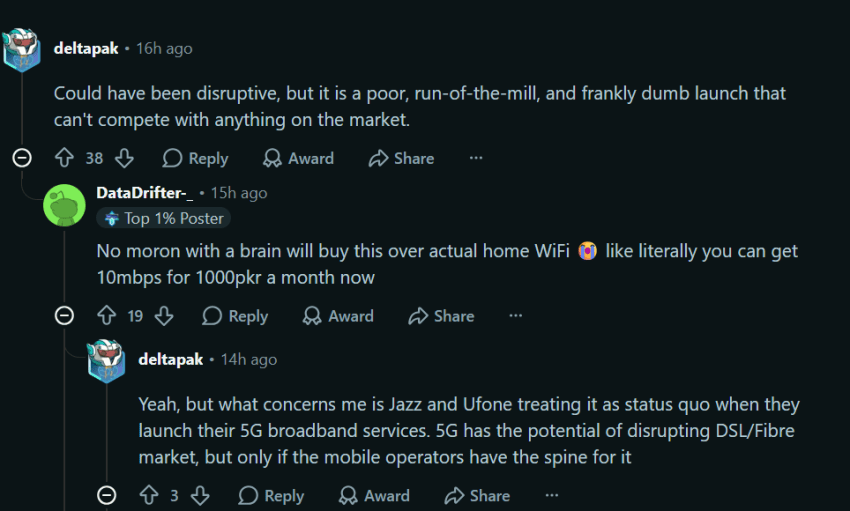
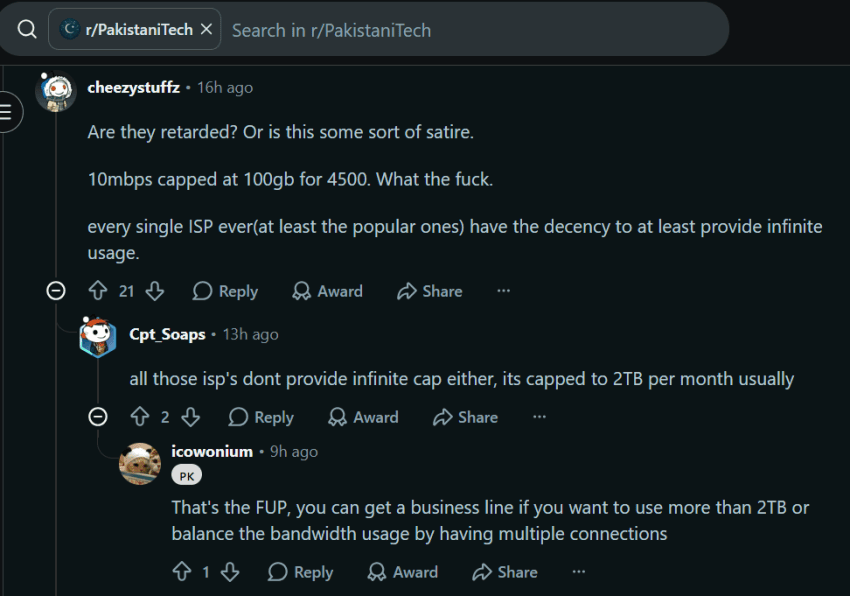
For consumers comparing internet services primarily on affordability and data volume, these numbers could be a major problem.
Why Call 5G If Speeds are Capped at 10 Mbps?
The pricing has become a central theme in users’ criticism, but the speed restrictions have also drawn sharp reactions.
One user questioned the point of paying for a service that combines potentially higher latency with a 100GB cap and expensive monthly charges. They argued that a 10 Mbps entry-level limit undermines the appeal of 5G, particularly when the device cannot be moved freely between locations.
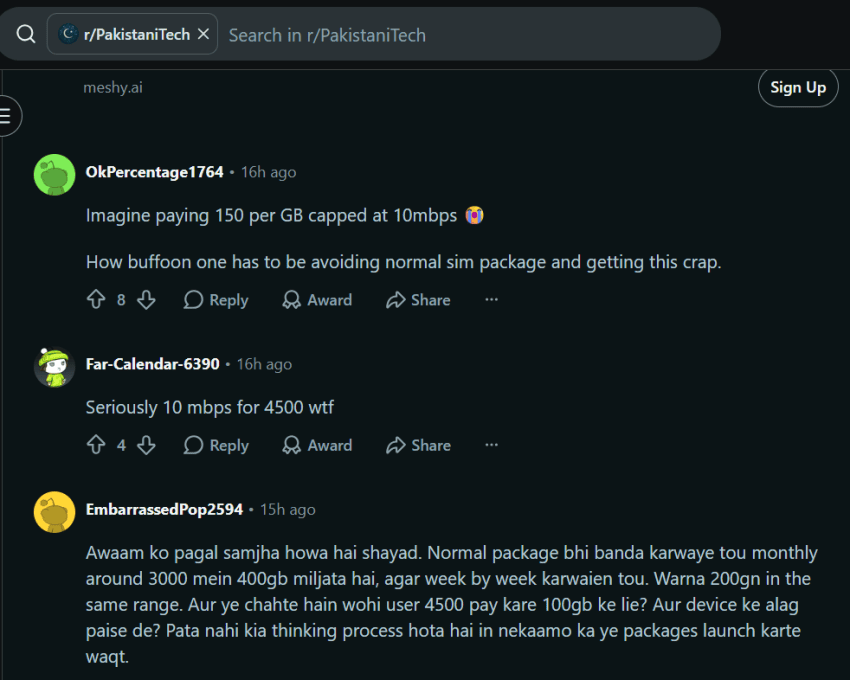
Another user called out advertised maximum speed of 50 Mbps and arguing that such a limit does not match the expectations created by the 5G label.
Although 5G is the underlying access technology, actual performance depends on network conditions, and the package speed limits restrict the maximum advertised throughput.
No Unlimited Package?
So far, there is no unlimited-data option. One user questioned how a home internet product could charge a minimum of Rs45 per GB without offering an unlimited package. The concern is especially relevant for households where multiple people share one connection.
Streaming services, software updates, video calls, gaming downloads, and everyday browsing can collectively consume substantial amounts of data. A 100GB allowance may therefore prove restrictive for families, even when their individual usage appears reasonable.
The hard cutoff after the monthly quota runs out adds to the frustration. Customers receive notifications when they consume 50%, 80%, and 100% of their allowance, but those alerts do not prevent the connection from stopping once the limit is reached.
The negative response has also focused on the availability of alternatives. One user Asad Bukhari argued that HomeFi is difficult to justify for homes and offices when fibre broadband is available at competitive prices. He also raised concerns about the resilience of mobile networks during power outages, noting that connectivity can be affected when telecom towers lose power and backup systems are insufficient.

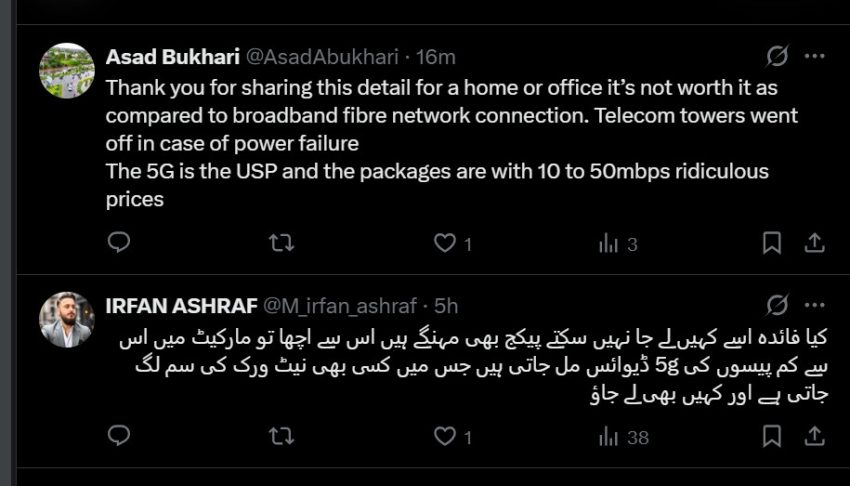
Another user, Irfan Ashraf, questioned the lack of portability, arguing that consumers could purchase less expensive 5G routers that accept SIM cards from different networks and can be used in multiple locations, subject to device compatibility and network restrictions.
For users who have access to affordable fibre or want the flexibility of a mobile router, the product’s advantages may be difficult to see.
For users who want affordable, high-volume home internet, the current packages may be a tough sell. Unless the company introduces more competitive prices, larger allowances, higher speed tiers, or an unlimited option.
Zong slapped with Rs77Million penalty over ‘Illegal BVS Device Operation’