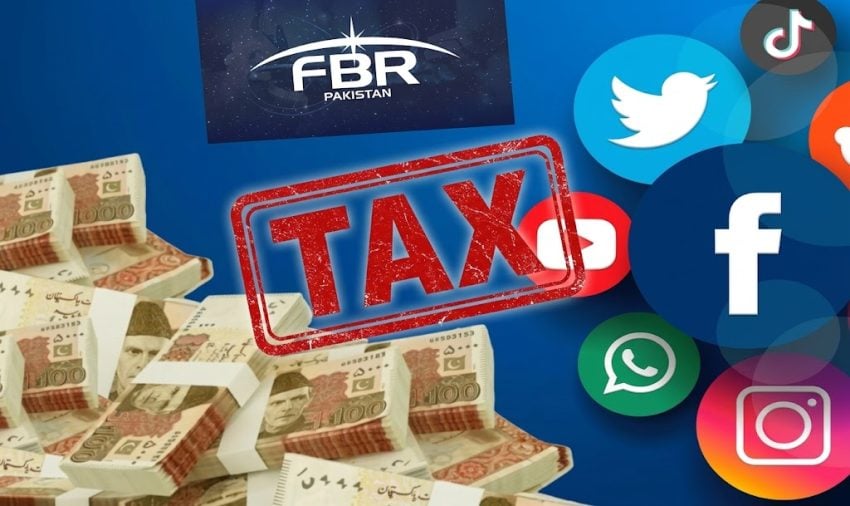
LAHORE – For Pakistani social media creators, the tax spotlight is moving beyond YouTube, which is one main earning platforms for tens of thousands. From Facebook Reels to TikTok videos and Instagram content, FBR proposed a major change that could bring earnings across more platforms under its existing tax calculation rules, putting digital creators on their toes.
Pakistan’s content creators could face broader tax scrutiny as FBR proposes extending its YouTube-specific earnings benchmark to other social media platforms, while existing 5% withholding tax and income declaration requirements remain in force.
In draft notifications, the apex tax authority proposed replacing word “YouTube” with “social media platforms” in two provisions of the Income Tax Rules, 2002, potentially extending the reach of its prescribed earnings calculation mechanism beyond the video-sharing site.
The proposed amendments concern Rule 13ZP, which applies to residents, and Rule 19R, which covers non-residents. Both provisions currently define revenue per mille (RPM) by referring specifically to YouTube videos. If finalised, the changes would bring the wording into line with the broader social media taxation framework, which encompasses qualifying content-related income across digital platforms.
The proposal could have implications for creators earning through Facebook, Instagram, TikTok and other eligible services. However, the latest amendments remain at the draft stage and have not yet taken effect. The FBR has invited objections and suggestions within seven days of publication in the official Gazette.
At the centre of the framework is an RPM benchmark of Rs195 for every 1,000 YouTube video views, subject to revision. Under existing special procedure, the remuneration used for calculating income is generally determined by comparing the amount generated through the prescribed RPM formula with the actual remuneration received. The higher amount is used under the applicable rules.
This means that a creator’s declared earnings may be assessed against the FBR’s prescribed benchmark rather than being determined solely by the amount received in cash. Creators who believe their actual remuneration was lower can provide supporting evidence to the relevant commissioner. Such evidence may include platform payout statements, bank records and other documents establishing their earnings.
The framework applies to remunerative or monetised content, rather than automatically treating every video or social media post that attracts views as taxable income under the RPM formula.
The proposed expansion comes after Pakistan introduced a separate withholding tax mechanism for social media earnings through Section 154B of the Income Tax Ordinance, 2001, under the Finance Act 2026. Under this provision, banks and non-banking financial institutions must deduct tax when qualifying social media revenue is credited or received through accounts.
The prescribed withholding rate is 5%. For resident taxpayers, the deduction generally operates as minimum tax, while for non-residents without a permanent establishment in Pakistan, it is treated as final tax, subject to the applicable legal conditions.
The mechanism has been in effect since July 1, 2026, and covers qualifying income from platforms including YouTube, Facebook, Instagram and TikTok. Certain taxpayers, including those not appearing on the Active Taxpayer List, may face a higher effective tax burden under other applicable provisions.
The latest draft, therefore, does not introduce the 5% withholding tax. Instead, it seeks to broaden the wording of the separate income calculation rules.
Under existing special procedure, eligible creators must declare their social media earnings separately in their annual income tax returns.
Allowable expenses are restricted to a maximum of 30% of total revenue, subject to the applicable rules. The framework also requires quarterly advance tax payments.
Remuneration may include more than direct cash payments. Qualifying gifts, complimentary products and other benefits received in connection with content creation can also count as income in kind. Where declared income falls below the amount calculated under the prescribed procedure, the relevant commissioner may examine the discrepancy, rectify the return where legally permitted and recover the amount due.
These requirements form part of the existing framework and are distinct from the latest draft amendments.
The rules also address income earned by non-resident individuals through interactions with users in Pakistan. For non-residents, the prescribed thresholds are 50,000 users during a tax year or 12,250 users during a quarter. These criteria help determine whether qualifying income constitutes Pakistan-source income under Section 101(3B)(b) of the Income Tax Ordinance, 2001.
The thresholds refer to users, not simply subscribers, and do not apply universally to every creator.
The proposed changes draw authority from Section 99C of the Income Tax Ordinance, 2001, read with Section 237, which provides rule-making powers. One of the draft notifications also refers to Section 101(3B)(b), concerning the determination of Pakistan-source income for relevant non-residents.
The broader framework was established through SRO 1640(I)/2026, SRO 1641(I)/2026 and SRO 1642(I)/2026, issued in September 2026. These notifications addressed the relevant taxpayer category and introduced special procedures for residents and non-residents.
FBR’s proposed revisions have not yet become binding amendments. Stakeholders have seven days from publication of the draft notifications in the official Gazette to submit objections or recommendations for consideration.
Until the amendments are formally notified, the existing rules remain applicable. For content creators, the key issue is the potential expansion of the RPM provision across eligible platforms, alongside the tax obligations already in place. The proposal does not establish a uniform final tax bill for every creator, nor does it mean that all social media views automatically generate taxable income.