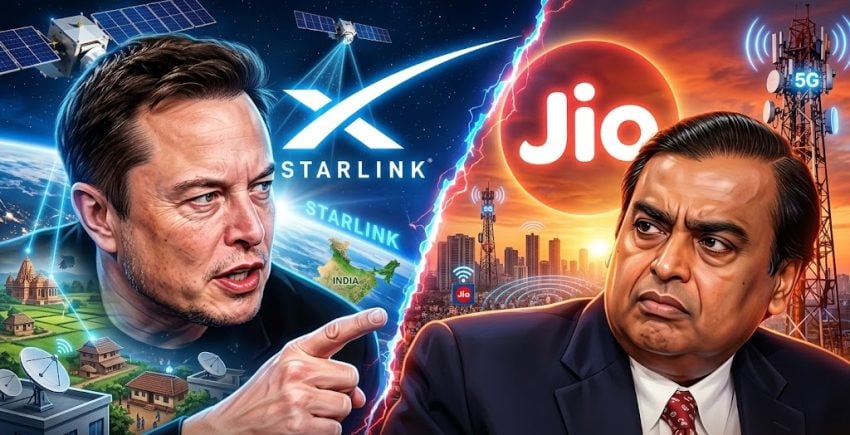
NEW DELHI – When Starlink can reach over 165 countries but still can’t take off in India, the most populous country of 1.48 billion, Elon Musk has a question, and Mukesh Ambani is in the firing line.
With a sarcastic “Prime Minister Ambani” jibe, X owner Musk turned regulatory delay into public showdown over telecom dominance, competition and who really calls the shots. India says it’s all about security and spectrum. Musk isn’t buying the wait.
Musk’s post about Mukesh Ambani reignited debate over Starlink’s delayed entry into India. Behind the public jabs lies a bigger battle over market competition, satellite spectrum and the future of the country’s telecom industry.
Dear Prime Minister Ambani,
Please accept my humble apologies for not realizing that you are the real boss of India.
Naturally, you would prefer to maintain your monopolistic exploitation of the great people of India, but would you nonetheless consider allowing Starlink to compete?
There are many areas of India, as there are in all countries, with no Internet access, which denies children the opportunity for education and for small businesses the opportunity to sell their goods to a global market. Starlink would change their lives for the better.
Thank you 🙏
— Elon Musk (@elonmusk) October 9, 2026
SpaceX chief accused powerful business interests of standing in the way of competition and questioned why his company had yet to begin operations despite securing key regulatory approvals. His comments became increasingly personal, with Musk suggesting that Ambani held more influence over India’s decisions than the country’s own prime minister.
Musk accused powerful business interests of blocking Starlink, while the Indian government says the company still has to meet regulatory requirements that also apply to other satellite operators.
At centre of heated debated is a simple question, why has Starlink still not launched commercially in India? On October 7, Musk accused unnamed business figures of trying to protect their market dominance by preventing Starlink from entering the country.
A day later, he questioned why the company was still waiting for approval after years of dealing with Indian regulators. In another post, his criticism had taken a more personal turn. In a sarcastic post, Musk addressed Prime Minister Narendra Modi as “Prime Minister Ambani”, suggesting that the Reliance chairman had undue influence over decisions affecting Starlink.
Starlink seeks access to one of the world’s largest telecommunications markets. The company could provide internet connectivity to remote villages and underserved areas where conventional broadband infrastructure is difficult or expensive to build. But its arrival would also introduce another player into a market where established telecom companies already hold considerable influence.
Whether those companies have actively obstructed Starlink, however, remains unproven.
The tension between Musk and Ambani did not begin with the latest exchange on social media. Their differences became more visible in late 2024, when India debated how satellite spectrum should be allocated.
Ambani and Bharti Airtel chairman Sunil Bharti Mittal supported allocating satellite spectrum through auctions. Musk opposed that approach, arguing that it differed from international practices for satellite services.
India ultimately chose administrative allocation under the Telecommunications Act, 2023, rather than the auction model advocated by sections of the domestic telecom industry.
The disagreement exposed competing interests. Traditional telecom operators have invested heavily in mobile networks, while satellite companies such as Starlink aim to provide connectivity across large geographical areas without relying entirely on ground-based infrastructure.
The way spectrum is allocated can affect the cost of providing services and the conditions under which companies compete. For Starlink, gaining access to India represents an important expansion opportunity. For established operators, the growth of satellite internet adds another dimension to an already competitive market.
Starlink got Key Approvals, but Still Cannot Launch
Starlink has already made progress towards entering India. The company gets its Global Mobile Personal Communications by Satellite (GMPCS) licence from the Department of Telecommunications in June 2025. The following month, the Indian National Space Promotion and Authorisation Centre (IN-SPACe) authorised its first-generation satellite constellation.
However, those approvals did not give Starlink the green light to begin commercial operations.
The remaining hurdles mainly involve security clearance and the finalisation of satellite spectrum pricing and allocation. The Ministry of Home Affairs is involved in the security assessment, while the Department of Telecommunications and the Telecom Regulatory Authority of India are working on the spectrum framework.
Indian authorities want assurances that satellite communications will remain subject to domestic oversight. Their concerns include the location of ground gateways, the storage of user data, lawful interception and the ability to monitor communications during emergencies. Officials have also raised questions about the possibility of traffic being routed through infrastructure outside India.
Starlink has said it has prepared infrastructure specifically for the Indian market, including multiple gateway sites, and that Indian customer data will remain within the country. Even so, the company must satisfy the relevant authorities before it can start providing services commercially. Foreign investment clearance has also featured in some accounts of the approval process.
Indian government rejected Musk’s suggestion that Starlink is being unfairly treated. Ministry of Communications described claims of discrimination as baseless and misconceived. Communications Minister Jyotiraditya Scindia has also stressed that India does not allow monopolies.
As per government officials, three operators hold GMPCS licences. Starlink, Jio Satellite Communications and Bharti-backed Eutelsat OneWeb. All three are at broadly comparable stages of the regulatory process and still face outstanding requirements.
None can launch commercially until the necessary security conditions are met and the spectrum framework is finalised. Amazon Leo, formerly known as Project Kuiper, remains at an earlier stage of the approval process.
The government’s position is that Starlink’s delay is part of a wider regulatory process, not evidence that officials are protecting a particular company. Musk, on the other hand, has questioned why the process has taken so long despite Starlink’s progress towards meeting the requirements.
Interestingly, Jio and Airtel are not simply rivals standing in Starlink’s way. Both companies have also signed commercial agreements with Musk’s satellite internet business.
Last year, Jio and Airtel announced arrangements to help distribute Starlink equipment through their retail networks and support installations, subject to regulatory approval. Starlink received its telecom licence a few months later, in June 2025.
The partnerships show complicated nature of the market. Jio and Airtel can benefit from distributing Starlink products while also competing with satellite internet services for customers. Their interests overlap in ways that make the dispute less straightforward than a simple clash between Starlink and India’s existing telecom companies.
Pakistan halts Starlink’s license approval for internet services: reports
Reliance Jio is also looking towards the future of satellite connectivity. Reports suggest that the company is considering a low-Earth-orbit satellite constellation of approximately 1,600 to 1,650 satellites, with estimated investment costs ranging from $10 billion to $15 billion. Plans presented at the India Mobile Congress 2026 reportedly included around 1,600 satellites and supporting ground infrastructure.
Akash Ambani indicated that Jio intends to combine the use of satellite capacity from international providers with the development of its own domestic capabilities. If the project moves forward, it could give Jio greater control over satellite network capacity and strengthen its position in remote connectivity.
For the unversed, Jio and Airtel together account for around 77% of India’s wireless subscribers, based on figures from around August 2026. Jio holds roughly 39% of the market, while Airtel has around 38%.
Although their combined share is below the often-quoted figure of more than 80%, the two companies remain dominant players.
Starlink could offer an alternative for people living in remote communities where traditional broadband infrastructure is limited. Its satellite network could also help maintain communications during floods, earthquakes and other disasters that disrupt ground-based networks.
Musk repeatedly highlighted these benefits in arguing that Starlink should be allowed to operate in India.
For now, Starlink’s commercial launch depends on security clearance and the finalisation of the satellite spectrum framework. The government maintains that these requirements are necessary for all licensed operators. Starlink, meanwhile, has emphasised its preparations for the Indian market and Musk has continued to question the length of the approval process.
Elon Musk’s Starlink and Chinese Satellite firm apply for licenses in Pakistan