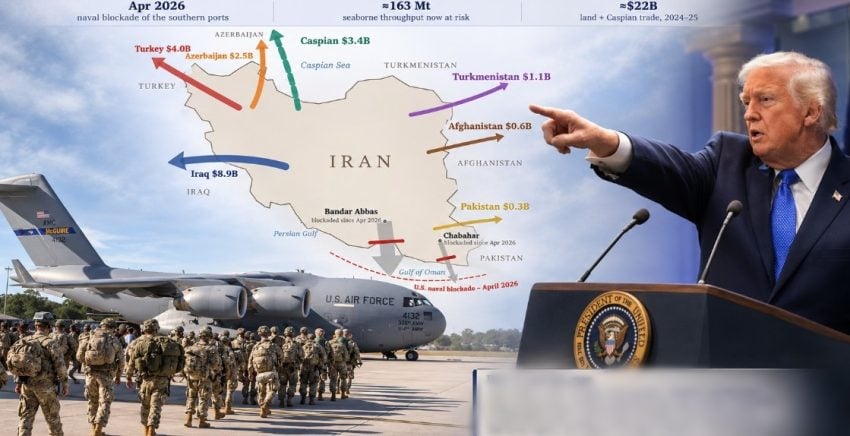
WASHINGTON – More pressure mounts on war-hit Iran as US President Donald Trump expands naval blockade strategy to land routes with launch of Task Force Iron Gate, targeting Tehran’s weapons supply networks, critical military shipments and financial lifelines.
The special military task force aimed at cutting off Tehran’s access to advanced weapons, critical technologies and financial resources through land routes and the Caspian Sea. It could target Iranian oil shipments which are already facing months-long naval blockade that US military officials claim has prevented approximately $25 billion in crude oil exports.
The new initiative, named Task Force Iron Gate, was ordered by US Central Command (CENTCOM) chief Admiral Brad Cooper on Saturday, November 7, 2026.
While American naval forces concentrated on restricting Iranian maritime trade, Washington is now turning its attention to alternative supply corridors that could allow Tehran to bypass sanctions and military restrictions. Task Force Iron Gate will operate from CENTCOM headquarters in Tampa, Florida, with a team of approximately 20 military and civilian personnel.
The unit will coordinate with other US government agencies to identify and disrupt the movement of sophisticated weapons systems, dual-use technologies, sanctioned equipment and illicit financial resources across Iran’s land borders and the Caspian region.
The operation could also increase scrutiny of trade and transportation networks connecting Iran with Central Asia, Russia and neighbouring countries. US officials believe such routes could potentially help Tehran obtain military-related equipment and generate revenue despite restrictions on its traditional shipping channels.
The new task force comes as Washington continues enforcing a naval blockade designed to deprive Iran of one of its most important sources of income. US initially imposed maritime restrictions on April 13, 2026, targeting vessels entering or leaving Iranian ports and oil terminals, particularly around the Persian Gulf and Gulf of Oman.
American authorities maintained exemptions for humanitarian shipments, subject to inspections, while generally allowing neutral vessels travelling between non-Iranian destinations to continue their journeys. According to CENTCOM, the blockade has prevented roughly $25 billion worth of Iranian crude oil exports, delivering what Washington describes as a major economic setback for Tehran.
Oil-tracking assessments suggest Iranian shipments have fallen sharply, with new exports through primary Gulf routes reaching exceptionally low levels during September and October. However, the restrictions have not completely stopped Iranian oil movements.
Limited shipments reportedly continued through alternative transportation routes, pre-positioned offshore stocks and arrangements designed to circumvent maritime controls.
Admiral Brad Cooper presented Task Force Iron Gate as a further step toward tightening restrictions on Iran’s military recovery and financial capabilities. CENTCOM commander said the operation would reinforce the naval blockade while restricting Iran’s ability to obtain materials needed for weapons production. He also indicated that the initiative would make it increasingly difficult for Tehran to finance groups Washington designates as terrorist organisations, restore damaged weapons factories and replenish military inventories.
Washington’s latest military initiative follows the introduction of Operation Economic Outcast, a sweeping financial pressure campaign announced by US Treasury Secretary Scott Bessent in August 2026.
The campaign targets five major sectors considered crucial to Iran’s economic resilience and international transactions like Digital assets and cryptocurrency networks, Gold and precious metals, Technology and sensitive equipment. Aviation and related supply chain and Shipping and maritime trade.
Bessent described the initiative as a major economic offensive intended to weaken Iran’s financial connections with the outside world. The campaign includes restrictions and potential secondary sanctions targeting businesses, individuals, vessels and intermediaries accused of helping Iran evade US measures.
Iran reports attacks on Qeshm Island as Trump issues fresh warnings amid escalating tensions