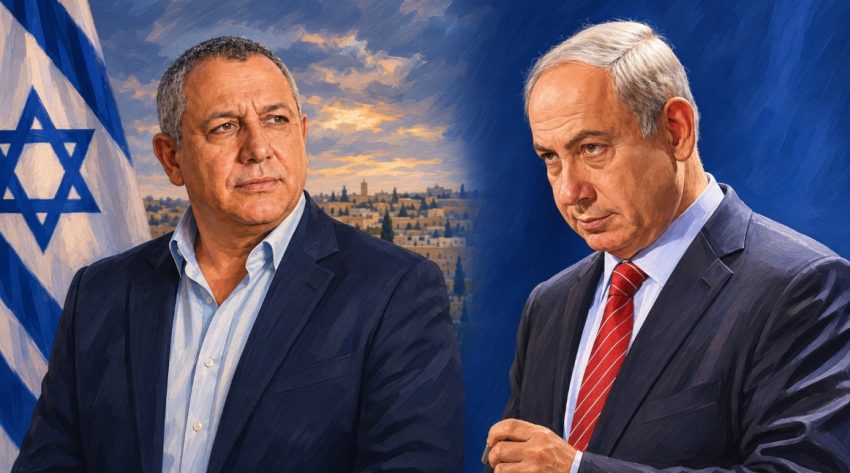
TEL AVIV – Israeli Prime Minister Benjamin Netanyahu is facing political setback as former military chief Gadi Eisenkot emerges as frontrunner to form Israel’s next government, backed by Arab political parties and a broad opposition alliance determined to end Netanyahu’s leadership.
Eisenkot got support from 67 lawmakers in 120-member Knesset, comfortably surpassing 61-seat majority threshold. Netanyahu, meanwhile, has received just 46 endorsements, exposing deep cracks in his political alliance.
The political shake-up intensified during consultations with President Isaac Herzog, when two major Arab political groups formally backed Eisenkot, significantly strengthening his chances of receiving the mandate to establish a new government. Although the former army chief appears to have the numbers on his side, differences among opposition parties could still complicate his path to power.
The turning point came when the Arab-led Ra’am party and the Joint List, collectively holding 19 parliamentary seats, announced their support for Eisenkot. Ra’am leader Mansour Abbas, whose party controls eight seats, endorsed Eisenkot while reiterating his support for a two-state solution to the Israeli-Palestinian conflict and US President Donald Trump’s Gaza peace initiative.
His party reportedly plays major role in Israeli coalition politics, including its participation in the government led by former Prime Minister Naftali Bennett. The 11-seat Joint List also threw its weight behind Eisenkot despite serious political disagreements with the former military commander.
Joint List leader Yousef Jabareen said Arab voters had overwhelmingly demanded political change after years of what he described as discrimination, racism, rising crime and social marginalisation under Netanyahu’s administration. However, he acknowledged that supporting Eisenkot was far from an ideal choice.
Arab political leader described the decision as choosing between two undesirable alternatives, arguing that removing Netanyahu from office had become the more pressing priority. Jabareen also criticised Eisenkot for failing to take a stronger position against allegedly inflammatory statements directed at Arab citizens during the election campaign.
While Eisenkot gains political momentum, Netanyahu is facing growing resistance from within his traditional support base. His right-wing and religious alliance secured 53 parliamentary seats, but not all its members have agreed to recommend him for another term. The most damaging setback came from United Torah Judaism, a longtime coalition partner whose seven lawmakers declined to endorse Netanyahu.
Gadi Eisenkot – Profile
Gadi Eisenkot, the former chief of the Israel, belongs from Moroccan family who started his military career in 1978 when he joined the IDF’s Golani Brigade during compulsory military service. He rose through the ranks and became commander of the brigade in 1997 before holding several senior military positions.
In 2015, he was appointed chief of the IDF General Staff, serving until his retirement in 2019. After his military career, Eisenkot entered politics and secured a seat in Israel’s parliament. His political prominence increased after the Hamas-led attacks on October 7, 2023, when he joined Netanyahu’s emergency war cabinet.
His son, Gal Eisenkot, was killed during fighting in Gaza in December 2023. His nephew Maor Cohen Eisenkot was killed the following day, while another nephew, Yogev Pazy, died during military operations in November 2024. Eisenkot later emerged as an increasingly prominent critic of Netanyahu’s handling of the Gaza conflict and Israel’s broader security strategy.
In 2025, he established centrist political party, Yashar, a Hebrew word associated with honesty, integrity and straightforwardness. The party secured 21 parliamentary seats in the October 27 elections, strengthening Eisenkot’s position as a major contender for national leadership.
Despite receiving support from Arab political parties, Eisenkot maintained hardline position on Hamas and Israel’s security concerns. During his election campaign, he pledged to dismantle Hamas’s military capabilities and remove its leadership from power in Gaza within 18 months of becoming prime minister.