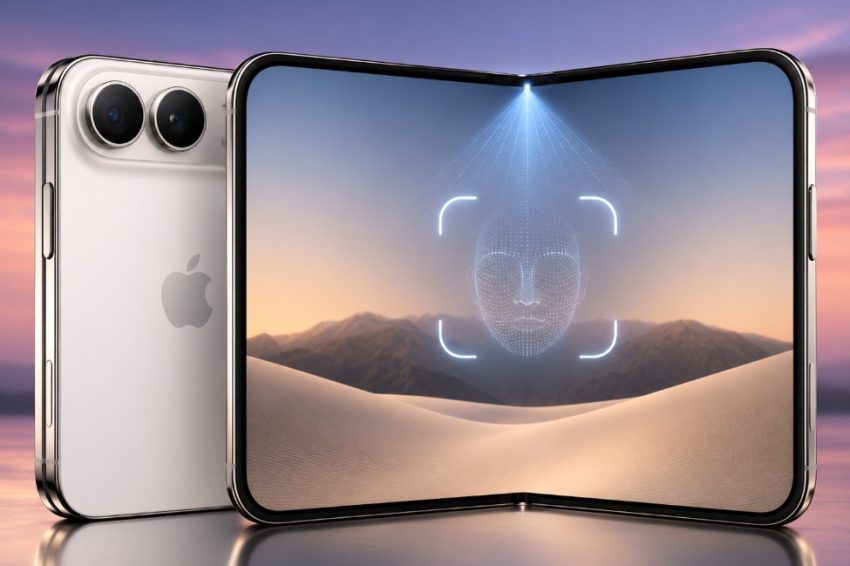
LONDON – Apple brings new feature for first foldable iPhone, allowing users to unlock device simply by looking at the front camera. However, the long-awaited facial recognition system comes with a surprising restriction that could leave some users disappointed.
The technology giant added camera-based facial unlocking to iPhone Duo through iOS 27.3 developer beta 2, released on November 16, 2026, bringing much needed feature to its premium foldable device. The update means iPhone Duo users will no longer have to rely on the fingerprint sensor every time they want to unlock their phones. Instead, the device can recognize their faces using its standard selfie camera.
However, unlike Apple’s robust Face ID, the new feature comes with strict security limitations, including a 45-minute restriction that requires users to authenticate again through Touch ID or a passcode.
Face Unlock is now on the iPhone Duo! With iOS 27.3 Beta 2 https://t.co/TVz1SIyjFr
— MilesAboveTech (@milesabovetech) November 16, 2026
The company introduced facial recognition without dedicated 3D scanning hardware used in normal iPhones. The new feature, officially called “Unlock with Front Camera,” is available under Settings in the Touch ID & Passcode section.
Users can activate it by registering their facial appearance through the front camera. The setup process involves looking at the screen and turning the head, similar to how Face ID enrollment works on other iPhones. Once configured, the system recognizes the registered face and unlocks the smartphone without requiring a fingerprint scan each time, provided the user has recently authenticated.
Apple has long favored dedicated TrueDepth sensors over ordinary camera-based facial recognition and similar technology has been available on Android smartphones for years, but Apple had previously avoided introducing it as a replacement for its more advanced biometric authentication system.
iPhone Duo Hacked within Hours of Launch as iOS 27 Security Flaw sparks frenzy among Apple Users
Despite added convenience, Apple’s new face unlock feature cannot function independently of Touch ID or the device passcode. Users must first verify their identity using the fingerprint sensor or passcode before facial unlocking becomes available. If the phone remains inactive for approximately 45 minutes, camera-based face unlock stops working until the user authenticates again.
The feature also works only when the iPhone Duo is folded shut and its external display is active. Users cannot unlock the smartphone using this method while the larger internal screen is unfolded. Its functionality is further restricted to unlocking the Lock Screen.
Unlike traditional Face ID, the new system cannot authorize Apple Pay transactions, access saved passwords, approve sensitive account logins or perform other security-critical operations. These restrictions are intended to compensate for the absence of advanced three-dimensional facial recognition hardware.
Why Apple’s $2000 iPhone Launched without Face ID
Apple unveiled the iPhone Duo with 5.4-inch Super Retina XDR external display and a massive 7.6-inch folding screen, providing approximately 50% more display space than iPhone 18 Pro Max. Built around a premium titanium frame, the smartphone measures approximately 5.2 mm thick when unfolded.
Despite its premium screen, the foldable device comes without Face ID, relying instead on a Touch ID fingerprint sensor built into the side button. The decision was reportedly linked to space constraints created by its thin body, folding hinge and dual-display design.
Apple’s conventional Face ID requires several specialized components, including an infrared camera, a flood illuminator and a dot projector to generate a detailed three-dimensional facial map. Fitting these components into the foldable design reportedly presented challenges, prompting Apple to retain Touch ID as the primary biometric authentication method.
One of key differences between new system and traditional Face ID becomes apparent in low-light environments. Early testing reportedly suggests that the iPhone Duo’s camera-based unlocking performs well in daylight and other brightly lit conditions. However, facial recognition becomes less reliable in dim surroundings and may fail completely in darkness.
This is because the technology depends on images captured by the ordinary front-facing camera rather than specialized infrared sensors. Traditional Face ID, by contrast, can recognize faces even in complete darkness. The new system reportedly processes facial information locally, using hardware-level security protections associated with the A20 Pro chip’s Secure Exclave architecture.
Although the technology offers a convenient alternative to fingerprint scanning, it does not provide the same level of authentication capability as Apple’s full Face ID system.