
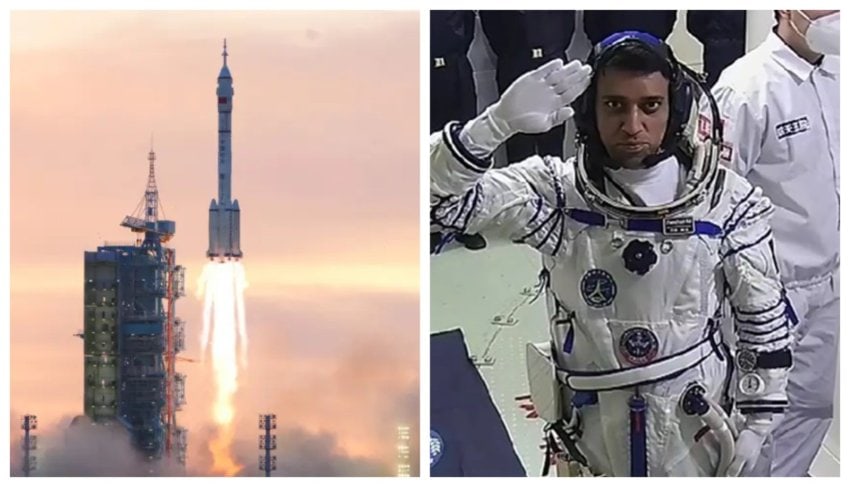
Pakistan has marked a historic milestone in its space programme as its first astronaut, Muhammad Zeeshan Ali, embarked on China’s Shenzhou-24 mission alongside two Chinese astronauts.
The spacecraft was launched from China’s Jiuquan Satellite Launch Centre at around 5am Pakistan time aboard a Long March-2F rocket. The mission successfully completed its initial launch stages and proceeded along its planned trajectory, according to the information provided.
The three astronauts are expected to reach China’s Tiangong space station after approximately four to five hours of travel. They will reportedly spend a week aboard the orbital facility, conducting various scientific experiments.
During the journey, all three crew members remained secured in their seats and reviewed the mission manual, while astronauts already stationed aboard Tiangong observed the spacecraft’s departure.
Ali’s participation marks a significant achievement for Pakistan, making him the country’s first astronaut to travel into space. He is also set to become the first foreign astronaut to reach the Tiangong space station, according to the mission details.
Ahead of the launch, a special farewell ceremony was held for the Pakistani and Chinese astronauts. Federal Minister for Planning Ahsan Iqbal attended the event, while thousands of Chinese citizens gathered near the launch centre to witness the historic occasion.
Speaking before his departure, Ali described the mission as a major honour for Pakistan and said that the friendship between Pakistan and China had now extended to the galaxies. He also expressed hope that the two countries would undertake more joint space missions in the future.
Recalling his meeting with Prime Minister Shehbaz Sharif, Ali said the premier had told him that the mission was not just about one individual but represented Pakistan as a whole. He said the remarks strengthened his sense of responsibility and motivation.
President Asif Ali Zardari congratulated the nation on Pakistan’s participation in human spaceflight, describing the development as a moment of immense national pride. He praised the efforts of the Space and Upper Atmosphere Research Commission (SUPARCO), scientists and engineers involved in preparing for the mission.
The president also acknowledged China’s contribution to Pakistan’s space ambitions, saying the historic development would open new opportunities for scientific research, technological advancement and international cooperation.
SUPARCO Chairman Dr Yusuf Khan described the occasion as a historic day for Pakistan. He revealed that the organisation had received nearly 300 proposed scientific experiments from universities and educational institutions across the country. Four experiments were selected for the mission, while the remaining proposals were retained.
Explaining the astronaut selection process, Khan said medical fitness and the ability to withstand psychological pressure were among the key considerations. Of an initial pool of 50 candidates, 19 were sent to China for further selection, from which Muhammad Zeeshan Ali and Khurram Dawood were chosen.
Federal Minister for Planning Ahsan Iqbal also termed the spaceflight a new beginning for Pakistan, saying the achievement would inspire future generations and strengthen the country’s scientific ambitions.
Meanwhile, Federal Information Minister Attaullah Tarar shared a video of the special ceremony held ahead of the Shenzhou-24 launch on social media. Ahsan Iqbal and Pakistan’s ambassador to China were also present at the launch site, where they raised the national flag in tribute to the astronaut and the SUPARCO team.
The mission is being viewed as an important milestone in Pakistan-China scientific cooperation, highlighting the potential for future collaboration in space exploration, research and technology.