
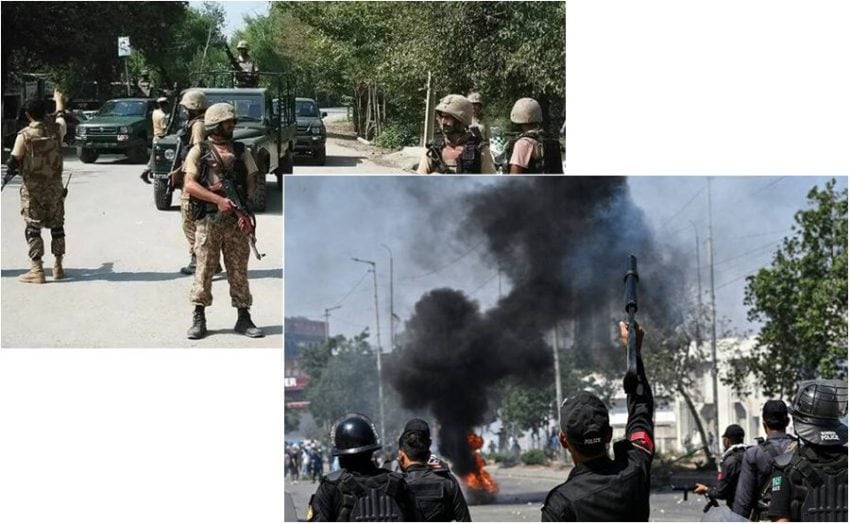
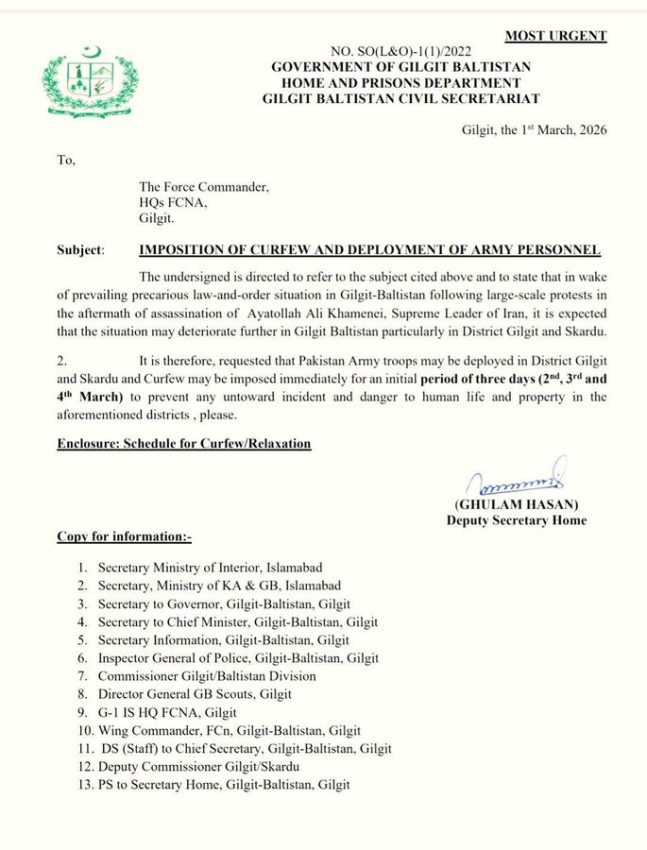
GILGIT — The Government of Gilgit-Baltistan has imposed a strict curfew across districts of Gilgit and Skardu and called in Pakistan Army under Article 245 of the Constitution to restore order in wake of deadly protests that have engulfed the mountainous region.
The unrest erupted after the assassination of Iran’s Supreme Leader Ayatollah Ali Khamenei in what authorities described as a joint U.S.-Israeli airstrike in Tehran on February 28. A notification from the Home and Prisons Department (No. SO(L&O)-1(1)/2022) cited a “precarious law-and-order situation,” warning that tensions could worsen. Under Article 245, Pakistan Army troops have been deployed to assist civil authorities for an initial 14-day period. However, the immediate curfew will remain in effect on March 2, 3, and 4.
Officials said the deployment aims to prevent further bloodshed and restore stability after days of escalating clashes, arson, and targeted attacks on public and international institutions.
In Gilgit city, demonstrators targeted and burned offices belonging to the United Nations Military Observer Group in India and Pakistan and the United Nations Development Programme. Local officials described the attacks as among the most severe unrest seen in the region in recent years.
To prevent shortages of food and medical supplies, authorities have outlined limited relaxation periods: Curfew from midnight to noon; relaxation from 12:00 PM to 4:00 PM; restrictions resume until midnight. Relaxation from midnight to 5:00 AM; full curfew from 5:00 AM to 4:00 PM. Security officials warned that violations of the curfew would result in strict legal action.
All educational institutions across Gilgit-Baltistan have been closed indefinitely. Foreign tourists in the mountainous region have been relocated to secure accommodations under police supervision.
Authorities sealed off “Red Zones” and clashes were reported near U.S. diplomatic facilities.
Flames over Kuwait as US Fighter Jet f-15 Crashes amid tensions with Iran