

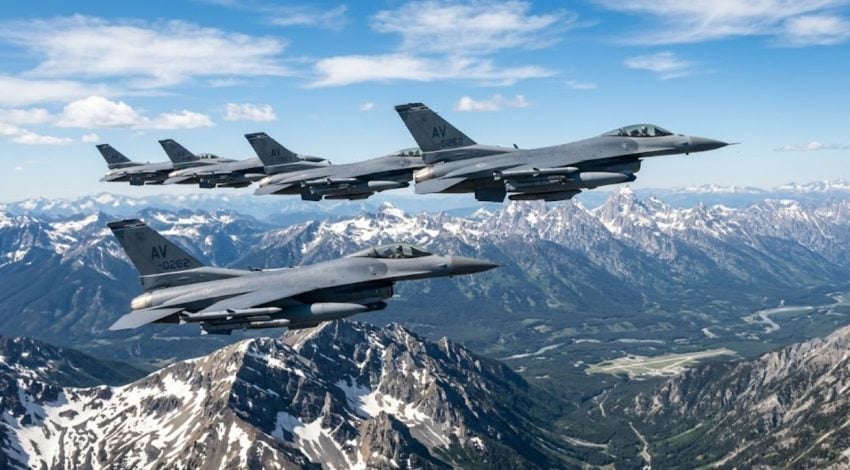
WASHINGTON – US approved $488 million deal to provide long-term support for Pakistan’s F-16 fleet, in major upgrade for combat fighters. F-16 Fighting Falcon jets, long seen patrolling the skies, are set to receive upgraded sustainment, spare parts, and technical backing that keep them mission-ready for years to come.
United States Air Force awarded massive $488 million contract to Northrop Grumman Systems Corp. for sustained engineering and technical support of F-16 Fighting Falcon radar systems, with Pakistan included among the participating nations.
The firm-fixed-price, indefinite-delivery, indefinite-quantity contract will focus on maintaining and supporting APG-66 and APG-68 radar systems installed in F-16 fighter jets. The work will be carried out in Linthicum Heights, Maryland, and is scheduled to continue through March 31, 2036—signalling a decade-long commitment to sustaining fleet readiness.
The contract falls under the US Foreign Military Sales (FMS) programme and spans a wide network of allied and partner countries, including Bahrain, Belgium, Chile, Denmark, Egypt, Greece, Indonesia, Iraq, Israel, Jordan, South Korea, Morocco, the Netherlands, Norway, Oman, Pakistan, Poland, Portugal, Romania, Thailand, and Turkiye.
The award was issued on a sole-source basis by the US Air Force Lifecycle Management Centre in Utah, with an initial $2.64 million in fiscal 2026 funding already allocated from Air Force and Navy budgets.
The deal underscores Washington’s continued push to ensure long-term operational readiness of F-16 fleets across partner nations, including Pakistan, which continues to rely on US-origin fighter jets under ongoing maintenance and upgrade arrangements.
This latest contract comes on the heels of another significant move in December 2025, when the US Defence Security Cooperation Agency (DSCA) notified Congress of a proposed $686 million upgrade package for Pakistan’s F-16 fleet—further deepening defence ties.
That proposed package includes advanced Link-16 tactical data systems, encrypted communications equipment, avionics upgrades, pilot training support, and full logistical assistance. US officials described it as a step toward enhancing interoperability between Pakistan, the United States, and allied forces for counterterrorism and joint operational readiness.
The upgrades are designed to extend operational life of Pakistan’s F-16 fleet up to 2040, while significantly enhancing safety and combat capability.
A diplomatic source familiar with the matter said Pakistan has welcomed continued US support for its F-16 fleet, noting that it plays a key role in maintaining operational effectiveness and compatibility with allied defence systems.
Pakistan got F-16 Fighting Falcon in 80s when the United States supplied the aircraft as part of a defense partnership, giving Islamabad a major leap in modern air combat capability. The jets quickly became a core part of the Pakistan Air Force.
In 90s, cooperation was disrupted due to US sanctions, halting further deliveries and straining ties. After 2001, relations improved again, leading to new F-16 deliveries and upgrade programs in the mid-2000s. Since then, Pakistan has continued receiving support and maintenance packages to keep its fleet operational.
FACT CHECK: No, Indian Air Force did not shoot down Pakistani F-16 near Sialkot