
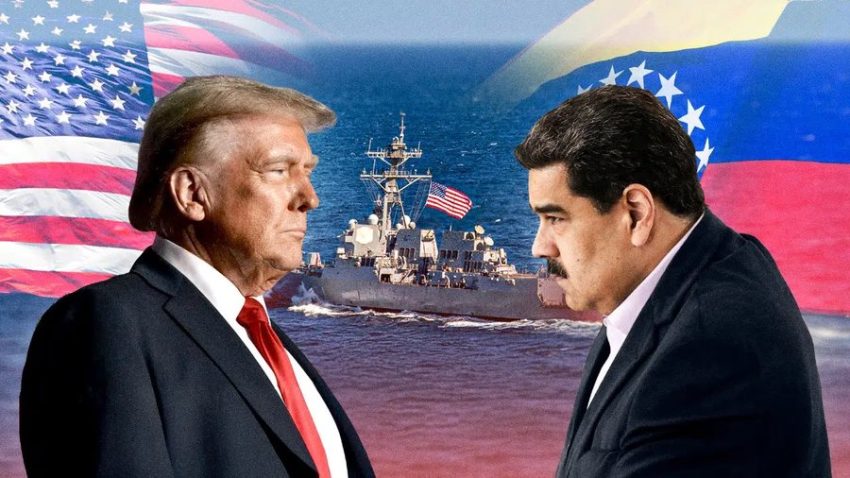
ISLAMABAD – Tensions surged as US President Donald Trump announced that American forces captured Venezuelan President Nicolás Maduro and his wife, Cilia Flores, after what he described as a “large-scale strike” on Venezuela.
In dramatic post on Truth Social, Trump declared that Washington successfully carried out major military operation against the South American nation, resulting in the detention of Maduro and Flores, who were then flown out of the country. POTUS said he would address world during a presser in Florida.
The announcement followed reports of explosions and military activity in Caracas earlier in the day.
INTERNATIONAL RESPONSE
In the UK, Liberal Democrat lawmaker Ed Davey warned Prime Minister Keir Starmer that failing to condemn Trump’s actions could set a dangerous global precedent. He cautioned that silence from Western leaders could embolden Russia and China to launch similar attacks on other nations without fear of consequences.
Despite military action, sources familiar with Venezuela’s state-run oil company PDVSA said oil production and refining operations continued as normal. Key energy infrastructure reportedly escaped damage, though the port of La Guaira near Caracas, one of the country’s largest ports—suffered severe destruction, according to initial assessments.
Venezuela’s Interior Minister Diosdado Cabello confirmed the country had come under attack, accusing the United States of launching a surprise assault while civilians slept. He said Venezuela had endured 28 weeks of threats prior to what he called a “treacherous and vile” strike.
EUROPE ACTIVATES DIPLOMATIC CHANNELS
Italy’s Foreign Minister Antonio Tajani said Rome was closely monitoring developments, particularly given the presence of approximately 160,000 Italians living in Venezuela, many with dual citizenship. Italy’s foreign ministry crisis unit was activated, and Prime Minister Giorgia Meloni was kept continuously informed.
European Union foreign policy chief Kaja Kallas confirmed she had spoken with U.S. Secretary of State Marco Rubio, stating that the EU was closely watching the rapidly evolving situation.
VENEZUELA INVOKES UN SELF-DEFENSE RIGHTS
Venezuela’s representative to the United Nations declared that the country was invoking Article 51 of the UN Charter, asserting its inherent right to self-defense. Foreign Minister Yvan Gil announced that Venezuela had formally requested an emergency meeting of the UN Security Council in response to what he described as U.S. criminal aggression.
Meanwhile, U.S. Senator Mike Lee said Rubio told him that Maduro had been arrested by American forces and would be brought to the United States to face criminal charges. According to Lee, Rubio indicated that no further military action inside Venezuela was expected now that Maduro was in U.S. custody.
GLOBAL POWERS CALL FOR CALM
Spain urged de-escalation and respect for international law, offering to serve as a mediator to help reach a peaceful resolution.
Russia issued a sharp condemnation, labeling the U.S. operation an act of “armed aggression.” Moscow warned that Washington’s justification was unacceptable and accused the U.S. of allowing ideological hostility to override diplomatic pragmatism.
US Deputy Secretary of State Christopher Landau said Maduro would now “finally face justice” for crimes he is accused of committing.
CONFUSION AND FEAR
Adding to the uncertainty, Venezuelan opposition figures claimed that Maduro’s exit from the country was negotiated rather than forced. The New York Times reported that U.S. forces suffered no casualties during the operation, though the number of Venezuelan casualties remains unknown.
Venezuela’s Vice President Delcy Rodríguez said the government does not know where Maduro and his wife are being held and issued a public demand for proof that both are alive.
As governments worldwide scramble to respond, the situation in Venezuela remains volatile, with the potential to reshape regional stability and ignite a broader international crisis.