

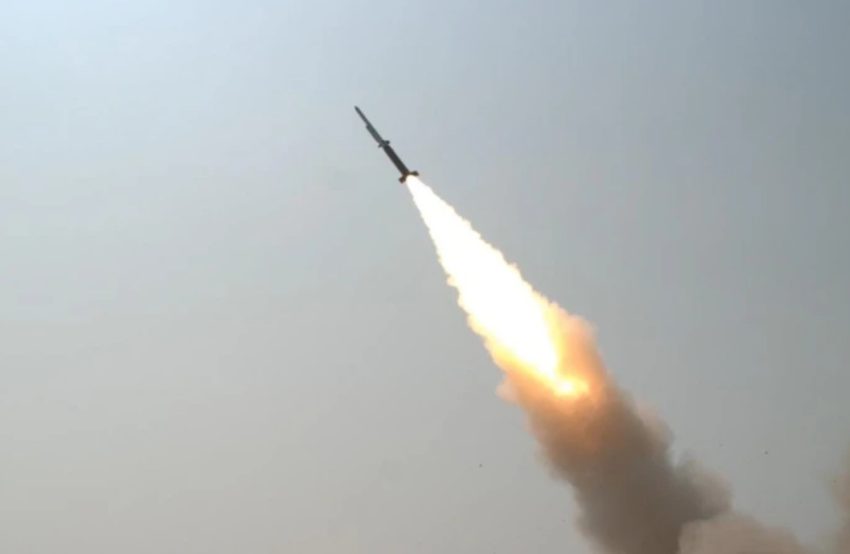
ISLAMABAD – India successfully tested revolutionary missile technology that dramatically extends range of air-launched weapons. Defence Research and Development Organisation (DRDO) demonstrated Solid Fuel Ducted Ramjet (SFDR) technology, a major breakthrough that positions India among the few nations in the world capable of developing next-generation, long-range air-to-air missiles.
Defence Minister Rajnath Singh personally congratulated DRDO and the Indian defense industry for this landmark achievement, calling it a “proud moment for the nation.”
The high-stakes test took place yesterday, February 3, at 10:45 AM from the Integrated Test Range (ITR) in Chandipur, Odisha, along the Bay of Bengal coast. According to the Ministry of Defence, this successful demonstration will pave the way for strategic air superiority, enabling India to target adversaries at unprecedented distances.
During the test, every subsystem performed flawlessly, including the nozzle-less booster, solid fuel ducted ramjet motor, and fuel flow controller. Initially, the missile was accelerated to the desired Mach number using a ground booster motor, after which the SFDR system took over, maintaining precise fuel flow and propulsion. Performance data, collected via state-of-the-art tracking instruments installed at Chandipur, confirmed that all systems worked exactly as intended.
The launch was closely monitored by senior scientists from multiple DRDO laboratories, including the Defence Research and Development Laboratory (DRDL), High Energy Materials Research Laboratory (HEMRL), Research Centre Imarat (RCI), and ITR, marking a coordinated effort across India’s top defense research institutions.