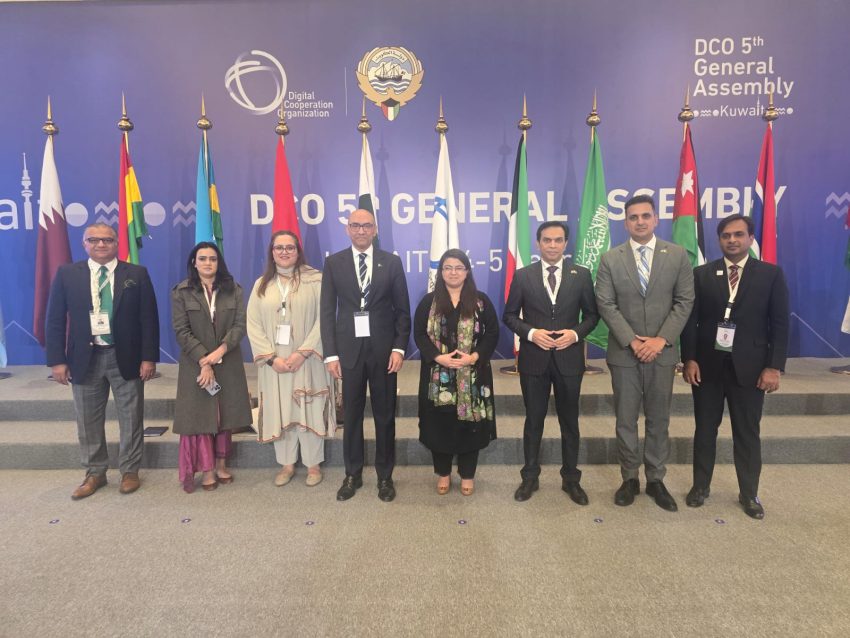
KUWAIT CITY – Pakistan will host the next General Assembly of the Digital Cooperation Organization (DCO) in 2027 after member states on Friday adopted the Kuwait Declaration on Responsible AI for Global Digital Prosperity and confirmed Islamabad’s assumption of the DCO Council presidency for 2026.
The decision was taken at the conclusion of the DCO’s fifth General Assembly, held on Feb 4–5 under Kuwait’s presidency, which brought together ministers and senior officials from member states, observers, and partner organizations to advance cooperation on artificial intelligence and the digital economy.
The Kuwait Declaration commits member states to ethical and inclusive AI governance, recognising artificial intelligence as a driver of productivity, competitiveness, and improved public services, while underscoring the need to address risks related to inequality, bias, privacy, and security. The Declaration aligns with the DCO’s four-year agenda for 2025–2028, aimed at promoting sustainable digital transformation.
During the Assembly, member states endorsed a range of policy frameworks to support trusted digital growth, including the Model Digital Economy Agreement and mechanisms enabling secure cross-border data flows. Ministers also reviewed progress across initiatives covering digital economy measurement, data sovereignty, startup regulation, digital government services, investment facilitation, ethical AI, skills development, online safety, and e-waste management.
The Assembly confirmed the handover of the DCO Council presidency from Kuwait to Pakistan for 2026, with Saudi Arabia set to assume the presidency in 2027. An Executive Committee was also formed, chaired by Saudi Arabia and including Ghana, Rwanda, Djibouti, Pakistan, Kuwait, and Morocco.
Pakistan’s Federal Minister for IT and Telecommunications, Shaza Fatima Khawaja, said Pakistan was honoured to assume the council presidency at a “pivotal moment for the global digital economy,” adding that Islamabad looked forward to advancing responsible AI, strengthening cross-border digital cooperation, and ensuring that digital transformation delivers tangible benefits.
Kuwait’s Minister of State for Communication and Information Technology Affairs, Omar Saud Al-Omar, said digital cooperation under Kuwait’s presidency had moved “from dialogue to delivery,” citing progress on responsible AI governance and institutional trust.
DCO Secretary-General Deemah AlYahya said the Assembly reflected a collective commitment to cooperation in shaping the future of the digital economy, including efforts to advance trusted digital trade and counter online misinformation.
On the sidelines of the meeting, the Digital Cooperation Organization signed memoranda of understanding with the International Chamber of Commerce, Edraak – Queen Rania Foundation, and TikTok, as well as a letter of engagement with Arab News.
The International Digital Cooperation Forum, held alongside the Assembly, convened policymakers, business leaders, and experts to discuss practical cooperation on artificial intelligence and other emerging technologies.