
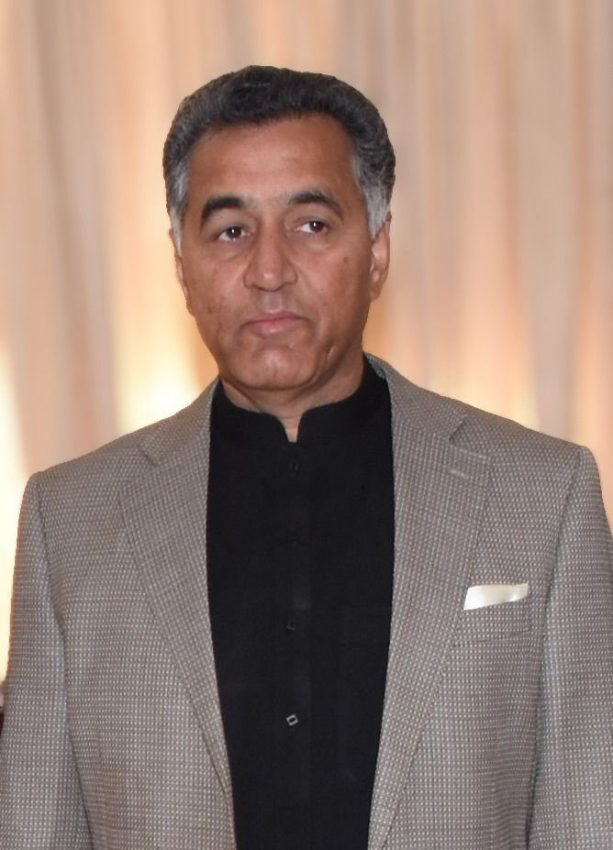
To this day, the image remains vivid. It was August 2021. Lieutenant General Faiz Hamid stood in the lobby of the Serena Hotel in Kabul, teacup in hand, offering the world a smile that bordered on arrogance. It was the smile of a man at the absolute peak of his influence. He was the ‘kingmaker’ of the shadows, a figure so entrenched in the power structure that the word ‘untouchable’ seemed written on his forehead. We watched him then and thought he was above the law. We were wrong.
Today, that image of invincibility has been shattered, replaced by the stark reality of accountability.
On Thursday, the news rippled through Pakistan like a shockwave: the Field General Court Martial (FGCM) has sentenced Faiz Hamid to 14 years of rigorous imprisonment. The charges? Engaging in political activities, violating the Official Secrets Act, misuse of authority, and fomenting instability.
As an observer of our country’s often turbulent power dynamics, I have heard the cynics for years. There has been a pervasive but wrongly built narrative in our drawing rooms and television talk shows that the powerful elite of the establishment are immune to the justice system. We were told that the law only exists for the common man, while the uniformed personnel protect their own.
This verdict does not just challenge that narrative—it has proven it wrong once again.
We must acknowledge a hard truth that is often ignored: the internal accountability system of the Pakistan Army is currently acting as the most efficient, speedy, and across-the-board mechanism of justice in the country. Instead of shielding its own, the institution has demonstrated that when a red line is crossed, consequences are swift. There is no other institution in Pakistan today—be it the judiciary, the bureaucracy, or political parties—that has demonstrated the will to hold its own former heavyweights accountable with such decisiveness.
General Faiz Hamid was not just a soldier; he was the head of the country’s premier intelligence agency. To see a figure of such immense former influence strip-searched by the law, tried, and sentenced is unprecedented in our recent history. It sends a message that rings louder than any political slogan: No one is above the law.
One cannot help but wish this standard applied everywhere. If the same level of efficiency and self-accountability witnessed in the FGCM were replicated in our civilian judicial system, justice could truly be provided to the masses. If our courts operated with this speed, holding the powerful accountable rather than dragging cases out for decades, similar examples could be created for other institutions, and the fate of this nation would change.
Critics might be tempted to dismiss this, but a closer look at the facts reveals a strict adherence to due process that our civilian courts often struggle to emulate. This was not a rushed summary execution of justice. The proceedings spanned over 15 months, beginning in August 2023. The accused was granted full legal rights, including the counsel of a defense team of his choice. The FGCM didn’t just hand down a sentence; it established guilt through a laborious legal proceeding. And, crucially, the door remains open—he has the right to appeal.
This creates a sharp contrast with other sectors in Pakistan, where accountability is often stalled until the accused dies, flees, or strikes a deal. Here, the military institution looked inward, identified a cancerous breach of discipline, and excised it.
The charges themselves are telling. By convicting him of “engaging in political activities” and collaborating with political elements to foment instability, the military has drawn a red line in the sand. Furthermore, the ISPR has clarified that his involvement in fomenting agitation (specifically regarding May 9) is being “separately dealt with.” By punishing a former three-star general for exactly these transgressions, the institution is walking the talk. It is an acknowledgment that the role of a soldier is to defend the borders and the constitution, not to maneuver political outcomes or “manage” housing societies like Top City.
For the common citizen, this is a moment of reassurance. It humanizes the institution, showing that it is made of people who are subject to rules. The “accountability and transparency” witnessed in this trial is a benchmark. It proves that a general’s stars do not shield him from the consequences of violating the Official Secrets Act or abusing power for personal gain.
Faiz Hamid’s 14-year sentence is a personal tragedy for the individual, certainly, but it is a monumental victory for the institution and the state. It signals that the era of perceived impunity is over. In the eyes of the law, a former DG ISI is just a citizen who must answer for his actions.
And that, perhaps, is the most powerful signal of stability Pakistan has seen in years.