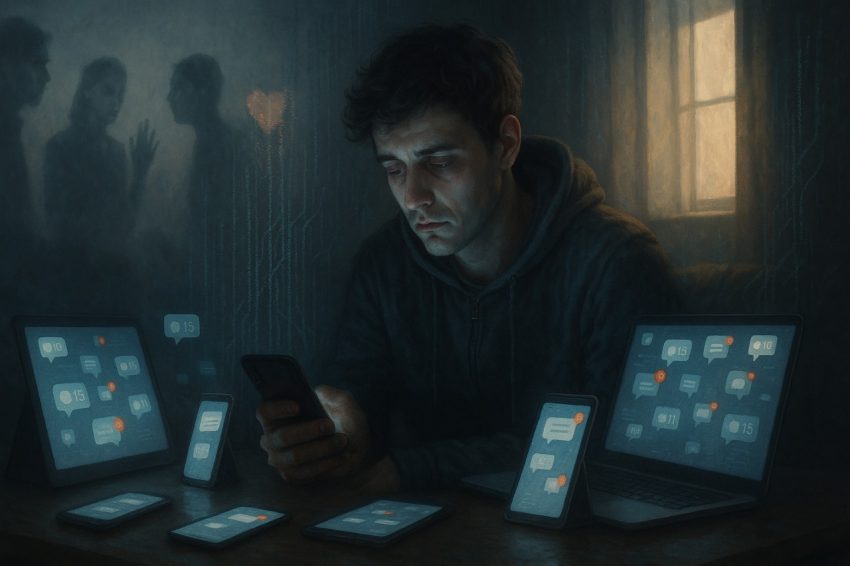
There was a time when conversations meant eye contact, not typing bubbles. Somewhere between Wi-Fi signals and endless scrolls, humanity quietly went offline. We assumed machines would learn from us, yet somewhere along the way, we started learning from them, not their intelligence, not their precision, but their patterns.
Today, the more profound crisis is not that technology is becoming human. It’s that humans are becoming the algorithm, predictable, reactive, impatient, and optimised for speed rather than depth. We scroll in loops, react as triggers, and consume as feeds. Emotional complexity that once defined us is being replaced by machine-like efficiency, and the loss is subtle yet profound.
Technology was meant to extend us, not edit us. It once mirrored our brilliance, the creativity imagined beyond limitations, the intuition no machine could code, the empathy no software could simulate. Yet in our pursuit of convenience, we surrendered the very traits that inventions were designed to preserve.
We built systems that respond instantly, and now we flinch at anything that requires patience. We created algorithms that predict behaviour, and now we behave in ways that make prediction easy. We designed machines without emotions, and now emotional restraint is mistaken for strength.
Studies have shown that excessive screen time is associated with a variety of adverse mental health outcomes. For example, a systematic review found that higher screen time in adolescents correlates with poorer mental well-being and a higher risk of depression, especially via smartphone use and social media engagement (Santos et al., 2023). Another study highlighted that increased screen exposure during adolescence in Pakistan was significantly linked to emotional distress and depressive symptoms (Khan, 2023). Globally, research has shown that problematic social media use affects social and emotional functioning, making it more difficult to sustain attention and empathy (de Vries et al., 2025).
Numbers hint at the more profound truth: we are outsourcing the parts of ourselves we once valued most. Memory has shifted to cloud storage. Imagination has turned to AI generators. Empathy competes with metrics, and attention, once a symbol of care, is now an endangered resource. Machines don’t pause to feel; increasingly, neither do we. We communicate more than ever, but connect less. Surrounded by notifications, we multitask through relationships. Conversations shrink into reactions with a heart emoji instead of a heartfelt presence. In a world designed for efficiency, emotional depth feels inconvenient.
And yet, the irony is unmistakable: we built machines in our image, only to reshape ourselves in theirs. This shift is not malicious; it is a passive, slow erosion. No alarm rings when family dinners become evenings of parallel scrolling. No notification alerts us when creativity becomes algorithm-dependent. No warning appears when our attention, once a rare gift of care, fragments beyond repair.
To reclaim our humanity, we do not need to reject technology. We need to return to the parts of ourselves that cannot be coded. Accurate intelligence isn’t processing speed; it’s perspective. Genuine connection isn’t instant; it’s intentional. Actual progress isn’t measured in updates, but in understanding.
Small, deliberate changes matter. Research suggests that intentional offline interactions, such as device-free meals, structured conversations, and moderated screen use, can improve emotional and social well-being among adolescents and adults (de Vries et al., 2025; Santos et al., 2023). Schools and families can encourage mindful digital practices and foster presence over scrolling.
This isn’t nostalgia for a pre-digital era. It’s a reminder that humanity was never defined by the tools we built, but by the conscience that guided us. Machines don’t lack morality; they reflect ours. If technology feels colder today, perhaps it is because we stopped feeding it warmth.
Perhaps the next frontier in innovation isn’t artificial intelligence; it’s authentic intelligence systems that help us think better, tools that cultivate reflection, and mechanisms that strengthen the humanity within us.
When humanity went offline, the world didn’t pause, but something within us did. Yet hope remains, because unlike the systems we built, we can choose. We can select depth over distraction, meaning over metrics, and presence over performance. And perhaps, when we stop living like algorithms, we will rediscover the one thing machines cannot imitate: the human spark that once powered every great idea we ever created.
Authors: Mishqat Naeem, Faseeh-ud-din, Abdul Raheem
Institution: Comsats University Islamabad, Lahore Campus
Contact Email: arnbhatti6@gmail.com