I was scrolling through my feed yesterday, and the mask didn’t just slip from the face of the Indian establishment; it was thrown to the floor and stomped on. It is chilling to watch retired Indian Army veterans on X (formerly Twitter) openly gloating, practically admitting that the recent hit on Bangladeshi leader Sharif Osman Hadi was a RAW operation. But their bloodlust didn’t stop at admissions. The timeline was flooded with a terrifyingly clear message: Hasnat Abdullah is next.
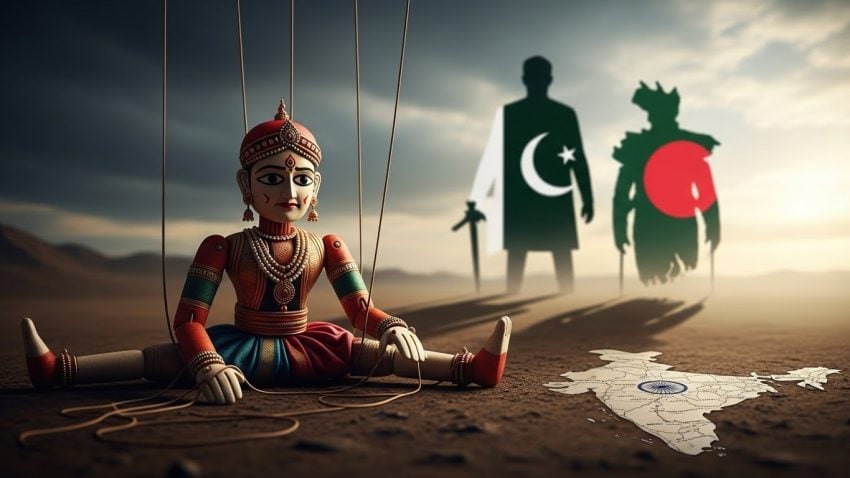
Why is a student leader in Dhaka causing such tremors in Delhi? The answer is simple. The people of Bangladesh have finally gathered the courage to demand the complete removal of Indian influence from their soil. They are demanding that Sheikh Hasina Wajid—the “Iron Lady” who ruled not as a prime minister but as a compliant puppet for New Delhi—be dragged back from her safe haven in India to face a tribunal. She is a war criminal in the eyes of her people, yet India protects her like a state asset.
This brings us to the quote that has set the Indian internet on fire. Hasnat Abdullah stood his ground and delivered a warning that history may well remember: “If India tries to destabilize Bangladesh, India will break into seven pieces.”
He wasn’t speaking in metaphors alone. He hit them where it hurts the most: the ‘Seven Sisters.’ It was a simple message to New Delhi: don’t throw stones when your own walls are made of glass. They’ve spent forty years acting like the neighborhood pyromaniac, lighting fires in Balochistan and suffocating Bangladesh just to watch them burn. But Hasnat is right. The days of lighting fires and walking away are over. The wind has turned, and the smoke is finally drifting into their own windows. The flames are blowing back. The sholay (flames) are rising, and it is India’s own house that is starting to scorch.
But there is a deeper pain gnawing at New Delhi, a geopolitical “indigestion” they simply cannot cure. It is the sight of Bangladesh and Pakistan finding their way back to each other.
For fifty years, India thrived on the narrative of 1971, keeping Dhaka and Islamabad locked in a deep freeze. Sheikh Hasina was the warden of that prison. As long as she was in power, any warmth toward Pakistan was strangled. But when the students threw her out in August 2024, they didn’t just topple a dictator; they shattered India’s greatest strategic asset in the region.
Now, India watches helplessly as the ice melts. They cannot digest the reality that Dr. Muhammad Yunus is talking to Pakistani leadership. They cannot stand that trade routes are reopening, that military cooperation is being discussed, and that the two Muslim nations are talking about “cleaning hearts.” To the Indian establishment, a handshake between a Bengali and a Pakistani is an existential threat.
This desperation is why we see these erratic, dangerous behaviors. It is why they are threatening assassinations on social media. It is why they are trying to brand the new Bangladesh as “extremist.”
But the world is no longer buying what New Delhi is selling. The “victim card” has expired. Since the investigation into the Sydney/Bondi attackers revealed an Indian footprint, India has found itself on a global watch list. The international community is waking up to what we in Pakistan have known for years: the state that claims to fight terror is often the one exporting it.
Hasina, the puppet, is gone. The strings are cut. And as Bangladesh moves closer to Pakistan—forming a natural, sovereign bond—India is left alone in the corner, holding the matchstick, realizing too late that it is their own credibility that has burned to the ground.