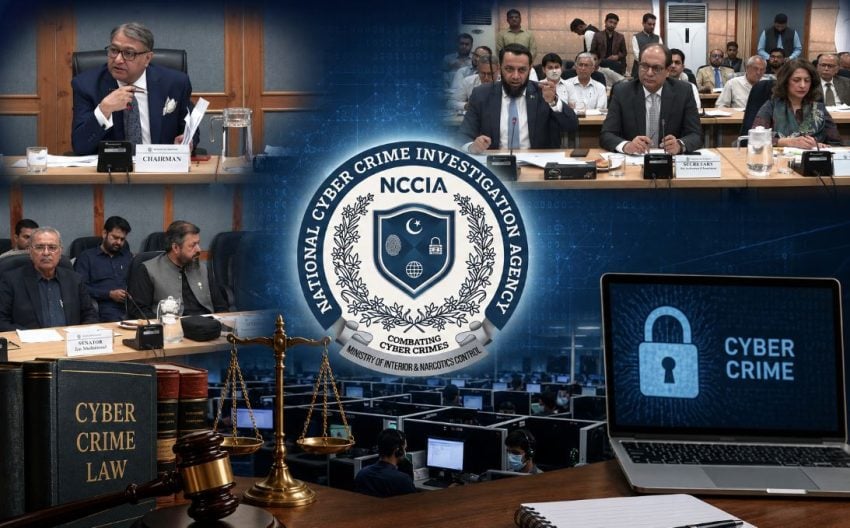
ISLAMABAD – Senate Standing Committee on Information and Broadcasting directed National Cyber Crime Investigation Agency (NCCIA) to stop taking stern measures against newspapers and journalists, saying such measures fall outside its legal mandate, and the committee sought verified data on social media accounts, called for stronger protection of media workers, and urged greater government support for the print media industry.
The committee, chaired by Senator Sarmad Ali, reviewed issues relating to media policy, journalists’ welfare, public sector media organizations and the functioning of the NCCIA. The meeting was attended by Senators Syed Waqar Mehdi, Jan Muhammad and Abdul Shakoor Khan, while Senator Pervaiz Rashid joined via video link.
The committee expressed serious concern over discrepancies in social media account data previously presented by NCCIA officials, noting that the agency had later distanced itself from figures submitted during an earlier subcommittee meeting. Directing the agency to clarify its position, Senator Sarmad Ali ordered NCCIA to submit verified and updated statistics.
The committee also took notice of reports that NCCIA had issued notices to certain newspapers and columnists. Members observed that such actions did not fall within the agency’s legal mandate and could amount to harassment of journalists and media organizations. Senator Sarmad Ali directed NCCIA to ensure that no action is taken against newspapers or their websites, stating that they do not fall within the agency’s jurisdiction.
Senator Syed Waqar Mehdi reminded the committee that NCCIA officials had earlier assured lawmakers that provincial police would no longer register FIRs under the Prevention of Electronic Crimes Act (PECA) and that such cases would instead be transferred to NCCIA. The committee directed the agency to submit a comprehensive report detailing whether provinces had transferred any PECA-related cases to it.
Briefing the committee, Information Minister Attaullah Tarar said the government had revised its advertisement policy in 2024, introducing transparent guidelines for the distribution of official advertisements. He said electronic media continued to receive the largest share of government advertising, followed by print and digital media, while only a limited portion of advertisements was being placed on social media platforms. He added that a third-party verification mechanism had been introduced to authenticate digital advertising.
On media workers’ welfare, the minister said the government was making efforts to ensure timely payment of salaries and other dues by linking compliance with the allocation of government advertisements. He proposed introducing a compensation package for families of media employees who die during service.
Senator Sarmad Ali maintained that it was primarily the responsibility of media organizations to compensate families of employees who die while on duty. However, Senator Syed Waqar Mehdi backed the minister’s proposal and suggested the committee recommend a fixed financial compensation package.
Expressing concern over the growing downsizing in the media industry, the committee recommended withholding government advertisements from media organizations that fail to pay employees on time and called for a revision in advertising rates. It further recommended mandatory registration of all media organizations with the Employees’ Old-Age Benefits Institution (EOBI) and compulsory life insurance coverage for media workers.
The minister sought proposals from the relevant department regarding a life insurance scheme and assured the committee that the government would consider contributing to such a fund.
The committee stressed that print media required immediate support to remain financially sustainable, with Senator Sarmad Ali observing that strengthening mainstream media was essential to counter fake news and disinformation circulating on social media. Senator Jan Muhammad highlighted the financial challenges faced by regional newspapers, particularly in Balochistan, and emphasized their role in promoting the national narrative. The committee directed the ministry to formulate a comprehensive policy for the promotion and protection of regional newspapers.
The committee also discussed the recently released film Buleha. Senator Pervaiz Rashid expressed concern over the use of the name of revered Sufi saint Bulleh Shah for a film containing violent content. As the information minister said he was not in a position to comment, the committee decided to summon all members of the Central Board of Film Censors along with the film’s producer at its next meeting. It also directed the ministry to provide the minutes of the censor board meeting in which the film was approved.
During the meeting, lawmakers were informed that Pakistan Television (PTV) had, for the first time, become financially self-sufficient. The minister said PTV was now recruiting contractual employees to reduce pension liabilities and disclosed that the state broadcaster held exclusive broadcasting rights for the FIFA World Cup 2026 in Pakistan.
He also said recently recruited PTV News anchors had been appointed on merit and were contributing positively to ratings and viewership. Responding to questions about their salaries, the minister said the compensation details of anchors would remain confidential to protect their privacy but could be shared with the committee during an in-camera session if required.
The committee also reviewed the financial situation of Radio Pakistan. Senator Waqar Mehdi urged the Pakistan Broadcasting Corporation (PBC) to revise rental rates for its Karachi office building, noting that eight of its 17 floors remained vacant. Officials informed lawmakers that tenders for revised rental rates had recently been issued. The committee directed PBC to submit a viable utilization plan for the vacant space and also recommended commercial use of unused portions of PTV buildings to generate additional revenue. Members further emphasized reviving drama production at PTV.