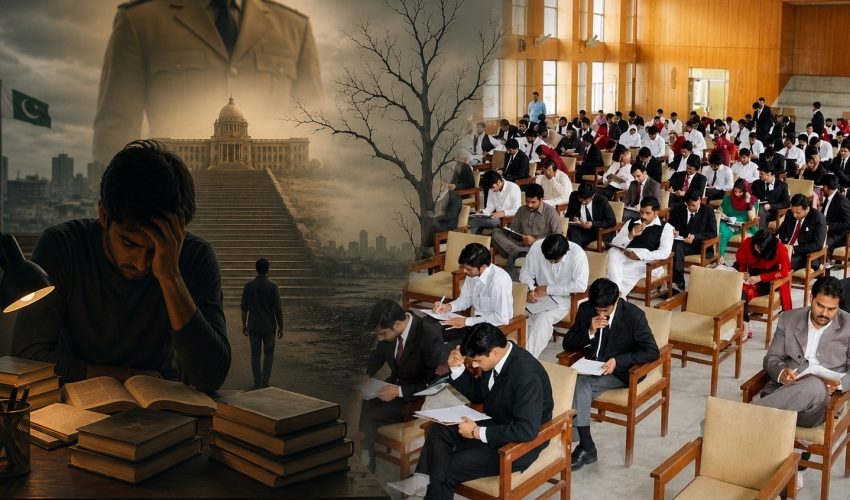
ISLAMABAD – Pakistan’s most prestigious competitive examination is facing a crisis of confidence. Once regarded as the ultimate career aspiration for young graduates, the Central Superior Services (CSS) examination is witnessing an unprecedented decline in interest, with registrations falling by nearly 48% in just four years.
Latest data shows the number of applicants dropped from 35,059 in 2022 to 18,139 in 2025, showing a dramatic shift in how Pakistan’s youth view careers in the bureaucracy.
The decline is not merely statistical, as it signals changing aspirations, growing skepticism, and mounting criticism of the recruitment system that many believe no longer reflects the skills needed for modern governance.
Critics argue that CSS examination continues to reward extensive theoretical knowledge, memorization, and lengthy written responses while placing comparatively less emphasis on leadership, innovation, decision-making, communication, and practical administrative ability. As a result, many young professionals question whether excelling in the examination truly predicts success in public service.
Another criticism frequently raised is that some candidates who perform exceptionally well during the examination struggle to deliver effective results after entering government service. While many civil servants perform with distinction, critics contend that the current assessment process does not always identify individuals best suited for real-world governance and public administration.
Conducted annually by Federal Public Service Commission (FPSC), CSS examination recruits officers for Basic Pay Scale-17 (BPS-17) positions across Pakistan’s federal civil services. Successful candidates are allocated to one of 12 occupational groups, including Pakistan Administrative Service (PAS), Police Service of Pakistan (PSP), Foreign Service of Pakistan (FSP), Inland Revenue Service (IRS), Pakistan Customs Service, Information Service, Commerce and Trade Group, Audit and Accounts, Office Management Group, and other federal services.
Eligibility requirements include Pakistani citizenship, a bachelor’s degree from an HEC-recognized institution with at least a second division, and generally an age between 21 and 30 years, although certain categories receive age relaxation. Candidates are permitted a maximum of three attempts.
The selection process itself remains one of the toughest in Pakistan. Candidates must first clear the Multiple Choice Preliminary Test (MPT) before appearing in a written examination worth 1,200 marks, followed by medical screening, psychological assessment, and a 300-mark viva voce. The overall recruitment process carries 1,500 marks.
Despite attracting thousands of applicants each year, only a tiny fraction ultimately secure government appointments. CSS 2025 examination shows scale of the challenge. Of 18,139 registered applicants, only 12,792 appeared in the written examination. Just 355 candidates passed the written stage, representing a pass rate of 2.77%.
After medical examinations, psychological assessments, and interviews, 342 candidates successfully completed the process, but only 170 were finally recommended for appointment.
The pattern was same in CSS 2024. Around 23,100 candidates applied, 15,602 appeared in the written examination, 395 passed the written stage, around approximately 2.53%, and only 229 candidates were ultimately recommended for appointment.
Overall, the exam remained among lowest recruitment success rates, with only about 0.7% to 1.8% of registered applicants eventually getting recommendations because of limited vacancies and strict evaluation standards. Female candidates have, however, shows increasingly strong performances in recent years, securing a significant share of recommended positions.
Those familiar with issue link the sharp decline in registrations to several factors. These include intense competition, demanding English and analytical requirements, changing career priorities among graduates, expanding opportunities in the private sector, concerns over career progression in government service, and growing perceptions that the examination system places greater value on academic knowledge than on practical competence and leadership.
CSS 2022 Cheating Case: Candidates, FPSC Officials get clean chit despite Tampering Allegations