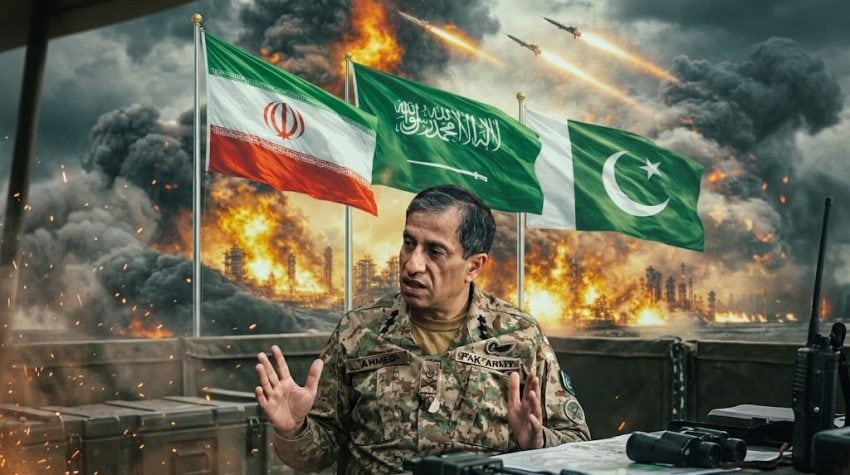
ISLAMABAD – As tensions continue to grip the Middle East, Pakistan is walking a delicate diplomatic tightrope, keeping communication channels open with Tehran while reaffirming its defence commitments to Saudi Arabia. DG ISPR Lt Gen Ahmed Sharif Chaudhry said Islamabad will continue pushing for de-escalation, while the Pakistan-Saudi Arabia-Türkiye defence alliance strengthens its collective deterrence posture.
ISPR chief, speaking to Independent Arabia, has pledged to intensify diplomatic efforts to prevent further escalation in the Middle East while reaffirming its commitment to Saudi Arabia’s security, as the military leadership outlined the defensive objectives and collective deterrence framework of the Pakistan-Saudi Arabia-Türkiye alliance.
He warned that the repeated cycle of escalation and de-escalation was undermining regional stability, stressing that continued confrontation would serve neither the interests of the countries involved nor those of the wider region.
Pakistan, he said, would continue engaging relevant parties alongside its regional partners to contain tensions, prevent the conflict from spreading and create space for diplomatic progress.
Pakistan’s diplomatic engagement with Iran has continued for several months, according to the DG ISPR, with discussions centred on restraint and preventing the conflict from intensifying. Responding to questions about whether Islamabad issued a direct warning to Tehran after attacks on Saudi Arabia, Lt Gen Chaudhry neither confirmed nor denied that such communication had taken place. He however mentioned that Pakistan’s exchanges with regional stakeholders remained focused on reducing tensions.
The military spokesperson cautioned that recurring outbreaks of violence could derail efforts to establish sustainable peace. He stressed that political engagement and negotiations were necessary to prevent further escalation and limit the conflict’s geographical and military scope.
Islamabad’s position, as outlined in the interview, combines continued diplomatic outreach with a warning that prolonged regional confrontation could have serious consequences for collective security.
Reaffirming Pakistan’s position on Saudi Arabia, Lt Gen Chaudhry said the Kingdom’s sovereignty, territorial integrity and the security of Makkah and Madinah remained fundamental concerns for Islamabad. He said that Pakistan was extending the support required under its existing defence commitments and would continue fulfilling its obligations to Saudi Arabia.
While withholding operational information on grounds of military confidentiality, he maintained that Pakistan remained prepared to employ its available capabilities to meet those responsibilities.
The remarks came amid concerns over Houthi attacks on Saudi Arabia. Lt Gen Chaudhry said the incidents had provoked strong reactions within Pakistan’s political and military leadership and among the public, reflecting the significance attached to protecting the Kingdom and Islam’s holiest sites. His comments shows Islamabad’s intention to maintain its security commitments to Riyadh while continuing to pursue diplomatic avenues to prevent the wider conflict from escalating.
Pak Army spokesperson said collective deterrence mechanism associated with Pakistan-Saudi Arabia-Türkiye defence arrangement was already being implemented.
Calling framework as defensive in nature, Lt Gen Chaudhry said it was founded on the right of self-defence under Article 51 of the United Nations Charter. He maintained that the arrangement was not directed against a particular country and was intended to deter aggression rather than pursue offensive objectives.
According to his explanation, aggression against any one of the three member states, whether direct or indirect, would engage the collective response commitments of the alliance. The framework’s institutional structure is also developing, with a secretariat and a strategic political and defence committee established to support coordination among the participating countries, he said.
DG ISPR clarifies Presence of Pakistan Army Troops in Saudi Arabia
The arrangement builds on longstanding political, historical and defence ties between Pakistan, Saudi Arabia and Türkiye. Lt Gen Chaudhry also clarified that it would operate alongside existing bilateral defence agreements and security partnerships rather than displace them.
Lt Gen Chaudhry said the alliance was designed to make clear that threats against its members would be met with a coordinated security response in line with their commitments. He highlighted the difficulties associated with deterring non-state armed groups, noting that such organisations can operate differently from conventional state actors and may not respond to traditional diplomatic signals in the same way.
In this context, he argued that credible defence arrangements were essential to discourage attacks and prevent armed groups from exploiting instability across the region. DG ISPR also cautioned against allowing security confrontations to expand, warning that a broader military conflict would undermine regional interests and make negotiated settlements harder to secure.
Pakistan-Saudi Arabia-Türkiye arrangement could potentially accommodate additional members, Lt Gen Chaudhry indicated, suggesting that the framework was not necessarily confined to its three founding countries. He said states that shared the alliance’s objectives of regional stability and collective security could be considered for future participation.
However, he offered no confirmation of reports concerning specific countries that might join, explaining that such decisions rested with the political and strategic leadership of the existing members. He reiterated that the initiative was intended to strengthen security cooperation and promote stability, not to establish a confrontation with any particular regional power.
DG ISPR also addressed maritime security challenges in the Strait of Hormuz and Bab el-Mandeb, two strategically important waterways for international shipping and regional commerce. Lt Gen Chaudhry highlighted the importance of cooperation among countries to protect maritime routes and safeguard trade flows. He also referred to Pakistan’s participation in multinational maritime security arrangements as part of broader efforts to address shared challenges.
DG ISPR explains Pakistan’s Position on Saudi Defence as Houthi Attacks instensify