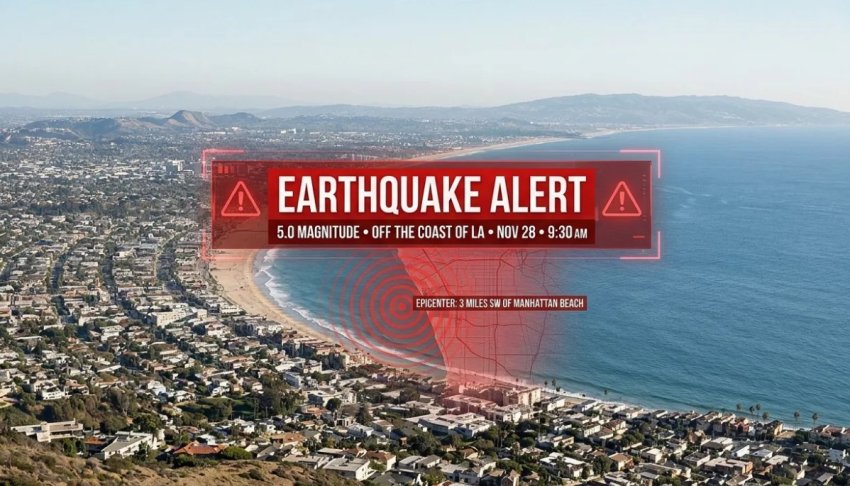
SOUTHERN CALIFORNIA — A strong earthquake jolted Southern California coastline this morning, sending residents rushing out of homes and businesses across the Los Angeles metropolitan area. The magnitude 5.0 earthquake, centred beneath Santa Monica Bay near Manhattan Beach, was followed by more than 40 aftershocks, raising concerns about continued seismic activity across the region.
The earthquake struck at approximately 9:30 a.m. Pacific Standard Time, with its epicentre located about 5 kilometres (3 miles) southwest of Manhattan Beach. According to preferred solution from the Southern California Seismic Network (SCSN), the earthquake measured magnitude 5.0, while the USGS National Earthquake Information Center (NEIC) reported a magnitude of 5.1.
Initial automated estimates ranged from 4.7 to 5.2 as seismic monitoring agencies analysed the event. The earthquake originated approximately 12.8 kilometres (8 miles) beneath the surface.
LA Earthquake
The tremors were widely felt throughout Southern California, particularly in communities surrounding the South Bay. Residents in Manhattan Beach, Redondo Beach, Torrance, Hawthorne, El Segundo and Hermosa Beach reported noticeable shaking, while people in other parts of the greater Los Angeles area also experienced the earthquake.
The sudden movement prompted some residents to leave their homes, offices and shops. Objects reportedly fell from shelves, while furniture and other household items shifted during the shaking.
Thousands of residents submitted reports through the USGS “Did You Feel It?” system, with the number of reports reaching tens of thousands. Some communities recorded shaking intensity as high as VI, classified as strong, although computer-based estimates placed peak shaking at approximately intensity V, or moderate.
ShakeAlert earthquake early-warning system also activated, delivering alerts to people in affected areas. Its initial assessment estimated the earthquake’s magnitude at approximately 5.1.
The main earthquake was followed by an extensive sequence of aftershocks, with more than 40 additional seismic events recorded as the day progressed. The strongest aftershock occurred at around 11:41 a.m. local time, registering between magnitude 4.5 and 4.6.
Other tremors measured around 3.7 to 3.8 and 4.0 to 4.1, while smaller earthquakes measuring around 2.2 to 2.3 were recorded soon after the initial shock.
USGS forecasts indicated that further seismic activity remained possible over the following week. The probability of at least one magnitude 3.0 or stronger earthquake was estimated at more than 99%, with approximately five such events expected.
Scientists expected the aftershock rate to decline gradually, although residents were advised not to assume that the seismic sequence had ended.
Despite the widespread shaking, initial assessments did not identify major structural destruction or significant injuries. Los Angeles Fire Department activated its earthquake response procedures and launched inspections across the city. Emergency personnel assessed infrastructure through ground, aerial and maritime operations involving 106 stations. The department reported no significant damage or injuries during its initial assessment.
One of more visible incidents occurred at Los Angeles International Airport (LAX), where glass and windows were shattered in Terminal 7, particularly around an overhead walkway area leading towards the parking facilities. Sections of the affected area were temporarily blocked off while safety checks were conducted.
Additional reports indicated that a ceiling panel may have fallen during one of the subsequent aftershocks. However, the reported airport damage remained limited compared with the broader scale of the earthquake.
Despite earthquake’s offshore epicentre beneath Santa Monica Bay, the National Tsunami Warning Center issued no tsunami warning or threat. Authorities did not identify a tsunami danger requiring public evacuation, allowing emergency attention to remain focused on aftershock preparedness and infrastructure inspections.
The earthquake stands out as one of the larger seismic events to affect the Los Angeles metropolitan area in more than a decade. It was the largest event in the area since the magnitude 5.1 La Habra earthquake in 2014.
Southern California lies within an active tectonic region characterised by numerous fault systems and recurring seismic activity. Areas around the Palos Verdes Peninsula and surrounding geological structures are part of this complex earthquake environment.
USGS assigned the earthquake a Green PAGER alert, indicating a low likelihood of significant casualties or widespread economic damage. However, specialists noted that older or structurally vulnerable buildings closer to the epicentre could still experience limited damage. While the initial emergency assessments offered some reassurance, the continuing aftershock sequence remained a concern for residents and authorities.
People across affected communities were advised to remain alert, secure potentially unstable household objects and monitor official earthquake updates. Emergency guidance continued to emphasise the importance of the internationally recommended safety procedure: Drop, Cover, and Hold On whenever shaking begins.