
TEHRAN/WASHINGTON – US President Donald Trump has said Iran wanted to reach an agreement despite continuing differences, while Iranian leaders have vowed not to bow to pressure and stressed that any deal must not amount to surrender.
Speaking to reporters before departing Joint Base Andrews for Myrtle Beach, South Carolina, Trump said Iran wanted a deal but, in his view, was not prepared to make what he called the “right agreement.”
Trump claimed Iran had no money, navy or air force and was struggling to pay its troops and police personnel. He also claimed that inflation in Iran had reached 350 percent.
“Now we’ll just see what happens,” Trump said, according to the account provided.
Referring to the blockade of the Strait of Hormuz, Trump said the United States had “complete control” over the entire region, including the strait and the adjoining land areas.
Meanwhile, Iranian President Masoud Pezeshkian, meanwhile, said Tehran would not surrender to intimidation or pressure, while acknowledging the economic difficulties created by the war and the naval blockade.
Addressing a ceremony, Pezeshkian said war would have to end at some stage and argued that ending it now would be preferable while Iran remained in a position of strength and dignity.
He described an agreement reached through recent negotiations as a major achievement, saying it had been unanimously approved by Iran’s Supreme National Security Council. According to Pezeshkian, the agreement contained no provision that could be interpreted as Iran surrendering.
The Iranian president said Tehran did not reject peace but needed to remain vigilant in the face of what he described as deception.
“We will not bow to pressure,” Pezeshkian said, adding that Iran would continue to stand against its opponents and deliver a decisive response.
Pezeshkian also acknowledged rising prices and other economic difficulties resulting from the war and said Iran needed to prepare for and accept problems, including inflation caused by the conflict.
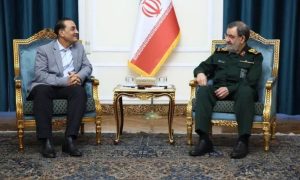
Separately, Iranian Revolutionary Guard commander-in-chief Ahmad Vahidi said continuing a strategy aimed at strengthening Iran’s defensive and offensive capabilities was the only “wise and effective” course.
In a message to the defence minister marking Iran’s National Defence Industry Day, Vahidi said the battlefield was facing a new form of combined military aggression. He claimed Iran had established a strong defensive shield against threats posed by its enemies and those seeking to harm the country.
Vahidi also praised Iran’s defence industry for developing the country’s “defensive and offensive capabilities and deterrent power” amid what he described as a period of “cruel and arrogant sanctions.”