
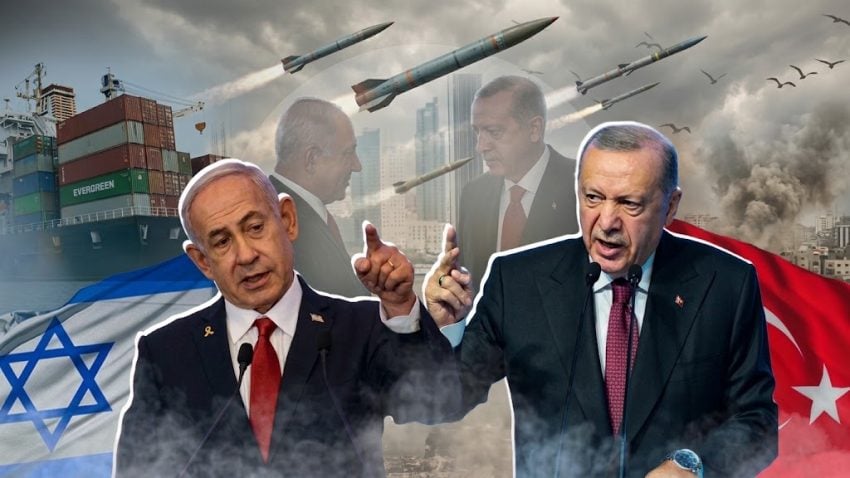
ANKARA — A dangerous development is opening in Middle East as Israel and Turkey edge toward confrontation in Syria, raising fears that a dispute between two powerful regional actors could spiral into something far larger.
The latest escalation came this week, when Tel Aviv struck Syria’s Abu al-Duhur airbase near Aleppo, only about 45–60 kilometers from the Turkish border. Israel says the strikes aimed to stop what it viewed as potentially threatening Turkish military buildup inside Syria. Ankara and Damascus reject that explanation, denying plans for a permanent Turkish base or the deployment Israel described.
The disagreement left Washington scrambling to prevent the confrontation from becoming a direct Israeli-Turkish crisis. And behind the immediate dispute lies a much bigger question: Is Israel underestimating Turkey?
Former US Navy intelligence officer Malcolm Nance warned that Turkey cannot be treated like the non-state groups Israel has fought in recent years. He said Turkey is NATO member with one of the alliance’s largest militaries, a rapidly expanding defense industry, NATO-trained pilots, increasingly sophisticated air defenses, and growing naval and drone capabilities.
Israel fought Hezbollah, Hamas and the Houthis, but Turkey is a sovereign state with a large conventional military and powerful international connections. Some Israeli voices have projected confidence, arguing that Israel has already confronted Hezbollah, Hamas and the Houthis and could handle Turkey as well. Nance’s warning is that such confidence could become a dangerous miscalculation.
The immediate crisis centers on Syria. Israel says it received intelligence indicating that Syria could permit a Turkish military deployment or buildup that would change the existing security arrangement and potentially threaten Israel’s freedom to operate in Syrian airspace.
Israeli officials say warnings were delivered before the strikes, including a reported communication between Mossad and Syria’s foreign minister. When those warnings failed to produce the response Israel wanted, the military acted.
Israeli Defense Minister Israel Katz warned Turkish President Recep Tayyip Erdoğan against what he described as “dangerous adventures” in Syria and warning Ankara not to test Israel’s determination. The strikes reportedly focused on runways and storage facilities while avoiding some older Syrian aircraft.
Turkey has denied that it was preparing the kind of military deployment Israel claimed. Ankara also condemned the Israeli strikes as reckless violations of Syrian sovereignty and dismissed Israel’s justification as untenable. That leaves two sharply different versions of events.
Israel says it acted to prevent a dangerous strategic shift. Turkey says Israel attacked based on claims that did not reflect reality. And that difference could become the most dangerous part of the crisis. If Israeli forces continue operating against what they perceive as Turkish military infrastructure, Ankara could eventually face domestic and strategic pressure to respond.
If Turkey begins expanding its military footprint in Syria, Israel could see that as confirmation of its worst fears. The cycle could feed itself.
US is now trying to keep the situation from exploding. Tom Barrack, the US ambassador to Turkey and special envoy for Syria, described Israel’s action as an “unnecessary escalation” and indicated that Turkey had not been warned in advance.
A clash between the two would put the United States in an exceptionally difficult position. Washington is now working toward a three-way deconfliction mechanism involving Israel, Turkey and Syria. The objective is straightforward: keep their forces from accidentally colliding before a localized incident becomes a regional crisis.
The military balance is one reason the current situation is attracting so much attention. Turkey has one of NATO’s largest armed forces by personnel and has spent years building up its domestic weapons industry. Its military capabilities now include advanced drones, missiles, air-defense systems and naval platforms. Turkey has also demonstrated a willingness to project military power beyond its borders, including in Syria, Libya and the South Caucasus.
Turkey’s pilots are trained within the NATO system, adding another layer to the strategic calculation. And then there is Incirlik. The presence of US forces at Incirlik Air Base illustrates how quickly a Turkish-Israeli confrontation could become an American problem. A serious incident involving Turkish forces could therefore create consequences far beyond the battlefield in Syria.
Turkey’s NATO membership is one of the most important factors in the equation, but it is also frequently misunderstood. Article 5 does not mean that every military confrontation involving Turkey automatically triggers a collective NATO war against the opposing side. The circumstances would matter.
A conflict resulting from operations in Syria, for example, would raise difficult questions about whether and how the alliance’s collective-defense commitments applied. But even without an automatic military response, Turkey’s NATO membership creates an enormous political barrier against a direct Israeli-Turkish war.
For the unversed, Israel and Turkey were once close strategic partners. Military and intelligence cooperation expanded substantially during the 1990s and 2000s, and Turkey was the first Muslim-majority country to recognize Israel. That relationship has now almost completely collapsed.
Erdoğan’s government has become one of Israel’s most vocal critics, particularly since the October 7, 2023, Hamas attack and the subsequent Gaza war. Turkish officials have maintained relationships with Hamas and have repeatedly condemned Israeli military operations.
Pakistan condemns Israeli attack on Syria’s Abu al-Duhur Airbase