
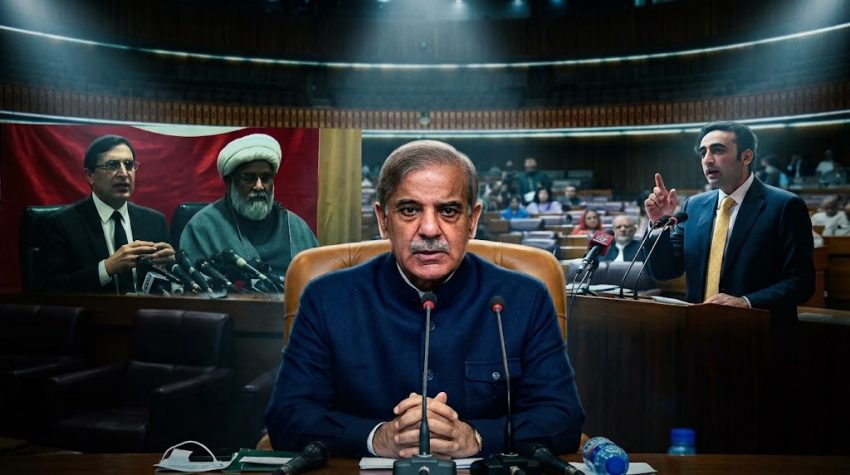
ISLAMABAD – Pakistan’s political tensions are rising within the ruling coalition, with PPP planning a possible no-confidence motion against Prime Minister Shehbaz Sharif led government.
Seniro journalist and TV host Hamid Mir claims that opposition parties are reportedly holding consultations over withdrawing support from the government, while voices within the Pakistan Peoples Party (PPP) are also calling for the party to distance itself from the Pakistan Muslim League-Nawaz (PML-N)-led setup.
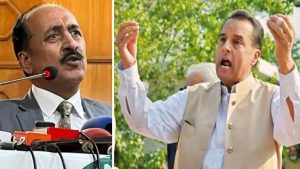
The development becomes particularly critical because PPP and PML-N are coalition partners. However, increasingly sharp exchanges between leaders of two raised questions about how long the alliance can withstand mounting political pressure.
The central political question now being raised is whether the same parliamentary strategy once used to remove Imran Khan from power could eventually be deployed against Shehbaz Sharif. Mir’s claim raises possibility that opposition parties could unite behind no-confidence motion, just as political forces previously joined hands to bring a no-confidence vote against PTI government in 2022.
If PPP were to withdraw its support and other opposition groups joined forces, the government’s position in parliament could become considerably more vulnerable. However, the source presents this as a political possibility under discussion, not a confirmed no-confidence motion.
The coalition’s internal tensions could prove more damaging than pressure from the opposition alone. According to Mir, PPP figures questioned the government’s performance and accused the PML-N leadership of political and administrative failures. Bilawal Bhutto is also reported to have expressed the view that continuing with the current rulers has become increasingly difficult, while raising concerns over economic management and alleged irregularities in Gilgit-Baltistan and Azad Kashmir.
The political attacks also spilled onto recent TV programmes, where PPP and PML-N bigwigs exchanged harsh statements, and such public confrontations are particularly significant because both parties remain part of the same governing arrangement.
Adding another layer to the political crisis is the controversy surrounding Imran Khan’s proposed transfer from Adiala Jail to Shifa Hospital. Mir said a three-member Supreme Court bench had ordered the PTI founder’s transfer to Shifa Hospital, but he was instead taken to PIMS before being returned to Adiala Jail. The PTI subsequently filed a contempt petition, arguing that the court order had not been properly implemented.
The government’s reported position is that security concerns and crowds around Shifa Hospital created difficulties. The PTI, however, disputes this explanation and maintains that the route was secure and under the control of police and Islamabad administration. The controversy has consequently moved beyond a medical issue and into the legal and political arena.
Mir claims that political groups that previously struggled to cooperate are now reportedly consulting one another about a joint strategy against the government. If those consultations result in an actual parliamentary alliance, the possibility of a no-confidence motion could become a much more serious threat.
He also mentioed the possibility of a broader street movement alongside parliamentary pressure. Another date highlighted in his claims is September 27, which is described as important for the government’s political future. However, the source does not establish that a no-confidence vote has formally been scheduled for that date.
For now, however, there is no confirmed no-confidence motion statement from any of these party leaders. What is clear from the claims is that speculation over such a move has entered the political debate, with the government’s coalition stability increasingly under scrutiny.